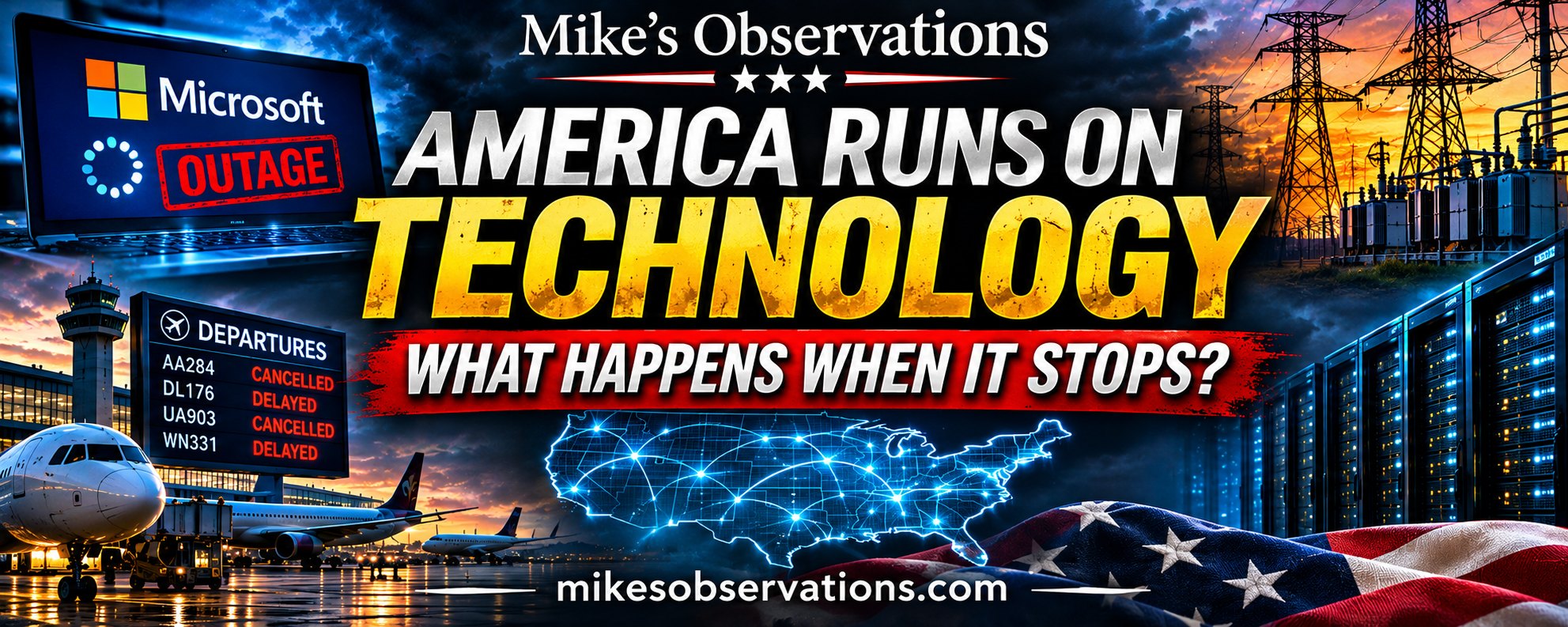
America Runs on Technology. What Happens When the Technology Stops?
By Michael Cunningham Sr. | Mike's Observations
November 15, 2026
Two Outages. One Uncomfortable Question.
Imagine waking up tomorrow morning to discover that the technology Americans depend upon every day has suddenly stopped working.
Airplanes cannot depart. Businesses cannot access their communications. Banks struggle to process transactions. Hospitals turn to emergency procedures.
This isn't a prediction of tomorrow's headlines.
It is a question about America's preparedness, and after the events of this past week, it deserves serious attention.
Within roughly 24 hours, Americans witnessed two major technological disruptions involving systems that millions depend upon.
The incidents were separate, according to officials. But together they exposed something we should not ignore.
Our modern civilization has become extraordinarily dependent on technology that most Americans never see, rarely understand, and simply assume will always work.
When America's Airplanes Stopped Flying
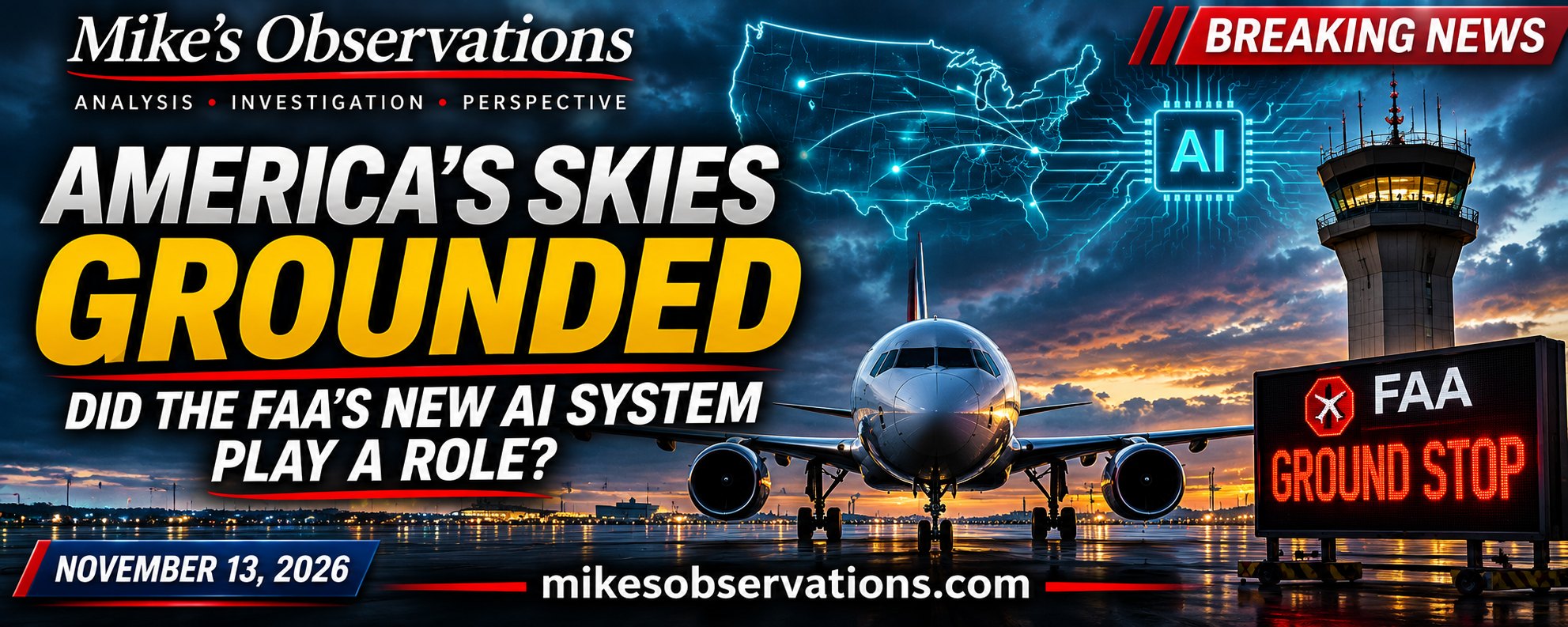
On Friday, November 13, the Federal Aviation Administration ordered a nationwide ground stop following serious problems involving air traffic control communications.
Thousands of flights were disrupted. Passengers were stranded. Airlines scrambled to reorganize schedules.
Transportation Secretary Sean Duffy explained that problems with overloaded network equipment had affected communications and radar data.
The FAA took the extraordinary step of stopping departures to protect passengers and crews.
By Saturday, federal officials were describing a problem involving equipment replacement during the transition from older copper communications infrastructure to fiber-optic systems.
The exact responsibility for the failure was still under investigation.
Consider what that means.
A problem involving a relatively small part of a massive communications network contributed to disruption across the nation's aviation system.
That is not a minor inconvenience. It is a warning about how much can depend on equipment that most Americans never knew existed.
Microsoft: Another Reminder of Our Dependence
Just one day earlier, Microsoft experienced a major worldwide service disruption affecting email and other business applications.
Millions of people and organizations rely on these systems to communicate and conduct business.
When those services fail, the consequences extend far beyond someone being unable to read an email.
Employees cannot communicate normally. Businesses lose productivity. Organizations must find alternative ways to operate.
Microsoft and federal officials have said there is no indication that the Microsoft disruption caused the FAA shutdown.
That distinction matters.
There is no verified evidence that the two incidents were coordinated attacks.
But the broader question remains:
Why have we allowed so many essential activities to depend upon increasingly complicated systems with potentially far-reaching points of failure?
The Danger of Interconnected Systems
Modern America operates through networks.
Electricity supports communications. Communications support banking. Banking supports commerce. Transportation supports food distribution. Hospitals depend upon electricity, communications, and computer systems.
When one important system fails, others may be affected.
Federal infrastructure officials have warned about these interdependencies for years.
And while interconnected technology brings tremendous efficiency, efficiency does not automatically guarantee resilience.
Sometimes the very systems that make our lives easier can make recovery more difficult when something goes wrong.
Is America's Infrastructure Keeping Up?
The FAA incident raises a particularly troubling question about aging technology.
Federal officials have acknowledged that America's air traffic control system needs extensive modernization.
In July 2026, the Government Accountability Office also identified shortcomings in federal aviation cybersecurity planning and implementation.
These problems did not appear overnight.
They developed over years of changing technology, growing demand, complicated procurement, and delayed improvements.
This is not simply a Republican problem or a Democratic problem.
It is an American problem.
Washington has spent decades arguing over priorities while critical infrastructure has continued to age.
We should demand better from every administration, every Congress, and every federal agency responsible for protecting essential services.
What About Cyberattacks and Foreign Adversaries?
America certainly faces cybersecurity threats.
Foreign governments and criminal organizations have demonstrated an interest in disrupting or exploiting American networks.
But we must be careful not to confuse a genuine vulnerability with proof that an attack has occurred.
Federal officials reported no evidence that the November 13 aviation disruption was caused by a cyberattack.
That does not eliminate the need to investigate security vulnerabilities.
It means our conclusions must follow the evidence.
There is a difference between asking whether an adversary could exploit a weakness and claiming that an adversary did exploit it.
A responsible investigation recognizes that difference.
Preparedness Is Not Paranoia
I have lived long enough to remember when a great deal of American life functioned without computers.
Businesses kept paper records. Families carried cash. People knew how to communicate and solve problems without depending on a screen.
I'm certainly not suggesting we abandon modern technology.
I use it myself every day.
But perhaps we have become so impressed with what technology can accomplish that we have neglected to ask what happens when it doesn't work.
Every household should have basic emergency supplies.
Every business should have a backup plan.
And every government agency responsible for essential services should be able to explain how it will operate when its primary systems fail.
Preparedness is not fear.
It is common sense.
The Questions Washington Must Answer
Americans deserve answers to several straightforward questions.
- How many of our essential systems still depend on outdated equipment?
- What safeguards prevent a localized equipment failure from becoming a nationwide disruption?
- Are modernization projects being tested adequately before implementation?
- Can critical services continue operating when primary communications networks fail?
- Who is accountable when known weaknesses remain unresolved?
These are not unreasonable demands.
They are questions taxpayers should have been asking for years.
My Final Observation
The most troubling part of this week's events is not that two technological failures occurred close together.
Failures happen.
The troubling part is how quickly an ordinary American's life can be disrupted by problems buried deep inside systems that are supposed to keep the country functioning.
America has accomplished extraordinary things through innovation.
But technological advancement without adequate safeguards can create new vulnerabilities.
We need modern systems. We need dependable backup systems. We need transparency. And above all, we need leadership willing to address weaknesses before they become emergencies.
The question is no longer whether technology can fail. We already know it can.
The question is whether America is prepared when it does.
Mike's Observations — Eight Decades of Faith, Service, Adventure, and a Life Well Lived.
What do you think? Has America become too dependent on technology? Are we doing enough to protect the systems we rely upon every day?
Share your thoughts and join the conversation at mikesobservations.com.