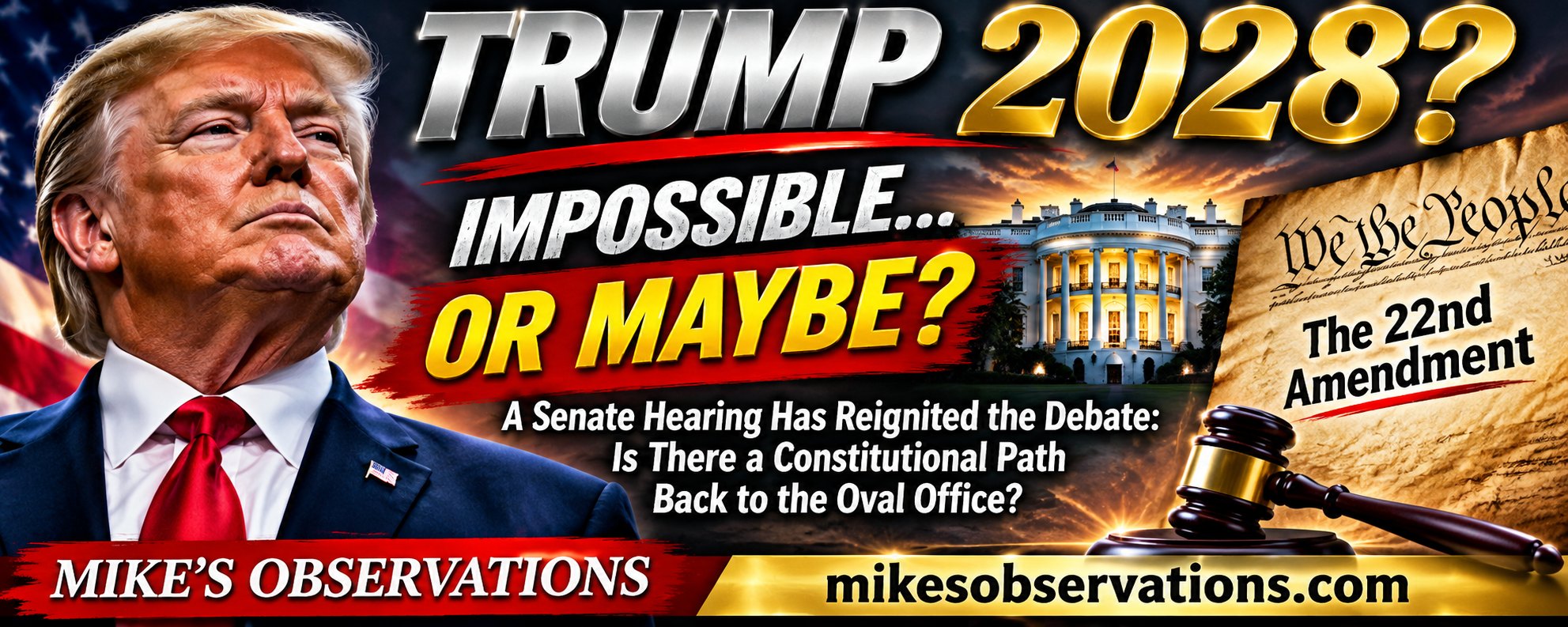
TRUMP 2028: IMPOSSIBLE? OR IS THERE A CONSTITUTIONAL TWIST NOBODY EXPECTED?
The 22nd Amendment says Trump cannot be elected again. But does that settle every possible route back to the Oval Office?
WASHINGTON — November 20, 2026
DONALD TRUMP. PRESIDENT AGAIN IN 2028?
Impossible, you say?
The Constitution says a president cannot be elected more than twice.
Case closed.
Or is it?
A recent Senate Judiciary Committee hearing has brought a remarkable constitutional question back into the spotlight: Could a twice-elected president ever return to the Oval Office without being elected president a third time?
Before anyone starts celebrating—or panicking—there's something important to understand.
The 22nd Amendment prohibits being elected president more than twice. But constitutional scholars have debated how that language interacts with the rules governing presidential succession.
That distinction is where the controversy begins.
THE QUESTION THAT STARTED IT ALL
During a November 18 Senate confirmation hearing, Trump-nominated judicial candidate James P. Sullivan declined to answer directly when asked whether Donald Trump could seek a third term.
His explanation involved judicial ethics.
Another nominee, William Lambert, gave a more definitive answer: the two-term limit applies to everyone.
But Sullivan's response was enough to revive an old argument.
Why wouldn't a judicial nominee simply say no?
There may be a perfectly ordinary explanation: judges and judicial nominees sometimes avoid commenting on constitutional questions that could eventually come before a court.
Still, the exchange highlights a question worth examining.
THE WORDS THAT MATTER
The 22nd Amendment begins with a restriction on being elected president more than twice.
Some commentators have asked whether that language leaves room for a former president to return through succession rather than election.
But there's a serious obstacle.
The 12th Amendment says someone constitutionally ineligible to be president is also ineligible to be vice president.
Legal scholars disagree over whether the 22nd Amendment makes a twice-elected president entirely ineligible to hold the office or merely prevents another presidential election victory.
No court has established that the proposed succession workaround would be lawful.
A constitutional argument is not the same thing as a constitutional loophole.
WHAT WOULD ACTUALLY HAVE TO HAPPEN?
There is one undisputed legal route: amend the Constitution.
That requires extraordinarily broad support in Congress and the states.
Another proposal involves a twice-elected president becoming vice president and subsequently succeeding to the presidency.
But that theory faces major constitutional objections, and there is no established judicial ruling validating it.
So, could Trump simply put his name on the ballot for president in 2028 and win another term?
Under the Constitution as it stands, no.
Could the country witness a legal fight over the meaning of presidential eligibility and succession?
That question is much harder to dismiss.
WHY IS WASHINGTON STILL TALKING ABOUT 2028?
Perhaps the most interesting part of this debate isn't whether a third Trump presidency is possible.
It's why the possibility keeps resurfacing.
Is it constitutional curiosity?
Political theater?
A serious effort to test the boundaries of presidential succession?
Or simply a controversy that guarantees headlines?
The public deserves to know the difference between a legal theory, a political proposal, and an actual constitutional pathway.
ONE LAST QUESTION
Donald Trump has already won the presidency twice.
The 22nd Amendment bars him from being elected a third time.
And yet, here we are, discussing the possibility of Trump returning after 2028.
Is the Constitution's answer as straightforward as most Americans believe—or is there a legal question that has never been fully tested?
For now, the answer to a third presidential election is no.
As for the disputed succession theory?
That debate isn't settled by a provocative headline. It would require a constitutional answer.