I have lived long enough to remember when a telephone was attached to the wall.
If you wanted to talk to somebody, you called their house.
Not their pocket.
Not their car.
Not their wrist.
Their house.
And if they weren't home, you didn't leave a text, send an email, or check their location.
You simply called back later.
Somehow, civilization survived.
Today, we carry more communication power in our pockets than I could have imagined as a young man. Within seconds, I can send a message across town or around the world.
We have Facebook, Instagram, X, email, text messages, video calls, and more ways to communicate than any generation in history.
We are connected almost every waking minute.
But I sometimes wonder:
Are we really closer?
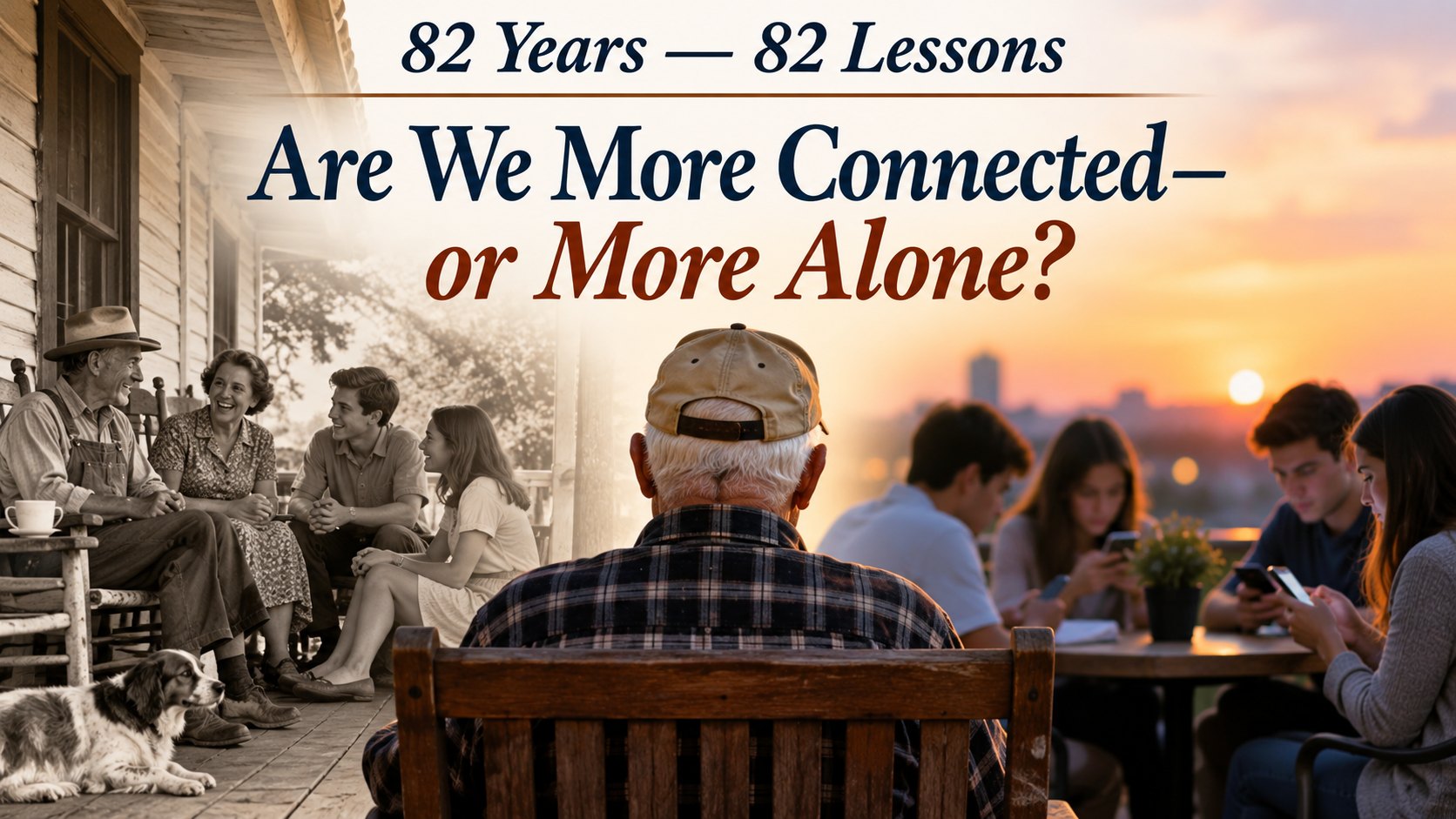
Or have we simply become better at being alone together?
When Conversation Required Two People
I remember a time when families sat around the supper table and talked.
There wasn't a phone beside every plate.
There wasn't a television playing in everyone's hand.
There wasn't somebody checking Facebook while another person was trying to tell a story.
We looked at one another.
We listened.
Sometimes we argued.
Sometimes we laughed until somebody nearly fell out of the chair.
But we were there.
Today, you can walk into a restaurant and see four people sitting at the same table, each staring at a different phone.
Four people.
Four screens.
Four different worlds.
Nobody is necessarily doing anything wrong.
But something has changed.
We Know More People—but Do We Know Them Better?
Social media has given us something remarkable.
I can keep up with people I haven't seen in years. I can see photographs of their children and grandchildren. I can hear from friends hundreds or thousands of miles away.
That's a blessing.
But social media can also create the illusion of friendship.
A person can have 2,000 "friends" online and still have nobody to call when life falls apart.
We know what people ate for supper.
We know where they went on vacation.
We know what they bought.
We know what they are angry about.
But do we know when they are hurting?
That's different.
There Was Something About the Front Porch
When I was young, people visited.
They didn't always make an appointment.
Sometimes somebody simply drove up.
You put on another pot of coffee.
You pulled up another chair.
And you talked.
Nobody worried about whether the house was perfectly clean or whether you had anything impressive to serve.
The important thing wasn't the house.
It was the company.
Some of life's best conversations happened on front porches, around kitchen tables, beside campfires, in workshops, at church, and leaning against pickup trucks.
Nobody photographed them.
Nobody posted them.
Nobody counted the "likes."
And somehow they mattered.
Technology Isn't the Enemy
I'm certainly not against technology.
At 82 years old, I'm writing a blog on the Internet.
That ought to settle that argument.
Technology has allowed families separated by thousands of miles to see one another's faces. It has helped old friends reconnect. It has given people access to knowledge that once required an entire library.
Used wisely, technology is extraordinary.
The problem isn't the phone.
The problem comes when the phone begins replacing the person sitting beside us.
We Have Instant Communication—but Less Patience
There was a time when we wrote letters.
Then we waited.
Sometimes days.
Sometimes weeks.
When that letter arrived, you read every word.
Sometimes you read it twice.
Today, if somebody doesn't answer a text within five minutes, we wonder what's wrong with them.
We've gained speed.
I'm not sure we've gained patience.
We've gained convenience.
I'm not sure we've gained understanding.
We've gained hundreds of contacts.
I'm not sure we've gained hundreds of friends.
Loneliness Can Hide Behind a Screen
One of the saddest things about modern life is that loneliness doesn't always look lonely.
Someone may post smiling photographs every day and still go to bed feeling completely alone.
A person may receive dozens of notifications and still desperately need somebody to sit down and ask:
"How are you really doing?"
And then stay long enough to hear the answer.
There is no app that can replace that.
Put the Phone Down Once in a While
Maybe the answer isn't complicated.
Call somebody instead of texting them.
Visit somebody instead of clicking "like."
Sit on the porch.
Have coffee together.
Eat supper without a phone in your hand.
Look your wife, husband, child, grandchild, or friend in the eyes when they're talking.
Listen without waiting for your turn to speak.
Tell people you love them while they're still here to hear it.
Because one thing 82 years has taught me is that there will come a day when you would give almost anything for one more conversation with somebody who is gone.
On that day, you won't wish you had spent more time scrolling.
Lesson From 82 Years
Technology can connect our devices.
Only love, time, attention, and genuine conversation can connect our hearts.
Maybe we don't need fewer phones.
Maybe we simply need to remember when to put them down.
Because the person sitting across the table from you may be far more important than everyone waiting inside that little screen.
At 82, I've learned this:
Being connected is not the same thing as being close.
And sometimes the shortest distance between two people isn't a phone call, a text message, or the Internet.
It's simply pulling up a chair.
— Mike Cunningham
82 Years — 82 Lessons
mikesobservations.com