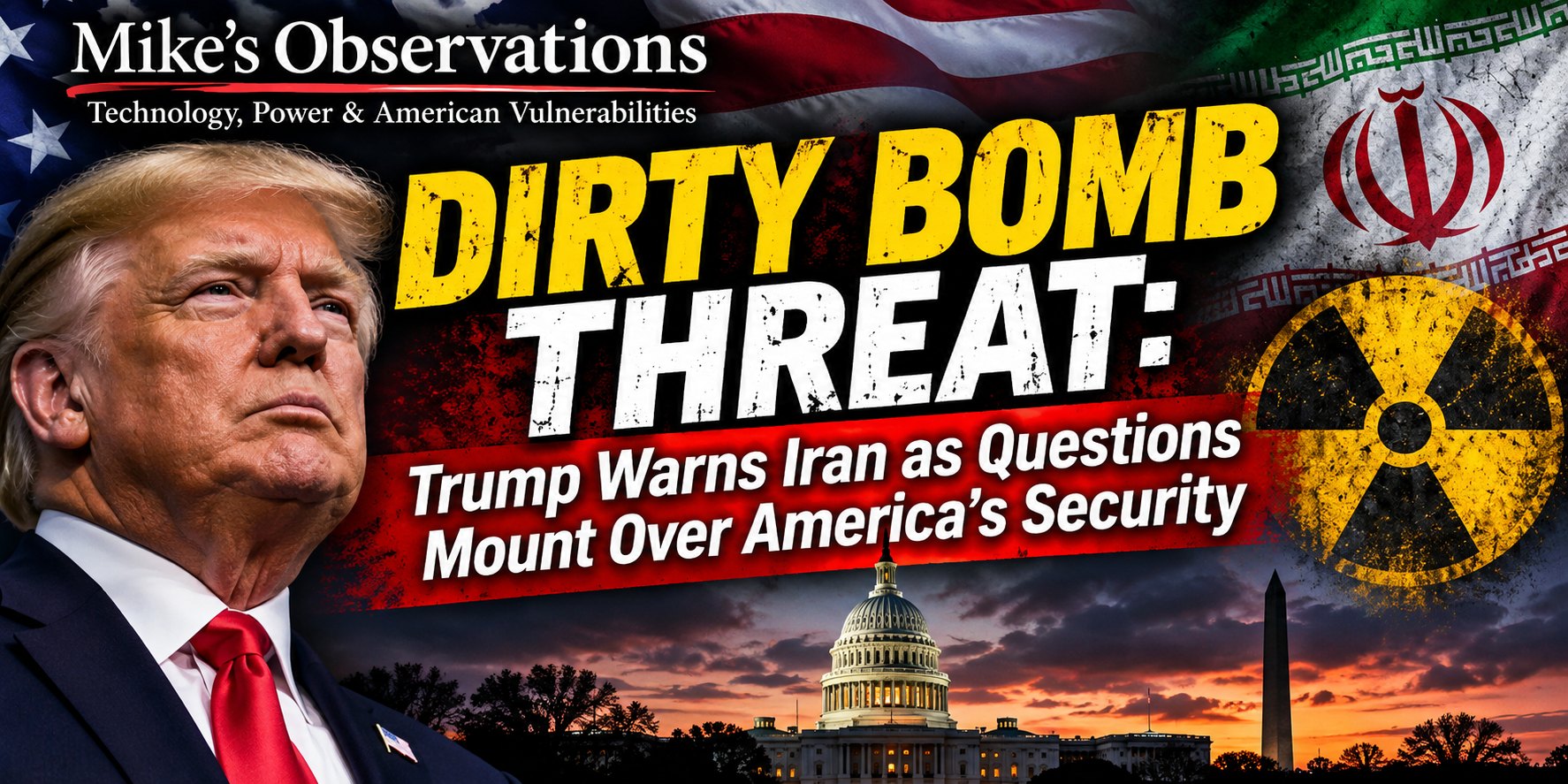
DIRTY BOMB THREAT: Trump Warns Iran as Questions Mount Over America's Security
By Michael Cunningham Sr. | Mike's Observations
November 17, 2026 — Investigative Follow-Up
America has received another disturbing warning, and this time the President of the United States has responded personally.
New intelligence reportedly indicates that Iran has been developing possible plans to attack senior Trump administration officials in Washington, D.C., using a radioactive dirty bomb or chemical weapon.
President Donald Trump has now warned Iran that an attack against the United States would bring devastating consequences.
But behind the headlines lies a question every American deserves to have answered:
How secure is the American homeland against an unconventional terrorist attack?
The President Responds
On Tuesday, November 17, President Trump addressed reports of a possible Iranian plot while speaking to reporters in the Philippines.
He confirmed that his administration was examining the intelligence and treating the allegations seriously.
Trump warned that Iran would pay an extraordinary price if it carried out such an attack.
Homeland Security Secretary Markwayne Mullin also addressed the reports, warning that an attack on Washington or another American city could trigger an all-out war.
These are not casual statements. They demonstrate the seriousness with which senior officials are approaching the reported intelligence.
But a presidential warning is not proof that an attack is imminent.
What American Intelligence Reportedly Discovered
According to CNN, seven U.S. officials familiar with intelligence assessments described possible Iranian planning involving a dirty bomb or chemical weapon.
Two sources reportedly said the intelligence included specific locations and potential targets.
Another source described intelligence chatter suggesting bomb-making materials might already have been hidden inside the United States.
That last allegation is particularly disturbing, but it has not been independently established as fact.
Officials reportedly disagree about the credibility of some of the intelligence, whether Iran possesses the necessary operational capability, and whether Tehran has decided to proceed.
There is a tremendous difference between considering an attack, preparing for an attack, and actually launching one.
That difference must not be ignored.
A Dirty Bomb Is Not a Nuclear Bomb
A dirty bomb combines conventional explosives with radioactive material.
Unlike a nuclear weapon, it does not create a nuclear chain reaction.
Its purpose could be to spread contamination, cause panic, force evacuations, disrupt commerce and undermine public confidence.
The physical damage might be concentrated near the explosion, while contamination concerns and the economic consequences could extend much farther.
It is a weapon designed not merely to destroy property but to terrorize a population.
And that raises an uncomfortable question: Are our emergency services, hospitals, law enforcement agencies and public officials adequately prepared?
The White House Says There Is No Credible Homeland Threat
Here is an important development that must be included in any responsible examination of this story.
The White House says it is monitoring potential threats but that there are currently no credible threats to the homeland.
That statement deserves attention.
It means that, despite the reported intelligence and contingency planning, the administration has not publicly identified an imminent attack.
Iran has also rejected the allegations, calling them fabricated and politically motivated.
Americans deserve the complete picture, including what remains disputed.
The Question of Materials Already Inside America
Perhaps the most troubling aspect of the intelligence reporting concerns the possibility that dangerous materials could already be inside the country.
That possibility has not been verified publicly.
Nevertheless, it raises legitimate questions about border security, hazardous-material controls, domestic intelligence coordination and the ability of federal authorities to identify potential threats before an attack occurs.
These questions are not accusations that a particular administration allowed a weapon into the country.
They are questions about whether the nation's security systems are capable of detecting and stopping a sophisticated threat.
A nation cannot afford to discover weaknesses in its defenses only after innocent Americans have paid the price.
A Surveillance Battle Complicates the Picture
CNN's reporting also identifies another potentially serious vulnerability.
A key federal foreign-intelligence surveillance authority expired in June, although previously approved surveillance orders remain effective until March 2027.
Senior national security officials have urged Congress to restore the authority, warning about the consequences of losing important intelligence capabilities.
But Congress also has a responsibility to protect constitutional rights and ensure meaningful oversight.
Protecting Americans from foreign threats and protecting Americans from government overreach are not competing luxuries.
Both are fundamental responsibilities.
Iran Denies the Allegations
Iranian officials have rejected the reported plot.
Their denials do not establish that the intelligence is false. Equally, anonymous intelligence allegations do not establish that Iran has ordered an attack.
The American people should expect intelligence agencies and elected officials to investigate thoroughly, verify the evidence and disclose what can responsibly be made public.
National security requires vigilance, not speculation presented as certainty.
My Observation: America Cannot Afford Complacency
For decades, Americans have watched threats develop overseas while believing that distance and powerful defenses would keep danger away from their communities.
But geography alone is no longer a guarantee of security.
Modern threats can involve cyberattacks, infrastructure sabotage, terrorism and unconventional weapons.
A successful attack does not have to destroy an entire city to create nationwide consequences.
Imagine the economic disruption, fear and loss of public confidence that could follow even a limited radiological incident in the nation's capital.
That possibility should concern every American, regardless of political affiliation.
The government has a duty to investigate credible intelligence, protect its citizens and maintain the ability to respond decisively.
Congress has a duty to provide appropriate resources and oversight.
And the news media has a duty to report what is known without turning possibilities into established facts.
The greatest danger is not merely what an enemy might be planning. It is the possibility that America could fail to recognize and address a genuine vulnerability before it is exploited.
The Questions Washington Must Answer
Are the reported Iranian plans supported by independently verified intelligence?
Have investigators found any evidence that dangerous materials or operational personnel are already positioned inside the United States?
Are federal and local authorities prepared to respond to a radiological or chemical attack?
And will Congress address genuine intelligence gaps while preserving the constitutional freedoms Americans expect their government to defend?
These are serious questions.
They deserve serious answers.
America does not need panic. America needs preparedness, accountability and leadership.
The White House says there is no credible homeland threat at this time. That is reassuring, but it should not end the broader discussion about national preparedness.
We will continue following the evidence as this story develops.
Mike's Observations — Independent commentary on faith, freedom, national security and the future of America.