When Did Americans Become Products for Sale?
By Michael Cunningham Sr.
Mike's Observations — An Old Marine's Perspective
I've got a question for every American reading this: When did we give somebody permission to turn our private lives into a business?
I'm 82 years old, and I've watched this country change in ways I never imagined possible.
I remember when people could travel across the country without a camera recording their license plate every few miles. When you could walk into a store, pay cash, and walk out without somebody building a computerized profile of your shopping habits.
When your personal business was exactly that.
PERSONAL BUSINESS!
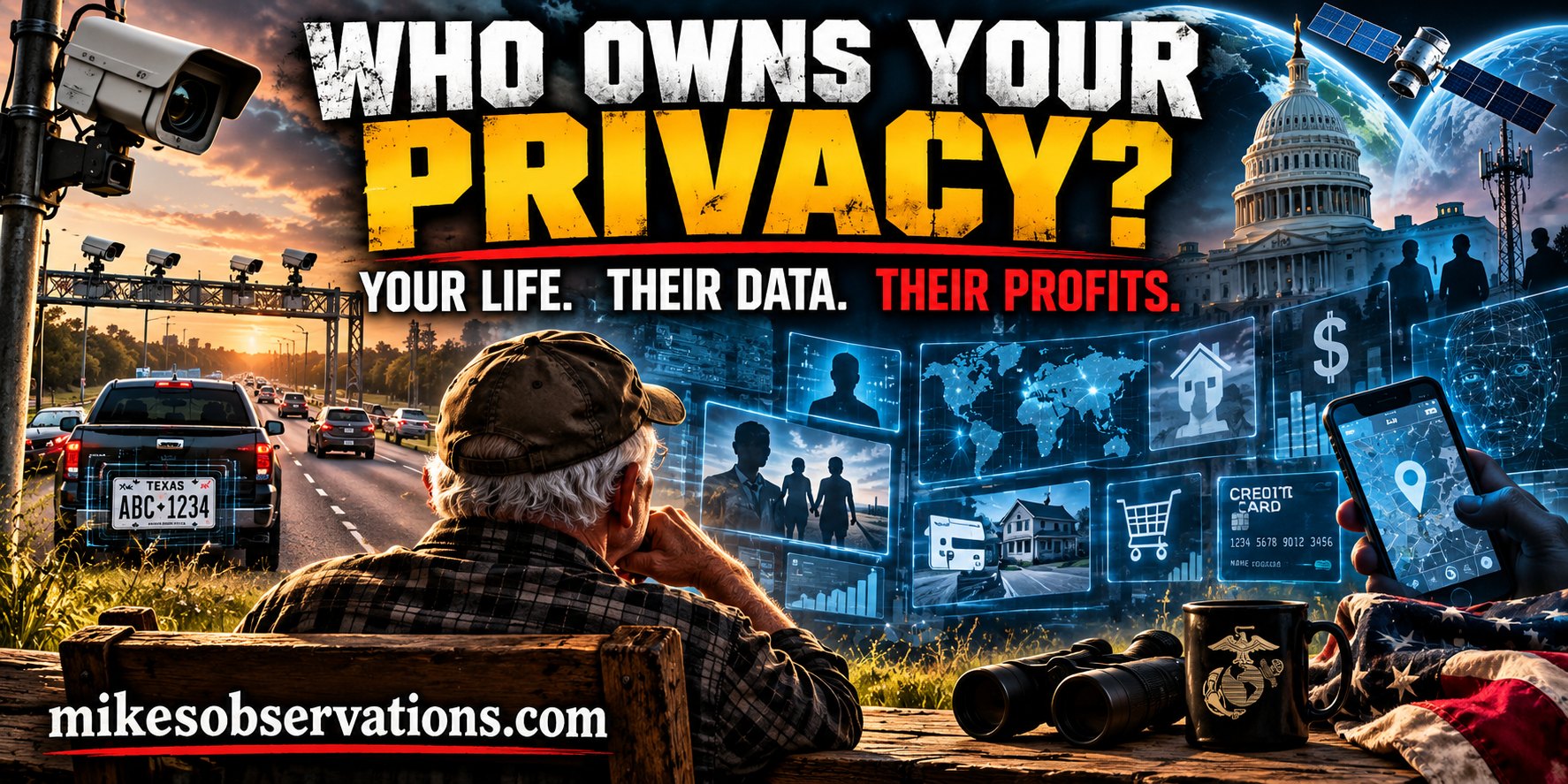
Today, we have cameras watching our highways, websites following our browsing habits, smartphones generating location information, and algorithms analyzing nearly everything we do online.
And there's a multibillion-dollar industry built around collecting, analyzing, and selling information about ordinary people.
Now somebody explain something to this old Marine.
WHO GAVE THEM PERMISSION?
You're Being Watched More Than You Realize
Drive down certain highways, and cameras can record your vehicle and license plate.
Walk into some businesses, and surveillance systems may record your movements.
Visit a website, and tracking technologies may collect information about what interests you, what you click, and how long you stay.
Carry a smartphone, and depending on your settings and the services you use, your location can be recorded.
Now, individually, some of these things may seem harmless.
A traffic camera can help investigate an accident. Security cameras can discourage crime. A website remembering your preferences can make life easier.
But what happens when information from dozens of sources gets combined?
Suddenly, somebody may know where you travel, where you shop, what you purchase, what you read, and what interests you.
And you may have absolutely no idea who possesses that information.
Does that bother anybody besides me?
Your Life Has Become a Commodity
Here's something that ought to make you angry.
There are companies known as data brokers whose business involves collecting and distributing information about people.
Some compile names, addresses, telephone numbers, property records, and other publicly available details.
Others work with commercially collected information about purchasing behavior, online activity, and location.
That information can be used for advertising, marketing, background research, and other purposes.
Sometimes it can be sold or shared with organizations you've never heard of.
Think about that.
You live your life. Somebody else collects information about it. And somebody else may make money from it.
Where exactly did you agree to that arrangement?
Oh, I know.
Somebody will tell me I agreed when I clicked that little box on a website.
The one connected to 37 pages of legal language written by attorneys.
Well, let me ask you something.
Is clicking "I Agree" really meaningful consent when most people have no practical idea what they're agreeing to?
What About Your Firearms?
Now let's touch a subject that's guaranteed to stir the pot.
Firearms.
Could information about the firearms you own become part of a commercial profile?
Information from purchases, internet searches, photographs, social media, and other records can sometimes reveal or suggest firearm ownership.
That doesn't mean somebody has an accurate list of every gun in your safe.
But the possibility raises a serious question.
What business does a commercial data broker have assembling information about a law-abiding citizen's firearms?
I served in the United States Marine Corps from 1962 to 1966.
I took an oath to support and defend the Constitution of the United States.
And I still believe the rights protected by that Constitution matter.
Including the Second Amendment.
If a citizen lawfully owns firearms, why should information about those possessions become another commercial product?
And don't misunderstand me.
This isn't just about guns.
The same principle applies to your medical information, finances, religious interests, and personal relationships.
A person's private life shouldn't automatically become somebody else's inventory.
What Happened to the Fourth Amendment?
The Fourth Amendment protects Americans against unreasonable government searches and seizures.
But here's something worth thinking about.
What happens when private businesses collect information that the government might otherwise have difficulty obtaining?
What happens when government agencies purchase information from commercial sources?
Does buying information instead of collecting it directly eliminate the privacy concerns?
Not in my opinion.
Now, the law is complicated. Different kinds of information receive different protections, and courts have placed limits on certain forms of government access.
But the underlying question is simple.
Should government agencies be able to buy their way around privacy protections that would otherwise restrict their investigations?
That's not a question about being Republican or Democrat.
It's a question about being an American.
"If You've Done Nothing Wrong, You've Got Nothing to Hide"
Oh, I've heard that argument.
And every time I hear it, I want to ask the person saying it a few questions.
Do you close your curtains at night?
Do you lock your doors when you leave home?
Would you hand a stranger your bank statements?
Would you invite somebody to read every personal letter you've ever written?
Of course not.
Does that mean you're doing something illegal?
Absolutely not!
PRIVACY IS NOT EVIDENCE OF GUILT!
It's part of living as a free individual.
And I don't believe Americans should have to justify wanting it.
The Most Dangerous Part Is How Quietly It Happened
Nobody announced one morning that Americans were going to surrender much of their personal privacy.
There wasn't some great national ceremony.
No parade.
No declaration.
It happened a little at a time.
First, cameras became commonplace.
Then computers began storing enormous amounts of information.
Then came the internet, smartphones, social media, location tracking, and increasingly sophisticated algorithms.
Each development brought convenience and benefits.
And with each development, new opportunities emerged to collect information about our lives.
We accepted one little change after another.
Until one day, we found ourselves living in a world where an enormous amount of personal information can be assembled with a few clicks.
We didn't necessarily vote to give up our privacy. In many cases, we simply allowed technology and business practices to redefine it.
Artificial Intelligence Changes the Equation
And now comes artificial intelligence.
I'm not against AI.
As a matter of fact, I use it regularly. I see tremendous possibilities in this technology.
But I also recognize something.
AI can analyze enormous collections of information far faster than any human being.
It can recognize patterns, connect records, and make predictions.
Imagine what that means when combined with years of location histories, purchasing records, browsing behavior, and public information.
The concern isn't that every AI system knows everything about everybody.
It doesn't.
The concern is what organizations with access to extensive personal information may be able to discover by using increasingly powerful analytical tools.
Technology is becoming more capable of examining our lives. Are our privacy protections keeping up?
That's the question.
Who Really Owns Your Privacy?
Let's get something straight.
Legally, privacy isn't one simple piece of property that somebody owns.
There are laws governing certain kinds of information, and Texans have specific rights under the Texas Data Privacy and Security Act.
But those rights have limitations and exemptions.
And ordinary citizens shouldn't need a law degree and a computer science education just to understand who has their personal information.
Here's what I believe ought to be expected:
Now, somebody is going to tell me those requirements would interfere with business.
Well, perhaps certain businesses would have to change how they operate.
Since when did somebody's business model become more important than an American citizen's privacy?
My 82nd-Year Lesson
I've lived through eight decades of change.
I've seen America move from party-line telephones to smartphones, from handwritten letters to instant worldwide communication, and from filing cabinets to computer systems capable of storing unimaginable amounts of information.
And I appreciate much of that progress.
But I've also learned something.
Just because we CAN do something doesn't necessarily mean we SHOULD.
Just because technology makes it possible to follow somebody's movements doesn't mean unlimited tracking is justified.
Just because information can be collected doesn't mean it should be kept forever.
And just because personal information has commercial value doesn't mean every detail of our lives ought to be for sale.
I don't want to return to 1962.
I enjoy modern technology too much for that.
But I do want us to remember something we understood back then.
SOME THINGS ARE SIMPLY NONE OF YOUR BUSINESS!
And that includes a great deal of what happens in the private lives of law-abiding Americans.
NOW LET'S STIR THE POT!
I want to hear from you.
WHO OWNS YOUR PRIVACY?
You?
The government?
Or the corporations collecting and trading information about your life?
Should companies be required to obtain your explicit permission before selling personal information?
Should law enforcement be allowed to purchase personal information that would otherwise require legal authorization to obtain?
And here's the question I really want answered:
IF YOU HAVE NOTHING TO HIDE, DOES THAT MEAN YOU SHOULD HAVE NOTHING PRIVATE?
Don't just read this and move on.
Agree with me. Disagree with me. Tell me where I'm wrong.
I welcome a good argument, provided we can keep it respectful.
Visit https://mikesobservations.com/, click Contact, and tell me what you think.
Because at 82 years old, I've learned that freedom deserves more than occasional attention.
It deserves defending.
Michael Cunningham Sr.
82 Years – 82 Lessons
Mike's Observations