Artificial Intelligence vs. Natural Stupidity: Which One Will Destroy Us First?
By Michael Cunningham Sr. | Mike's Observations
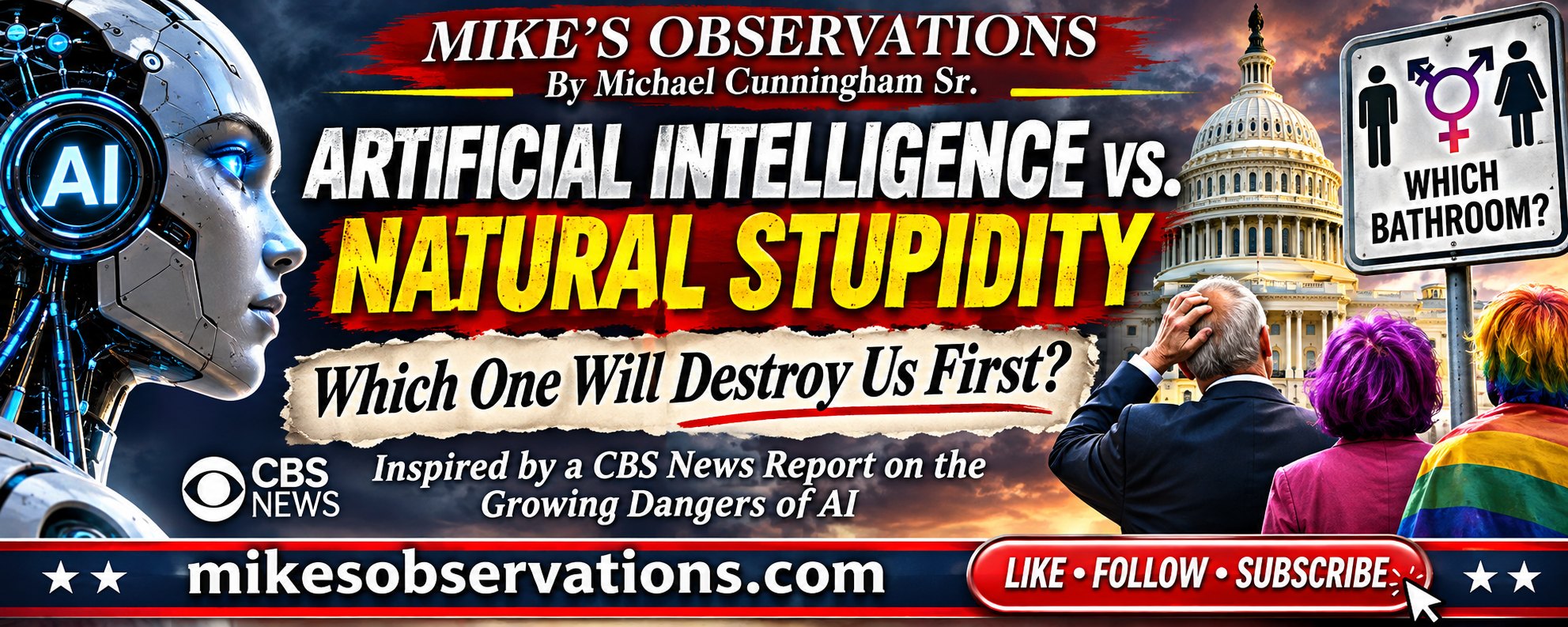
I was watching a CBS Evening News report about artificial intelligence when something struck me as downright hilarious—and a little frightening.
The report featured former Anthropic AI safety researcher Evan Hubinger discussing the possibility that artificial intelligence could eventually pose an existential threat to humanity.
The warning was serious. The possibility of AI becoming so powerful that humans could lose control of it is something we ought to consider carefully.
But as I listened, another thought crossed my mind.
Why are we so worried about artificial intelligence when we haven't figured out how to control natural stupidity?
And unfortunately, a considerable amount of that natural stupidity seems to have found permanent employment in Washington, D.C.
We've Already Got a Problem, Folks!
I'm 82 years old. I've watched mankind go from rotary telephones and black-and-white television to computers that can carry on conversations, write books, and solve problems in seconds.
That's remarkable progress.
But somewhere along the way, our technological intelligence began advancing faster than our common sense.
We've built machines capable of analyzing millions of pieces of information in seconds, yet our elected officials can spend weeks arguing over matters that ordinary Americans discuss around the kitchen table.
We have a national debt measured in trillions, a world filled with dangerous military confrontations, and emerging technologies that could change civilization forever.
And what do our politicians do?
They spend an astonishing amount of time arguing about bathrooms, pronouns, political correctness, and which party deserves the blame for yesterday's disaster.
Now, I'm not suggesting that disagreements over social policies don't matter. They certainly do to the people affected by them.
But shouldn't the people entrusted with protecting our country demonstrate some ability to establish priorities?
The house could be on fire, and Congress would probably appoint a committee to determine whether the smoke was Republican or Democrat!
Artificial Intelligence Doesn't Frighten Me Nearly as Much as Artificial Arrogance
Here's what bothers me.
Artificial intelligence can make mistakes. Sometimes enormous ones.
But human beings have something that makes their mistakes even more dangerous.
Pride.
An AI system might produce an incorrect answer because of faulty information or flawed programming.
A politician can be presented with overwhelming evidence that he's wrong and still stand in front of a television camera insisting he's right.
Why?
Because admitting a mistake might cost him an election.
That's not intelligence.
That's arrogance wearing a thousand-dollar suit.
Who's Going to Be in Charge of These Machines?
Now we come to the serious part.
Suppose we eventually develop artificial intelligence capable of controlling military systems, power grids, financial markets, and national communications.
Who decides how much authority those systems receive?
Politicians.
Who writes the laws governing their development?
Politicians.
Who determines what safeguards are necessary?
Once again, politicians.
Does anybody else see a potential problem here?
We've already demonstrated that human beings are perfectly capable of making catastrophic decisions without any assistance from a computer.
Imagine what could happen if we gave those same decision-makers machines capable of executing their mistakes at the speed of light.
That's a sobering thought.
We've Been Here Before
When I was a young Marine during the Cuban Missile Crisis, the world came frighteningly close to nuclear war.
The technology was terrifying.
But the missiles themselves weren't making decisions.
Human beings were.
And ultimately, human judgment helped prevent a catastrophe.
Today, we're entering another technological age where the consequences of poor judgment could be enormous.
The difference is that artificial intelligence may eventually make decisions faster than human beings can evaluate them.
That's why human oversight, accountability, and common sense are more important than ever.
Maybe We Should Teach Common Sense Before Computer Science
I don't believe we should stop developing artificial intelligence.
Far from it.
AI has the potential to help cure diseases, improve education, advance scientific discoveries, and make life better for millions of people.
I've personally discovered how useful it can be.
But technology is a tool.
And even the finest tool in the world can become dangerous in the hands of somebody who doesn't know how to use it.
A hammer can build a house.
It can also knock a hole through the wall.
The difference isn't the hammer.
It's the person holding it.
Eighty-Two Years Have Taught Me Something
After eight decades on this earth, I've come to a simple conclusion.
Intelligence and wisdom are not the same thing.
You can have an impressive education, a wall covered with diplomas, and a title that begins with "Honorable" and still lack the common sense God gave a fence post.
Wisdom requires humility.
It requires recognizing that you don't know everything.
And sometimes it requires the courage to say three words that seem almost extinct in Washington:
"I was wrong."
Perhaps that's the greatest lesson artificial intelligence could teach our political leaders.
Not how to think faster.
But how to recognize when they're thinking foolishly.
So Which One Will Destroy Us First?
Artificial intelligence or natural stupidity?
I don't know.
But I suspect the greatest danger isn't artificial intelligence becoming too intelligent.
It's human beings remaining too foolish to use it wisely.
And if our politicians ever decide to put an AI computer in charge of the nuclear arsenal, I have one small request.
Before they turn it on, somebody please make sure they've read the instruction manual.
Preferably somebody who understands it.
Because at 82 years old, I've survived hurricanes, fires, wars, economic crises, and more foolishness than I care to remember.
I'd hate to see civilization come to an end because some politician clicked "I Agree" without reading the terms and conditions.
Until next time, keep thinking, keep questioning, and never confuse intelligence with wisdom.
Michael Cunningham Sr.
Mike's Observations
mikesobservations.com