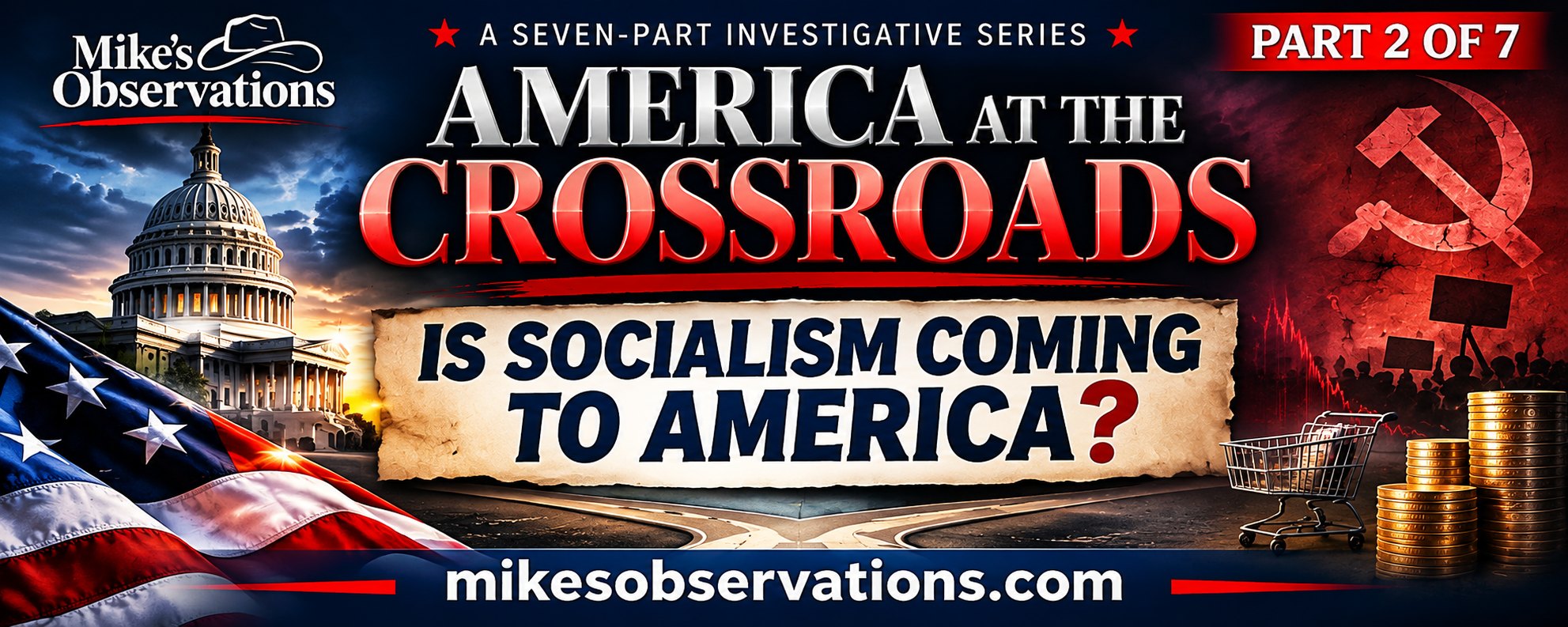
Is Socialism Coming to America?
America at the Crossroads — Part 2 of 7
By Michael Cunningham Sr. | November 6, 2026
What if the greatest political change in America isn't happening in Washington, but in what Americans are willing to accept from their government?
Three days ago, American voters delivered a political earthquake. Democrats captured both chambers of Congress, and here in Texas, a state long considered a Republican stronghold, voters elected Democrats to the governor's office, the U.S. Senate, and other major statewide positions.
For conservatives, the results were sobering.
But the question I want to examine today goes beyond which political party won an election.
Are we witnessing an ordinary political correction, or is America gradually moving toward socialism?
Those are two very different possibilities. And if we are going to understand where this country is headed, we had better learn to distinguish between them.
What Exactly Is Socialism?
The word socialism gets thrown around so freely in American politics that it has nearly lost its meaning.
Traditionally, socialism involves social or public ownership or control of major economic resources and productive enterprises.
But not everyone advocating government-funded healthcare, higher taxes, or expanded social programs is a socialist.
Many European countries combine privately owned businesses, competitive markets, and extensive government services. That arrangement is generally described as a mixed economy or social democracy.
Democratic socialism goes further in seeking democratic control or collective ownership of important parts of the economy.
The Democratic Socialists of America, for example, explicitly advocates collective ownership of major economic sectors, including energy and transportation.
That is a genuine ideological difference from the free-enterprise principles that have shaped much of America's economic history.
And it deserves serious examination.
The Election Was a Warning, Not a Socialist Mandate
Consider what happened in Texas.
According to the Texas Secretary of State's unofficial election returns, Democrat James Talarico defeated Republican Ken Paxton in the U.S. Senate race, while Democrat Gina Hinojosa defeated Governor Greg Abbott.
Those are extraordinary results.
But the evidence available so far does not establish that Texas voters suddenly embraced socialism.
Campaigns focused heavily on affordability, corruption, housing, and frustration with political leadership.
That distinction matters.
A voter who wants lower grocery prices, affordable medical care, or more accountability in government is not necessarily asking for government ownership of private industry.
Republicans would be making a serious mistake if they dismissed every dissatisfied voter as a socialist.
The more important question is whether the policies adopted after this election will strengthen individual opportunity or expand government control at the expense of personal freedom.
The Danger of Government Becoming Too Powerful
I believe the greatest strength of America has always been the opportunity for ordinary people to build something through their own initiative.
A person could start a business, purchase property, work hard, raise a family, and pursue a better future.
Government had a responsibility to protect those opportunities, not control every aspect of them.
Of course, government has legitimate responsibilities. Roads, national defense, law enforcement, and protection against fraud are necessary functions of an organized society.
And a free market without reasonable safeguards can produce abuses of its own.
But there is a difference between government establishing fair rules and government attempting to direct the economy from the top down.
When political leaders promise that government can solve every problem, citizens should ask three questions:
- Who pays for the promise?
- Who controls the program?
- What happens to individual freedom and responsibility?
Those questions should be asked whether the proposal comes from a Democrat or a Republican.
The Socialist Movement Is Real — But So Are the Differences Among Democrats
America does have an organized democratic socialist movement.
Its advocates support policies ranging from universal healthcare to public ownership of key industries.
Their stated objective is a fundamental change in the relationship between workers, businesses, and economic power.
However, the Democratic Party is not identical to the Democratic Socialists of America.
Democratic elected officials range from moderates who support private enterprise to progressives who favor far-reaching economic restructuring.
Treating them all as interchangeable would make this investigation less credible.
The challenge for Americans is to examine actual legislation rather than political labels.
If elected officials propose government ownership of major industries, that is one debate.
If they propose changing tax rates, regulating insurance, or expanding healthcare subsidies, those are different debates.
Each proposal deserves to be judged on its cost, consequences, effectiveness, and effect on liberty.
What Republicans Must Learn From Tuesday
I have supported conservative principles for much of my life.
I believe in limited government, personal responsibility, free enterprise, strong families, and the Constitution.
Those convictions have not changed because of an election.
But I also believe Republicans need to hear what the voters just told them.
Millions of Americans are worried about the cost of living. They are frustrated by political fighting. They want government to accomplish something besides blaming the other party.
Republicans cannot simply repeat familiar slogans and expect voters to return.
They need to offer practical answers on housing, healthcare, energy, taxes, and economic opportunity.
And Democrats now have a responsibility to demonstrate that their policies can deliver the results they promised.
Winning an election is one thing.
Governing successfully is another.
What About 2028?
Here is where I believe the stakes become even greater.
The 2026 election has changed the political landscape, but it has not determined the outcome of the 2028 presidential election.
Both parties have an opportunity to demonstrate leadership.
If Democrats govern effectively and respond to voters' concerns, they may strengthen their position.
If their policies create new economic burdens, undermine confidence, or produce political overreach, voters may turn against them.
Republicans have an opportunity to rebuild, but only if they address the reasons so many voters rejected their candidates.
I believe Americans are tired of the constant fighting.
They want leaders who understand that the country is bigger than either political party.
The Real Crossroads
After more than eight decades of watching America change, I have learned that freedom is not something a nation can take for granted.
It must be protected by informed citizens, accountable government, and a willingness to challenge those in power.
I am concerned about the growing expectation that Washington should provide the answer to every difficulty in American life.
But I am equally concerned about political leaders who use fear to avoid answering legitimate questions.
Calling every Democrat a socialist will not save the Republican Party.
And calling every conservative an extremist will not solve America's problems.
What will matter is the direction our elected officials actually take.
Will they encourage private enterprise or weaken it?
Will they protect constitutional liberties or expand government power?
Will they reduce the burdens on working families or simply offer another expensive political promise?
America does not become socialist because Democrats win an election. But neither does freedom protect itself simply because politicians promise to defend it.
The responsibility belongs to all of us.
And the next two years may tell us a great deal about what kind of country we intend to leave to the next generation.
America is at a crossroads. The question is not merely which party controls the government. It is how much control the government should have over the American people.
Michael Cunningham Sr. is an author, Marine Corps veteran, and commentator whose observations are shaped by eight decades of faith, service, and American life.
Tomorrow — Part 3: Our investigation continues into the political forces reshaping America.
Read the complete series at mikesobservations.com.