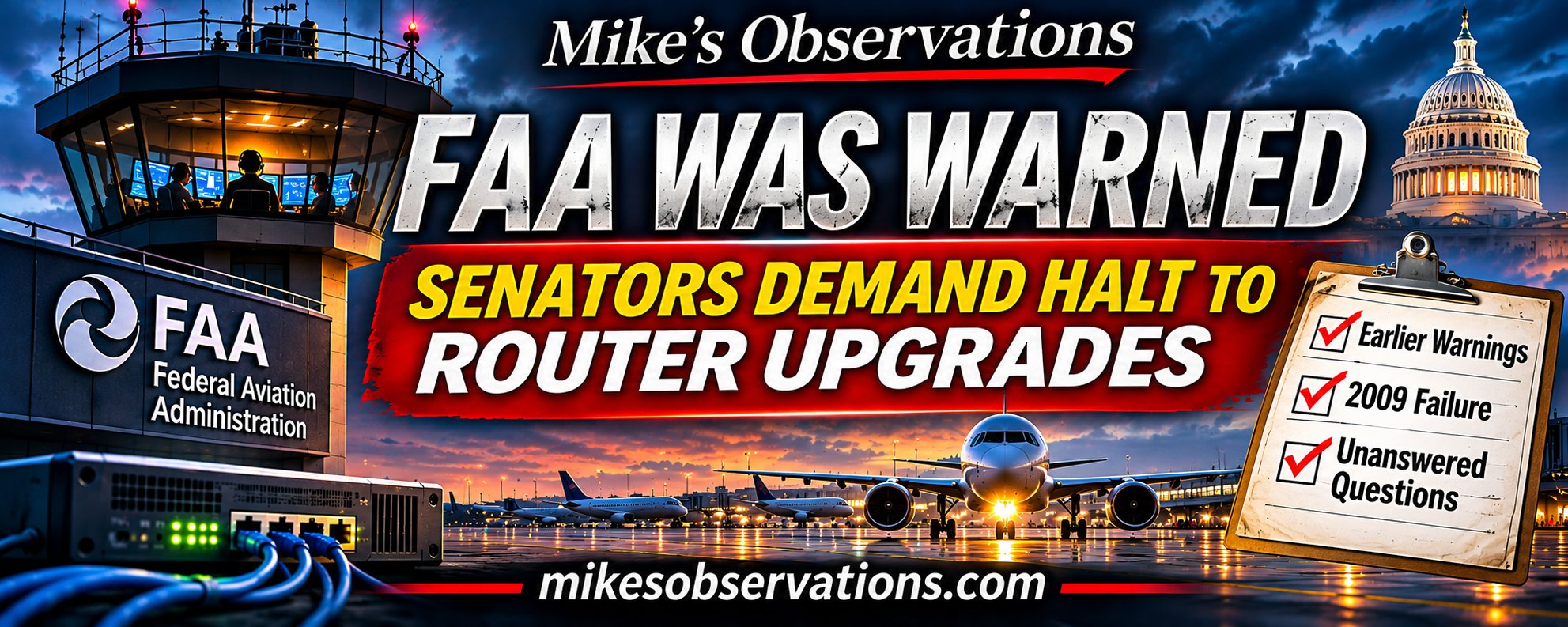
FAA WAS WARNED: Senators Demand Halt to Router Upgrades After Nationwide Shutdown
November 17, 2026 | Michael Cunningham Sr.
America's aviation system was brought to its knees Friday. Now, just four days later, members of Congress are demanding that the government stop installing additional equipment associated with the disruption.
And here's the disturbing part.
Federal watchdogs had already warned that the FAA's modernization efforts could disrupt air traffic.
Were those warnings taken seriously? Were adequate safeguards in place? And why did a similar telecommunications failure occur nearly seventeen years ago?
Those are questions Washington can no longer afford to dismiss.
Thirteen Senators Say Stop
On Tuesday, November 17, thirteen Democratic senators on the Senate Commerce Committee, led by Senator Maria Cantwell, called for the Federal Aviation Administration to immediately suspend further deployment of Juniper network routers until additional safety and reliability testing is completed.
The request follows the November 13 nationwide ground stop, which lasted nearly five hours and contributed to widespread flight cancellations.
The senators revealed figures provided by government contractor L3Harris Technologies.
The copper-to-fiber conversion involves replacing 3,648 routers with Juniper devices. Approximately 400 have been installed, but only 69 are operational.
That leaves thousands of installations still ahead.
The obvious question is whether the FAA has adequately demonstrated that the new equipment can operate safely across its interconnected network.
If the investigation has not established what went wrong, why should installations continue without further testing?
The Warnings Were Already There
This is where the investigation becomes especially troubling.
A September 2026 Government Accountability Office report warned that the FAA's accelerated modernization approach risked disruptions and uncertainty over costs.
A separate FAA-commissioned safety review in 2023 had raised concerns about maintaining reliable operations while replacing aging technology.
These warnings did not necessarily predict the specific router failure that occurred November 13.
But they identified the broader danger: replacing critical equipment while keeping one of America's most important transportation networks operating safely.
That distinction matters.
Warnings about systemic risk are not proof that anyone knew a particular router would malfunction. They are, however, reasons to demand evidence that those risks were evaluated and controlled.
Washington Has Seen Something Like This Before
On November 19, 2009, a telecommunications failure disrupted aviation operations across the United States.
An official FAA review later identified problems involving router configuration, maintenance verification, and network monitoring.
One particularly troubling finding concerned an alert system that had inadvertently been configured to ignore warnings from all network routers.
The 2009 incident was not identical to the November 2026 shutdown, and investigators have not established that the same technical defect occurred.
Nevertheless, the historical parallel is impossible to ignore.
Seventeen years later, America is again investigating how telecommunications maintenance contributed to a major aviation disruption.
What corrective actions followed the 2009 investigation? Were those lessons incorporated into later modernization projects? And who verified that the safeguards worked?
Those answers should be part of the current congressional investigation.
Two Routers, Two States, One National Crisis
Transportation Secretary Sean Duffy has identified equipment in Arkansas and Texas as central to the current investigation.
A router installed during copper-to-fiber work in El Dorado, Arkansas, was associated with network instability. Another router in Amarillo, Texas, also became involved in the disruption.
Officials are examining the equipment to determine whether the problem involved installation procedures, configuration, faulty hardware, or some combination of factors.
Duffy has said that the broadcasting capability of the 69 operational routers was disabled as a precaution.
Investigators have not established that sabotage or a cyberattack caused the incident.
The exact technical cause remains unresolved.
And until that cause is known, claims that a particular contractor, manufacturer, or employee was responsible would be premature.
But uncertainty about the cause does not eliminate the need for accountability.
The Contractor Question
L3Harris has worked on FAA telecommunications infrastructure for more than two decades.
The company has said it is cooperating with the federal investigation.
That cooperation is necessary, but Congress should also examine the contractual arrangements, installation procedures, independent testing, and oversight responsibilities involved.
Who approved the installation plans?
Who tested the network before additional equipment was activated?
Were engineers given sufficient time to evaluate potential failures?
And was there an effective process for isolating a malfunction before it spread across the national system?
These are not partisan questions. They are fundamental questions of public safety.
Modernization Cannot Become an Excuse for Carelessness
Transportation Secretary Duffy has argued that America's aging aviation infrastructure urgently needs replacement.
He has a legitimate point.
Outdated communications equipment, obsolete wiring, and aging computer systems create real operational risks.
But replacing old technology with new technology is not automatically an improvement if the transition itself introduces unacceptable dangers.
The administration has called for tens of billions of dollars in additional modernization funding.
Before approving another enormous expenditure, Congress should insist on documented testing, realistic schedules, independent oversight, and measurable safety improvements.
America needs modernization.
What America does not need is a rushed modernization program that creates the very disruptions it is supposed to prevent.
The Question Nobody in Washington Should Ignore
On November 13, the nation's aviation network experienced a failure serious enough to halt departures across the country.
On November 17, senators demanded that further router installations be paused.
Between those two dates, one question has become impossible to avoid.
If government officials knew the modernization process carried serious operational risks, what did they do to prevent those risks from becoming reality?
There may be reasonable answers.
The investigation may ultimately identify a previously unknown equipment defect or an isolated installation mistake.
But the American people should not be expected to accept assurances without evidence.
The FAA must explain what failed, why existing protections did not contain the disruption, and what will prevent another incident.
Congress must examine the warnings, the contracts, and the testing records.
And the contractors involved must provide complete technical information.
America's skies are too important for guesswork, and American taxpayers deserve more than promises.
The modernization must continue when it can be done safely.
But accountability must come first.
Mike's Observations — Independent investigation, informed commentary, and the questions Americans deserve to have answered.
mikesobservations.com