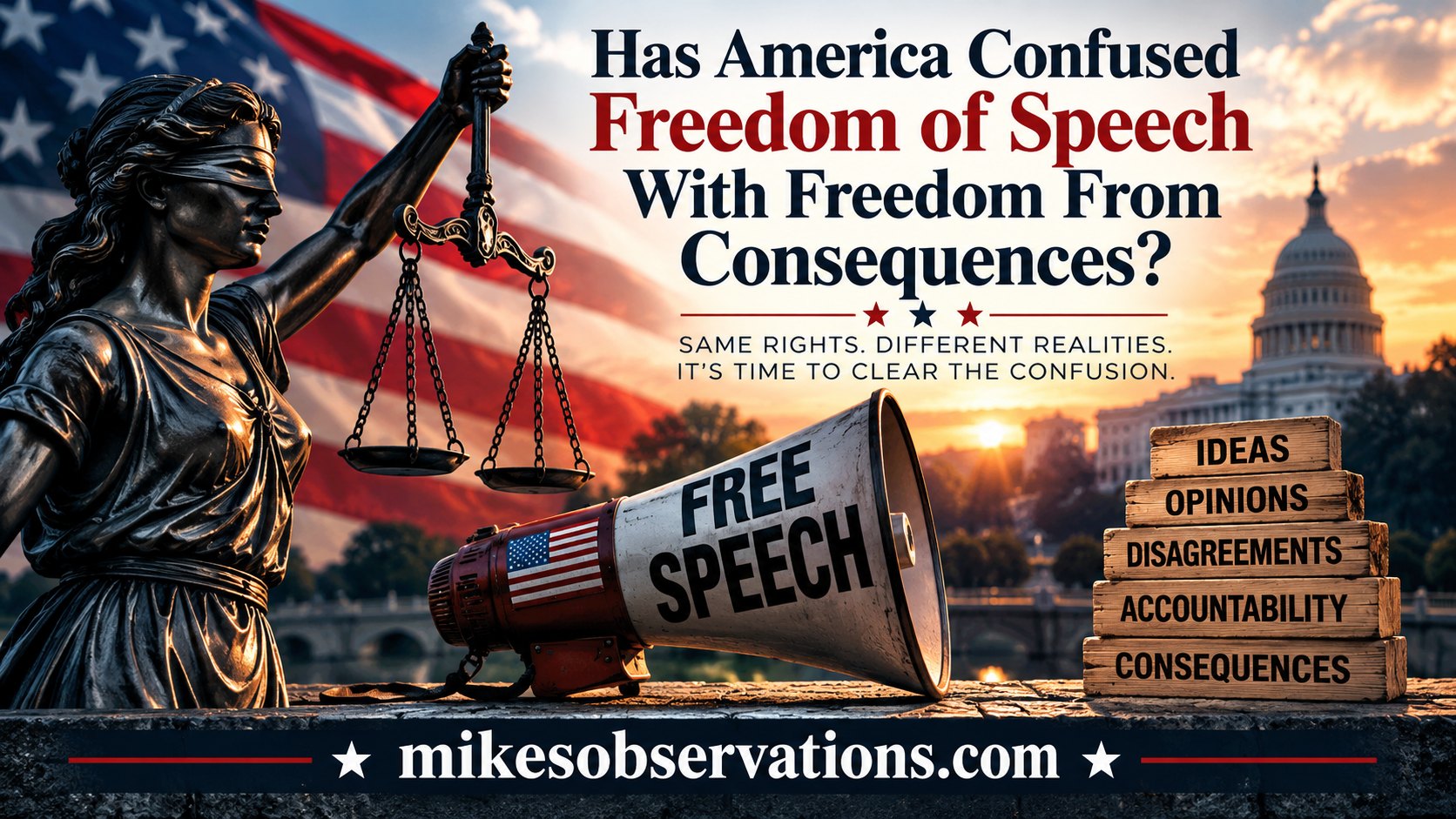
82 Years — 82 Lessons: Has America Confused Freedom of Speech With Freedom From Consequences?
By Michael Cunningham Sr.
There was a time in America when a man's word meant something. You could disagree with your neighbor, argue politics over a cup of coffee, or have a heated discussion at the dinner table—and still shake hands when it was over.
You didn't have to agree with someone to respect his right to speak.
Today, I'm beginning to wonder whether we've forgotten what freedom of speech actually means.
It seems that half the country believes freedom of speech means they can say anything they want without anyone objecting. The other half seems to believe that anything they find offensive ought to be silenced.
And somewhere between those two extremes, common sense has gone missing.
The Constitution Doesn't Guarantee Applause
The First Amendment to the United States Constitution protects freedom of speech against government interference.
That is one of the greatest protections ever written into law.
But here's something many Americans seem to have forgotten:
Freedom of speech does not mean freedom from criticism, disagreement, or consequences.
You have the right to express your opinion. I have the right to disagree with it.
You have the right to criticize the president. Your neighbor has the right to defend him.
You can speak your mind. But that doesn't mean everyone must applaud what comes out of your mouth.
And it certainly doesn't mean every private employer, customer, or neighbor must approve of your words.
There are important legal exceptions and protections, of course. Government punishment, unlawful retaliation, and private disagreement are not the same thing.
But the fundamental principle remains: freedom carries responsibility.
When Did Disagreement Become an Enemy?
I've lived through a lot of American history.
I remember when political disagreements could get pretty heated. People argued about presidents, wars, religion, and everything else under the sun.
But somewhere along the way, disagreement became something more sinister.
Today, disagree with the wrong person and you might be labeled hateful, ignorant, dangerous, or un-American.
Instead of answering an argument, people attack the person making it.
Instead of debating ideas, they demand silence.
And instead of asking, "Why do you believe that?" they ask, "How can we get rid of you?"
That's not healthy debate.
That's intellectual intimidation.
And it doesn't matter whether it comes from the political left or the political right. The damage is the same.
Social Media Gave Everybody a Megaphone
When I was growing up, if you wanted to insult somebody, you generally had to look him in the eye.
That tended to encourage a little restraint.
Today, a person can sit behind a computer screen and insult thousands of strangers before breakfast.
Social media has given ordinary Americans a voice that previous generations could hardly imagine.
That can be a wonderful thing.
But it has also created a world where people sometimes type things they would never have the courage—or the poor judgment—to say face-to-face.
Then, when their words come back to haunt them, they shout, "What happened to my freedom of speech?"
Nothing happened to it.
You spoke.
Other people listened.
And some of them didn't like what they heard.
That's part of freedom, too.
But Cancel Culture Has Gone Too Far
Now, before somebody thinks I'm defending the practice of destroying a person's livelihood over one foolish remark, let me make something clear.
I believe America has developed a dangerous appetite for public humiliation.
A person can make a mistake, say something foolish, or express an unpopular opinion, and suddenly thousands of strangers are demanding that he lose his job, his reputation, or his ability to earn a living.
Sometimes people are condemned without anyone bothering to learn the full story.
Sometimes words spoken years ago are judged without context.
And sometimes a sincere apology isn't considered enough.
That's not accountability.
That's punishment without proportion.
There's a world of difference between holding someone responsible for deliberate cruelty and destroying someone because he expressed an opinion you dislike.
A free society must leave room for people to be wrong, to learn, and to change.
Otherwise, we're not encouraging better speech. We're encouraging frightened silence.
What About the Right to Be Offended?
Here's something else I've learned in 82 years.
You cannot go through life without somebody offending you.
I've been offended plenty of times.
I've also probably offended a few people myself.
But being offended doesn't automatically make you right, and it doesn't automatically make the other person wrong.
We seem to have developed the idea that personal discomfort gives us the authority to silence another human being.
It doesn't.
The answer to an opinion you dislike is usually a better argument, not a demand that the opinion disappear.
And if someone is being deliberately cruel, dishonest, or hateful, we can challenge that behavior without abandoning our own principles.
My Christian Faith Teaches Me Something About Words
As a Christian, I believe words matter.
The Bible tells us in James 1:19:
"Let every man be swift to hear, slow to speak, slow to wrath." (KJV)
Think about that for a moment.
Swift to hear.
Slow to speak.
Slow to anger.
Wouldn't that change a few conversations in America today?
Scripture doesn't tell us to stop speaking the truth. It teaches us to speak with wisdom and self-control.
I've learned that just because I have the right to say something doesn't always mean I should say it.
Sometimes the strongest thing a man can do is hold his tongue.
And sometimes the most courageous thing he can do is speak when everybody else is afraid.
Wisdom is knowing the difference.
The Lesson I've Learned in 82 Years
America doesn't need less freedom of speech.
It needs more respect for that freedom.
We need to defend the right of people to express opinions we strongly disagree with.
We need to recognize that criticism is not necessarily censorship.
We need to stop treating every disagreement as a declaration of war.
And we need to remember that consequences should be fair, reasonable, and proportional—not acts of revenge disguised as justice.
I've lived long enough to know that no political party, no generation, and no individual has a monopoly on truth.
We all have something to learn.
And we might actually learn it if we stopped shouting long enough to listen.
Freedom of speech gives us the right to speak. Character determines how we use that right. Wisdom teaches us when to listen.
That's a lesson America desperately needs to remember.
Now I'd Like to Hear From You
Do you believe Americans are becoming too sensitive to opposing opinions?
Or do you think people are finally being held accountable for what they say?
Where should we draw the line between free speech, accountability, and punishment?
I welcome respectful disagreement. In fact, I encourage it.
Visit mikesobservations.com and share your thoughts through the Contact page.
After all, what good is freedom of speech if we're afraid to have a conversation?
Michael Cunningham Sr.
Eight Decades of Faith · Service · Adventure · A Life Well Lived