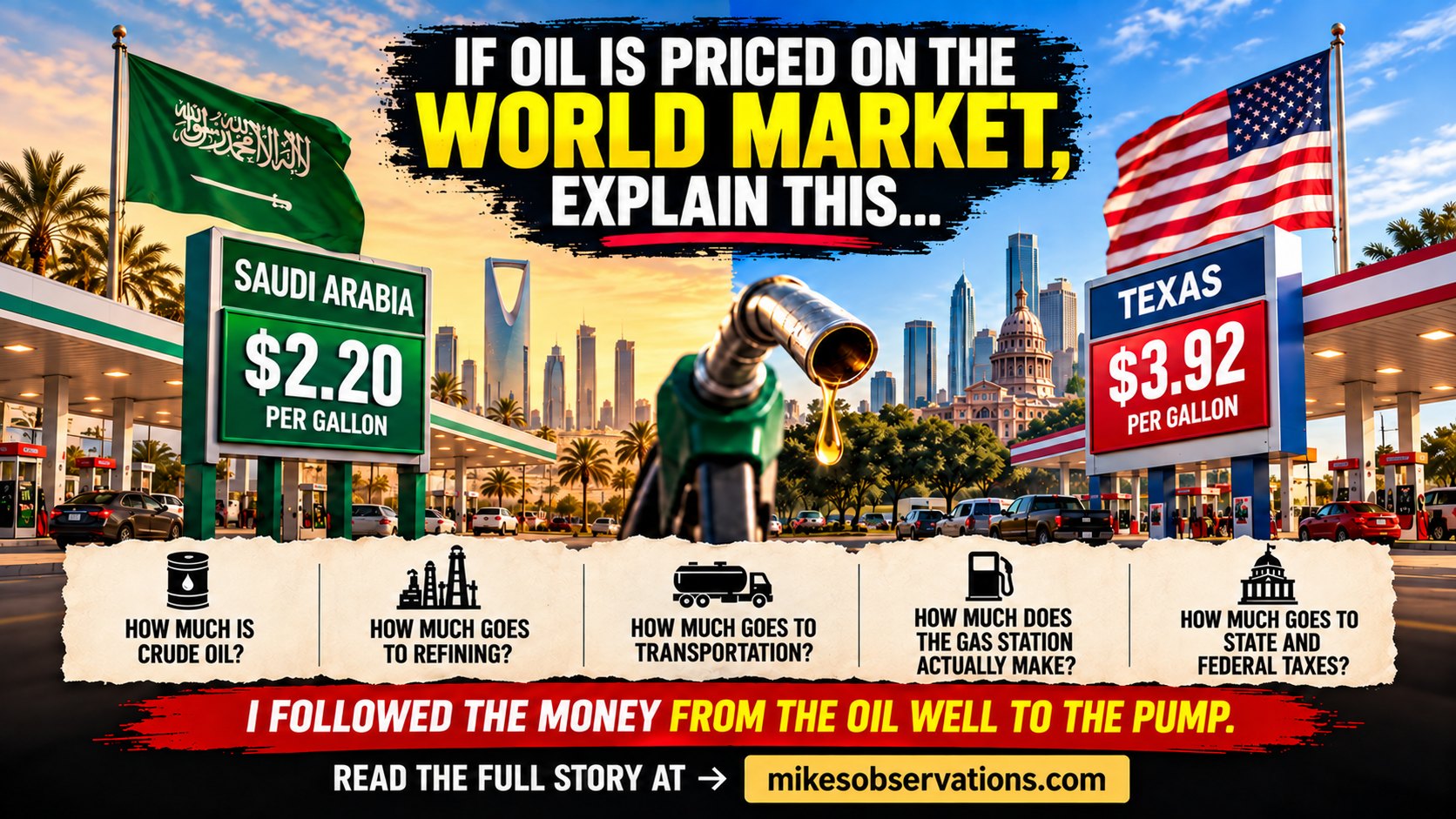
If Oil Is Priced on the World Market, Explain This
Every time gasoline prices rise, we hear essentially the same explanation:
“Oil is priced on the world market.”
That is true.
But it raises an obvious question.
If crude oil has a world price, why do gasoline prices vary greatly?
Gasoline may cost around $2.20 per gallon in Saudi Arabia.
Meanwhile, American drivers may pay considerably more.
The answer is simple.
Crude oil and gasoline are not the same market.
Crude Oil Has a World Price
Crude oil is an internationally traded commodity.
Major oil markets influence what producers and refiners will pay for crude.
However, we do not put crude oil into our automobiles.
Crude must first be transported and refined into gasoline.
Then it must be stored, distributed, and delivered to service stations.
Every country handles those steps differently.
Governments also impose different taxes and fuel-pricing policies.
Therefore, countries facing similar crude prices can have different gasoline prices.
What Are We Paying for at the Pump?
When Texans buy gasoline, their money does not simply reach an oil company.
The price generally contains four major components.
Crude Oil
Crude oil is usually the largest component.
However, the amount attributed to crude is not entirely profit.
Oil producers face enormous expenses.
These include leases, drilling, equipment, employees, transportation, and royalties.
Refining
Crude oil must be converted into gasoline.
Refineries require expensive facilities and enormous amounts of energy.
They also need skilled employees, maintenance, and other operating expenses.
Therefore, the refinery’s portion should not be confused with refinery profit.
Distribution and Marketing
After gasoline leaves the refinery, it must still reach consumers.
It may travel through pipelines to storage terminals.
Tanker trucks then deliver it to individual service stations.
This category includes transportation, storage, terminals, trucking, marketing, and retail expenses.
Service stations also have considerable operating costs.
They pay employees, electricity, insurance, maintenance, and property expenses.
They must maintain pumps and underground storage tanks.
They also pay credit-card processing fees on every purchase.
When you pay $4, the neighborhood station does not make $4.
Its actual fuel profit may represent only a small portion.
That explains why convenience stores encourage customers to come inside.
They earn additional money selling coffee, drinks, food, and other merchandise.
Then Come the Gasoline Taxes
Texas imposes a gasoline tax of 20 cents per gallon.
The federal gasoline tax is 18.4 cents per gallon.
Together, those taxes equal:
20¢ + 18.4¢ = 38.4¢ per gallon.
These are fixed per-gallon excise taxes.
They remain 38.4 cents whether gasoline costs $2, $3, or $4.
They remain fixed unless lawmakers change the rates.
Suppose gasoline sells for $4 per gallon.
Removing both taxes could reduce the price to approximately:
$4.00 − $0.384 = $3.616
That equals about $3.62 per gallon.
A 20-gallon purchase would save approximately $7.68.
However, removing those taxes would eliminate important government revenue.
That revenue currently supports transportation and other authorized purposes.
Therefore, eliminating taxes would involve another serious policy consideration.
What Does a Barrel of Oil Have to Do With It?
A standard barrel of crude oil contains 42 gallons.
That helps us visualize changes in crude-oil prices.
At $50 per barrel, dividing by 42 gives approximately:
$1.19 per gallon of barrel volume.
At $75 per barrel:
$1.79 per gallon.
At $100 per barrel:
$2.38 per gallon.
At $125 per barrel:
$2.98 per gallon.
At $150 per barrel:
$3.57 per gallon.
This does not determine gasoline’s final retail price.
A barrel produces several different petroleum products.
Refining economics involve more than dividing the barrel price by 42.
However, this calculation demonstrates the effect of changing crude prices.
A $25 crude increase can make a considerable difference.
Moving from $75 to $100 adds about 60 cents per barrel gallon.
Why Is Gasoline Cheaper in Saudi Arabia?
This question highlights the difference between crude oil and finished gasoline.
Saudi Arabia is one of the world’s major petroleum-producing countries.
Its domestic fuel prices do not simply mirror American prices.
Saudi prices reflect the country’s production and refining systems.
They also reflect domestic taxes and government pricing policies.
Saudi Arabia participates in the international petroleum market.
However, it maintains a domestic pricing structure different from America’s.
That is not a contradiction.
International markets influence crude-oil prices.
Domestic policies and costs heavily influence retail gasoline prices.
The same principle applies throughout the world.
Some governments tax gasoline heavily.
Other governments impose much lower gasoline taxes.
Some governments regulate or influence domestic fuel prices.
Others allow market forces to determine prices more directly.
That explains why gasoline prices differ greatly among countries.
But America Produces Large Quantities of Oil
This creates another common question.
Why does American oil production not guarantee very cheap gasoline?
American crude belongs to a much larger, interconnected petroleum market.
American producers and refiners respond to domestic and international prices.
American oil has value based upon what buyers will pay.
Comparable oil prices elsewhere also influence that value.
When world prices rise, American oil does not become economically isolated.
There are also several different types of crude oil.
Refineries process particular grades and mixtures.
America can produce large quantities while still importing certain crude oils.
At the same time, America can export other crude oils.
The same principle applies to refined petroleum products.
Who Is Making All the Money?
There is no single, simple answer.
When gasoline prices rise, money can appear throughout the economic chain.
The cause of the price increase determines who benefits.
Oil producers may benefit from higher crude prices.
Refining margins can sometimes increase dramatically.
Transportation and distribution costs can also change.
Retail profit margins constantly fluctuate.
Meanwhile, federal and Texas gasoline taxes remain fixed per gallon.
Those taxes change only when lawmakers change the rates.
Saying, “The oil companies receive everything,” is inaccurate.
However, saying, “The price is entirely taxes,” is equally inaccurate.
A gasoline gallon represents an entire economic chain:
Oil field → transportation → refinery → pipeline → terminal → truck → station → automobile.
Every step costs money.
Several steps may also generate profit.
Government taxes are added along the way.
The Bottom Line
The statement “oil is priced on the world market” is true.
However, that explanation is incomplete.
A better explanation is:
Crude oil trades within an international market.
Gasoline is a finished product sold within domestic markets.
Its price includes crude oil, refining, transportation, distribution, and retail costs.
It also includes taxes and each country’s fuel-pricing policies.
That explains the difference between Saudi Arabia and Texas.
Both participate in the same international petroleum market.
However, their motorists may pay very different gasoline prices.
Remember this when someone blames everything on the world oil market.
Much happens between the oil well and the gasoline nozzle.
Understanding that journey makes gasoline prices much easier to understand.
— Michael Cunningham Sr.