At 82 years old, I sometimes find myself wondering what the world will look like twenty years from now.
I have already lived through changes that would have seemed impossible when I was a boy.
I remember a world before cell phones, personal computers, the internet, GPS, social media, and
artificial intelligence. Long-distance telephone calls were something you thought twice about because
they cost money. If you
wanted to know how to get somewhere, you unfolded a paper map across the hood of your car.
Today, I can sit at a computer and have a conversation with artificial intelligence.
So when someone asks me what life will look like twenty years from now, my answer is simple:
Probably stranger and more amazing than anything we can imagine today.
Artificial Intelligence Will Be Everywhere
I believe artificial intelligence will become as ordinary as electricity.
Most people won't think about using AI. It will simply be built into their cars, homes, phones,
businesses, schools, and medical care.
An AI assistant may know your schedule, answer your phone, handle routine paperwork, help
manage your finances, plan trips, translate languages, and take care of hundreds of little tasks
that consume our time today.
Businesses may operate with far fewer employees.
Some jobs will disappear. Others will be transformed, and entirely new occupations will be created.
The important question may no longer be:
"Can a machine do this job?"
Instead, it may become:
"What can a human being do better with the help of a machine?"
Medicine Could Change Dramatically
Imagine going to the doctor twenty years from now.
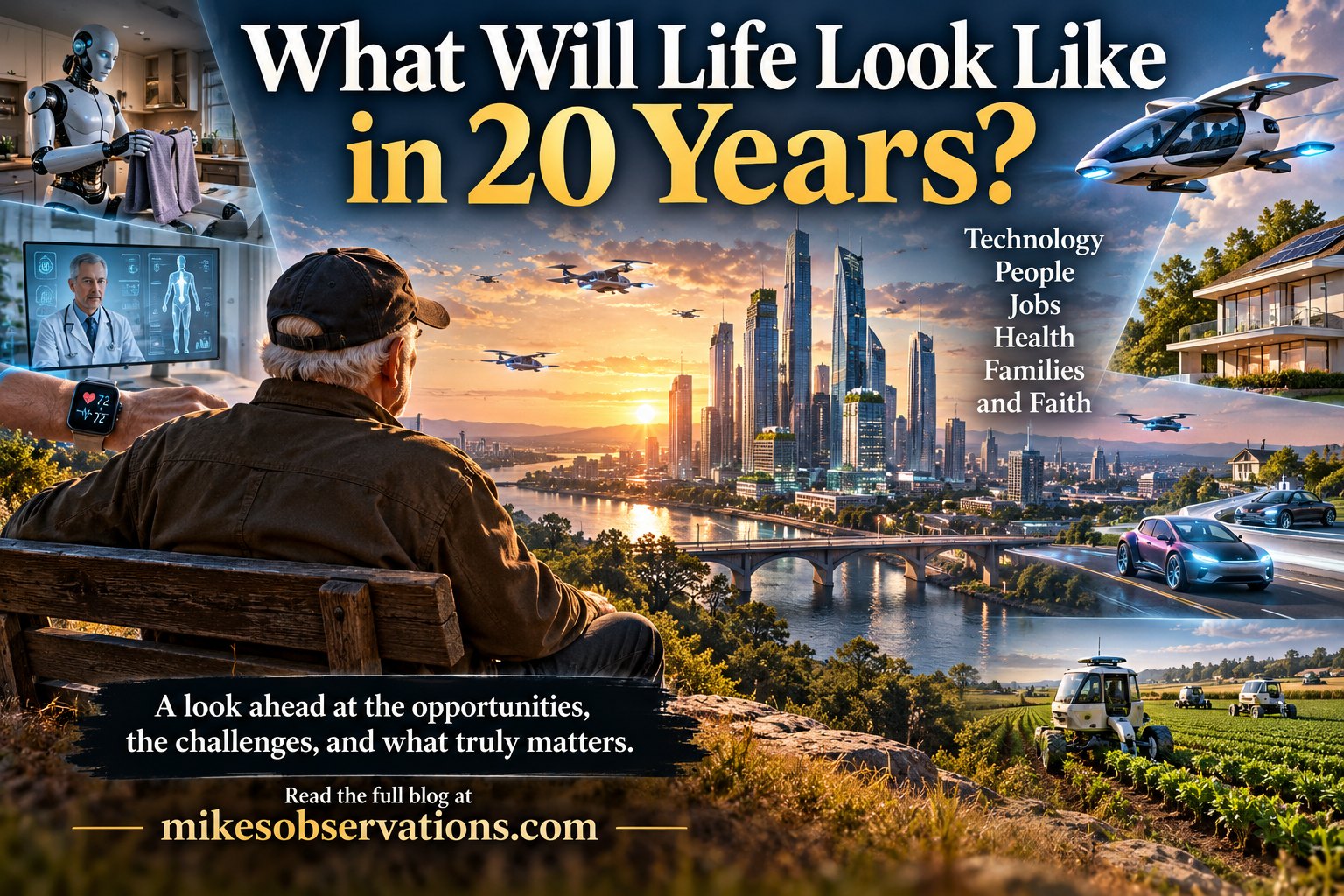
Before you ever walk through the door, your watch—or some device much smaller than today's watch—may already have monitored your heart, blood pressure, blood sugar, oxygen levels, sleep, movement,
and dozens of other measurements.
Artificial intelligence could detect warning signs before you ever feel sick.
Doctors may be able to identify diseases earlier, tailor treatments to the individual, and perhaps repair
or replace parts of the human body in ways that sound like science fiction today.
People may routinely live longer.
But that raises another question:
If we add years to our lives, what will we do with those years?
Living longer and living well are not necessarily the same thing.
Cars May Drive Themselves
Twenty years from now, many young people may find it strange that we once manually controlled
automobiles traveling 70 miles per hour only a few feet apart.
Self-driving vehicles could eventually take us almost anywhere.
For older people, that could mean something especially important: independence.
Imagine reaching an age when you can no longer safely drive but still being able to tell your vehicle,
"Take me to church," "Take me to the grocery store," or "Take me to see my grandchildren."
The car simply takes you there.
That would be a remarkable change.
Robots May Become Part of Everyday Life
Robots won't necessarily look like the ones we saw in old science-fiction movies.
Some will.
Others may simply be machines designed to perform one particular job.
They may clean homes, mow lawns, deliver packages, work in warehouses, help construct buildings,
assist nurses, care for elderly people, and perform dangerous industrial work.
Agriculture may become increasingly automated.
Factories certainly will.
And perhaps someday a robot will fold the laundry.
If they can accomplish that reliably, I will consider the technological revolution complete.
We May Work Differently
For generations, the pattern was simple.
You went to school, learned a trade or profession, found a job, worked for decades, and eventually retired.
That pattern may not survive.
People in the future may have several completely different careers during their lifetime.
Education may never really end.
Someone could train for a profession at 25 and discover at 40 that technology has changed it completely.
The most valuable skill may not be knowing one particular thing.
It may be knowing how to keep learning.
The World Will Become Even More Connected
Language barriers may nearly disappear.
Two people who don't speak a word of each other's language may someday have a perfectly normal
conversation while technology translates instantly between them.
A small business in East Texas could easily have customers in Europe, Africa, Australia, or Asia.
A child in a remote village may have access to the same information once available only in the world's
greatest universities.
Knowledge will become easier to obtain than at any time in human history.
But there is a danger hidden inside that blessing.
Having access to unlimited information doesn't automatically give us wisdom.
Those are two very different things.
Privacy May Become One of Our Greatest Challenges
Technology learns from information.
And we are producing enormous amounts of it.
Where we go.
What we buy.
What we watch.
Who we communicate with.
What we search for.
Even information about our bodies.
Twenty years from now, society may face some very difficult questions about who owns that
information and how it can be used.
Technology can give us tremendous freedom.
It can also create tremendous power for whoever controls it.
That is something future generations will have to guard carefully.
But What About People?
This is the part that interests me most.
Will technology make us happier?
I am not convinced that it will.
We already have technology that would have amazed the richest people on Earth when I was a boy.
Yet people still struggle with loneliness, broken families, fear, anger, addiction, depression, and
hopelessness.
A faster computer cannot repair a broken heart.
A robot cannot replace a loving family.
Artificial intelligence can provide information, but it cannot decide what kind of person you should
become.
Technology may change almost everything around us.
But the deepest needs of human beings haven't changed very much at all.
We still want to be loved.
We still want our lives to matter.
We still want someone beside us when life becomes difficult.
We still search for purpose.
And eventually, every one of us confronts the same great questions:
Why am I here?
What did I do with the life I was given?
What happens when this life is over?
Some Things Will Never Become Obsolete
Twenty years from now, computers will be more powerful.
Cars will be smarter.
Medicine will be better.
Robots will be everywhere.
Artificial intelligence may accomplish things we cannot presently imagine.
But kindness will still matter.
Integrity will still matter.
Courage will still matter.
Family will still matter.
Friendship will still matter.
Faith will still matter.
And I believe God will still matter.
Technology can change how we live.
It cannot change why life matters.
I have watched the world transform during more than eight decades of living. I expect the next
twenty years may bring changes faster than anything I have witnessed so far.
I hope we embrace the good.
I hope we have the wisdom to recognize the dangers.
And most of all, I hope that while we're busy building smarter machines, we don't forget to build
better human beings.
Because twenty years from now, the greatest question may not be:
"How advanced did our technology become?"
It may be:
"Did all that technology make us wiser, kinder, more compassionate—and more aware of what truly matters?"
That answer won't be determined by a computer.
It will be determined by us.
— Michael Cunningham Sr.