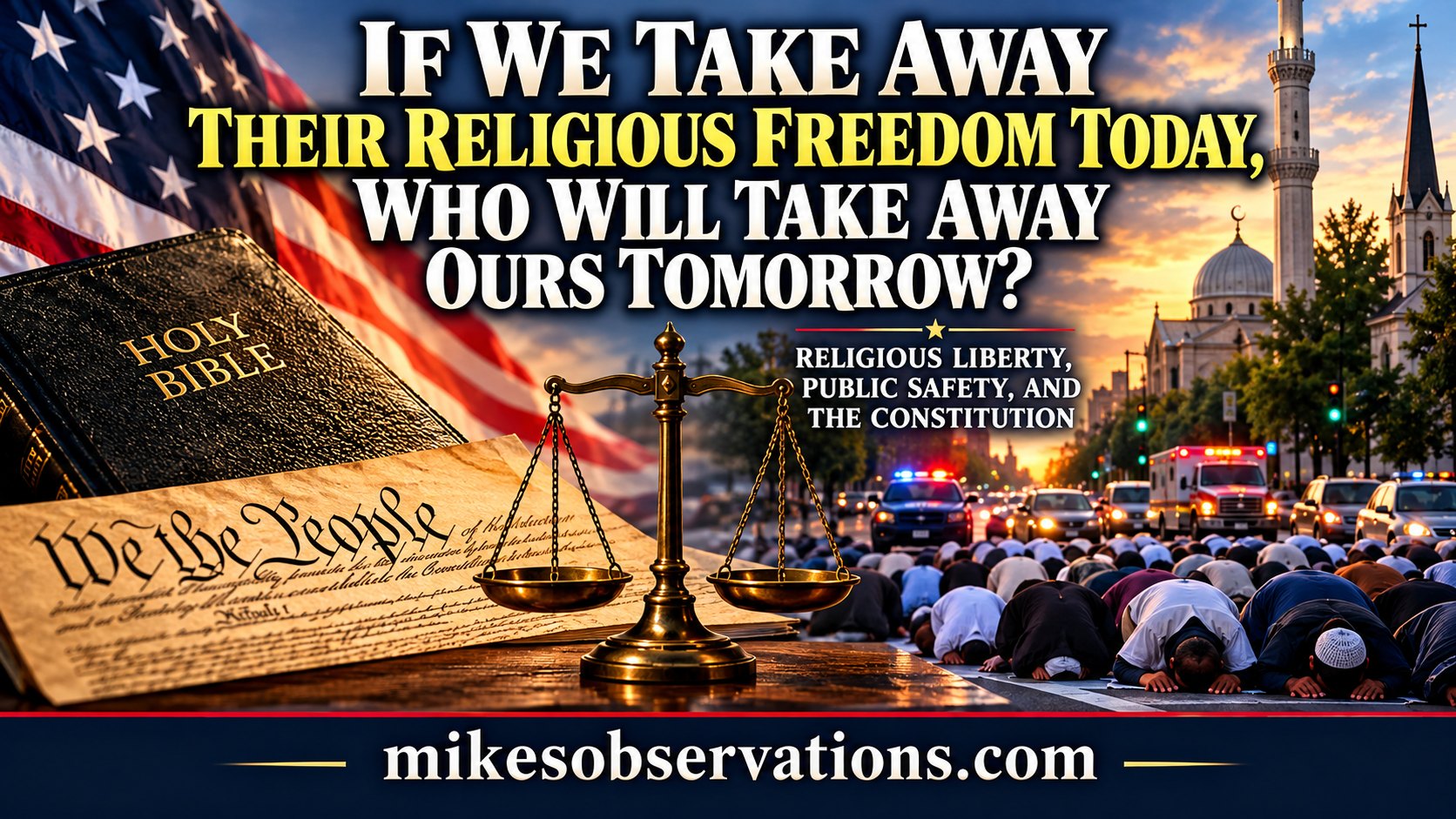
If We Take Away Their Religious Freedom Today, Who Will Take Away Ours Tomorrow?
Religious Freedom, Public Safety, and the Constitution
By Michael Cunningham Sr. | Mike's Observations
A question recently caught my attention: How strongly would I support a law prohibiting the Muslim call to prayer from public spaces?
The question troubled me, and I spent some time thinking about it.
I am a Christian. I am a Full Gospel minister. I believe that Jesus Christ is the Son of God and the only way to salvation. My beliefs are not negotiable.
But I am also an American, a Marine, and a man who believes deeply in the United States Constitution.
And that creates a question every freedom-loving American ought to consider.
If we allow government to silence one religion today, what prevents it from silencing ours tomorrow?
Freedom Doesn't Belong to One Religion
The First Amendment guarantees the free exercise of religion. It doesn't limit that protection to Christianity, nor does it require citizens to agree with another person's beliefs.
I can disagree with Islamic teachings while defending a Muslim's constitutional right to worship.
Those two positions are not contradictory.
In fact, I believe defending religious liberty is one of the responsibilities that comes with enjoying it.
If Christians expect government to respect our churches, our public prayers, our revivals, and our preaching, then we must recognize that other Americans possess constitutional protections as well.
A freedom that exists only for people we agree with isn't freedom. It's a privilege granted by whoever holds political power.
And privileges can be taken away.
Religious Freedom Does Not Mean Blocking Public Streets
Now comes the other side of this argument, and it is equally important.
I have seen concerns raised about religious gatherings occupying public streets, obstructing traffic, and creating dangerous situations.
That is a legitimate issue to examine.
An ambulance transporting a critically ill patient cannot afford to be trapped behind an unauthorized gathering. A fire truck responding to a house fire cannot simply wait for a religious service to conclude.
Neither should ordinary citizens be forced to surrender reasonable access to public roads because a group has decided to occupy them without proper authorization.
But notice something important.
The problem is not the religion. The problem is the obstruction.
If Muslims unlawfully block a street, the applicable traffic laws should be enforced.
If Christians unlawfully block that same street for an outdoor revival, those same laws should be enforced.
If political protesters or any other group do it, the principle remains the same.
Authorized parades, street closures, and public gatherings are another matter. Communities can make reasonable arrangements that accommodate free expression while protecting public safety.
What we cannot justify is creating one set of rules for Christians and another for Muslims.
Be Careful What Power You Give Government
At 82 years old, I have watched government change hands many times.
One administration introduces a policy. Another expands it. Eventually, powers created for one purpose may be used for something entirely different.
That is why I am cautious about any proposal giving government the authority to prohibit the public religious expression of a particular faith.
Suppose we approve a law specifically banning the Muslim call to prayer.
What happens when another administration decides that Christian street preaching is offensive?
What happens when a city decides that an outdoor baptism or a public Christian revival is undesirable?
What happens when the same reasoning used against Muslims is turned against Christians?
Would we still believe the government had that authority?
I certainly wouldn't.
We should never hand government a weapon we would fear seeing turned against ourselves.
Public Safety Is Not Religious Persecution
We must also recognize that religious liberty does not exempt anyone from every law governing public conduct.
Reasonable regulations concerning traffic, emergency access, crowd management, and amplified sound can protect the community when they are applied lawfully and fairly.
There is nothing inherently anti-Christian or anti-Muslim about requiring organizers to obtain appropriate permits for street closures or to maintain emergency access.
Public safety is a legitimate responsibility of government.
Religious discrimination is not.
The distinction matters, and Americans should insist that public officials understand it.
What Does My Christian Faith Require?
Jesus taught us to love our neighbors.
That doesn't mean we must accept every belief our neighbors hold. It doesn't mean abandoning our convictions or remaining silent about the Gospel.
It means recognizing the humanity and dignity of people with whom we disagree.
I can preach Jesus Christ without demanding that government silence a Muslim.
I can defend Christianity without supporting religious discrimination.
And I can insist on safe public streets without treating every public expression of Islam as a threat.
Our faith should be strong enough to stand on its own without requiring government to suppress competing beliefs.
My Answer to the Poll
So, after giving this question considerable thought, my answer is clear.
Would I support legislation specifically prohibiting the Muslim call to prayer in public spaces?
No.
Would I support reasonable, religion-neutral laws preventing unauthorized street obstructions and protecting emergency access?
Absolutely.
There is no contradiction in those answers.
One protects the Constitution. The other protects public safety.
Both protect the American people.
The Freedom We Defend Today May Be the Freedom We Need Tomorrow
I am proud of my Christian faith. I am proud to be a Marine. And I remain deeply grateful to live in a country whose founding principles recognize the importance of religious liberty.
But I believe those principles must be defended consistently, especially when doing so is uncomfortable.
The Constitution does not exist merely to protect popular beliefs.
Its protections matter most when someone else's beliefs are unpopular.
We can disagree vigorously about religion. We can insist that public streets remain safe and accessible. We can enforce reasonable laws without surrendering our constitutional principles.
What we must never do is confuse defending our faith with denying someone else's freedom.
Because the moment we decide that religious liberty belongs only to people who believe as we do, we have begun dismantling the very freedom we claim to cherish.
And one day, we may discover that the freedom we surrendered belonged to us, too.
What do you think? Where should America draw the line between religious freedom and public safety?
I welcome your thoughts, whether you agree with me or not.
Michael Cunningham Sr.
Mike's Observations
mikesobservations.com
Semper Fi!