I have lived long enough to watch technology change the American workplace over and over again.
I remember when there were no cell phones, no personal computers, no internet, and certainly no artificial intelligence sitting on your desk answering questions in seconds.
In the oilfield, we once drove reports miles into town just to send information back to the office.
Today, a man sitting at a computer can transmit more information around the world in seconds than we could have moved in days.
Every major technological change has brought the same question:
What is going to happen to our jobs?
Now that question has become much more serious.
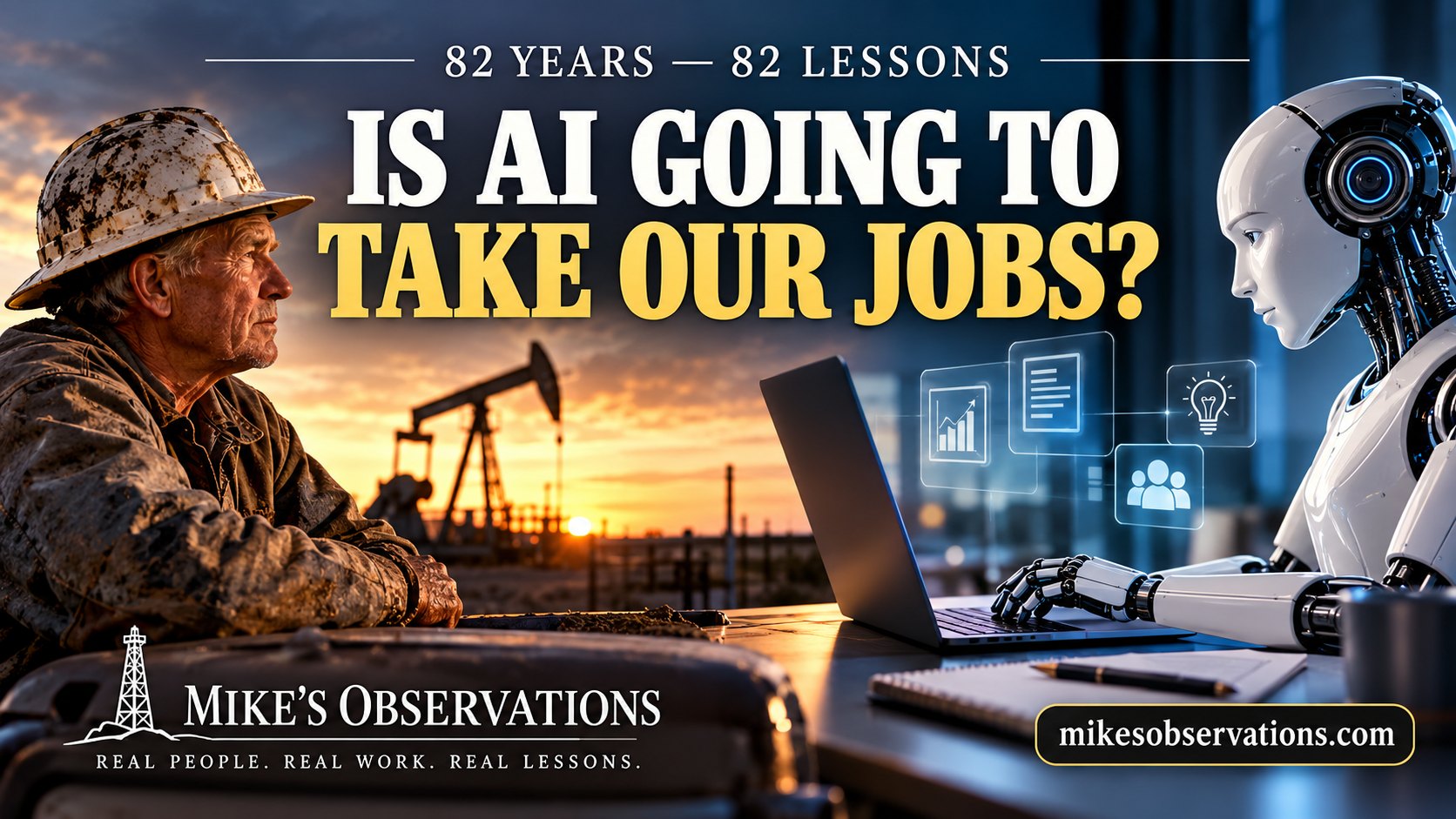
Is artificial intelligence going to take our jobs?
The short answer is:
Some of them—yes.
But that isn't the whole story.
We Have Been Here Before
Technology has always eliminated certain kinds of work.
Farm machinery dramatically reduced the number of people required to produce food.
Factories replaced many jobs once performed entirely by hand.
Computers eliminated rooms full of filing cabinets, typists, bookkeepers, and clerical workers.
ATMs changed banking.
Digital cameras changed photography.
The internet changed newspapers, retail stores, travel agencies, advertising, and almost everything else.
Yet people continued working.
The jobs changed.
And that may be the most important lesson as we enter the age of artificial intelligence.
AI Is Different
There is something about AI that makes this technological revolution different from many that came before it.
Previous machines mostly replaced physical labor.
AI can replace or greatly reduce certain kinds of mental labor.
It can write.
It can summarize documents.
It can answer customer questions.
It can analyze enormous amounts of information.
It can help write computer programs.
It can create pictures, advertisements, reports, presentations, and videos.
It can perform in seconds tasks that once required hours of someone's time.
That means this revolution won't affect only factory workers.
It can affect people sitting behind desks.
Which Jobs Are Most Vulnerable?
The jobs facing the greatest pressure may be those involving repetitive, predictable information work.
Customer-service representatives, data-entry workers, basic bookkeeping positions, routine administrative jobs, transcription work, and some entry-level writing and computer work could all change dramatically.
That doesn't necessarily mean every one of those occupations disappears.
It may mean that one person using AI can accomplish work that previously required several people.
And that creates a difficult economic question.
If a company once needed ten employees to perform a task and AI allows three employees to accomplish the same work, what happens to the other seven?
That is the part of the AI revolution we should not ignore.
But AI Will Create Jobs Too
History teaches us something else.
New technology creates opportunities that were difficult to imagine before the technology existed.
Nobody was training to become a website designer in 1965.
Nobody was dreaming of becoming a smartphone-app developer in 1975.
Nobody was building a career managing social-media accounts in 1985.
Those industries didn't exist.
AI will almost certainly create occupations we haven't even named yet.
There will be people who build AI systems, supervise them, train them, maintain them, audit their work, secure them, and use them in thousands of businesses.
But there is another opportunity that may be even larger.
Ordinary people who learn how to use AI effectively may become considerably more productive.
The Real Competition May Not Be Human Versus Machine
I believe we sometimes ask the wrong question.
Instead of asking:
“Will AI replace me?”
Perhaps we should ask:
“What can someone using AI do that I cannot do without it?”
That is where the real competition may develop.
A carpenter with modern power tools can accomplish more than a carpenter working entirely with hand tools.
The power tool didn't eliminate the carpenter.
It changed what the carpenter could accomplish.
AI may become the intellectual equivalent of the power tool.
The accountant who understands AI may work faster.
The small-business owner may compete with larger companies.
The mechanic may diagnose complicated systems faster.
The writer may research and organize information more efficiently.
The entrepreneur may operate a business that once required several employees.
The question becomes whether we learn to use the tool.
Young People Should Pay Attention
If I were starting my working life today, I would make learning artificial intelligence a priority.
Not because everyone needs to become a computer programmer.
They don't.
But nearly everyone entering the workforce should understand how AI can be used in their profession.
A young electrician who understands AI may have an advantage.
So may a nurse, engineer, salesperson, teacher, mechanic, accountant, business owner, photographer, or farmer.
AI knowledge may eventually become much like computer knowledge became years ago.
At first it was unusual.
Then it became useful.
Eventually it became expected.
Some Things Machines Still Cannot Replace
There is another side to this story.
Human beings bring something to work that machines do not.
Judgment.
Responsibility.
Compassion.
Trust.
Experience.
Leadership.
Character.
And the ability to understand another human being not simply as information, but as a person.
AI can give someone information about comforting a grieving family.
That is not the same thing as sitting beside someone who has just lost a loved one.
AI can explain leadership.
That doesn't make it a leader.
AI can generate a sermon.
That doesn't give a machine faith.
AI can write the words “I love you.”
It cannot love.
There will always be parts of human life where efficiency isn't the most important thing.
At 82, I Am Still Learning
Maybe this is the part that surprises me most.
At 82 years old, I am sitting here using artificial intelligence.
Think about that.
I grew up in a world where a telephone was attached to the wall.
I worked in an oilfield where getting a report to the office could require driving miles through mud and rain to find a telephone.
I worked as a photographer when photographs were made with film, chemicals, enlargers, and darkrooms.
And now I can sit at a computer and have a conversation with artificial intelligence.
That tells me something.
You are never too old to learn a new tool.
And if an 82-year-old man can learn to use AI, a 22-year-old certainly has no excuse for ignoring it.
So, Is AI Going to Take Our Jobs?
Some jobs will disappear.
Many more will change.
New jobs will appear.
And millions of people may discover that AI becomes another tool they use every day.
The transition won't necessarily be painless. Some people will have to retrain. Some careers will shrink. Businesses will have difficult decisions to make.
But I don't believe the most useful question is whether we can stop artificial intelligence.
That horse has already left the barn.
The better question is:
What are we going to do with it?
Throughout my lifetime, I have watched one technology after another arrive and change the way we live.
People adapted.
Businesses adapted.
Workers learned new skills.
And life moved forward.
Artificial intelligence may be one of the biggest changes yet.
So don't spend all your time being afraid that AI might take your job.
Learn how to make it help you do your job better.
Because the future may not belong to machines.
And it may not belong simply to people.
It may belong to people who learn how to work with the machines.
— Michael Cunningham Sr.
82 Years — 82 Lessons
mikesobservations.com