Is America Becoming Socialist Without Realizing It?
82 Years — 82 Lessons
By Michael Cunningham Sr. | Mike's Observations
Can a nation surrender its freedoms one government program at a time without ever realizing what it has lost?
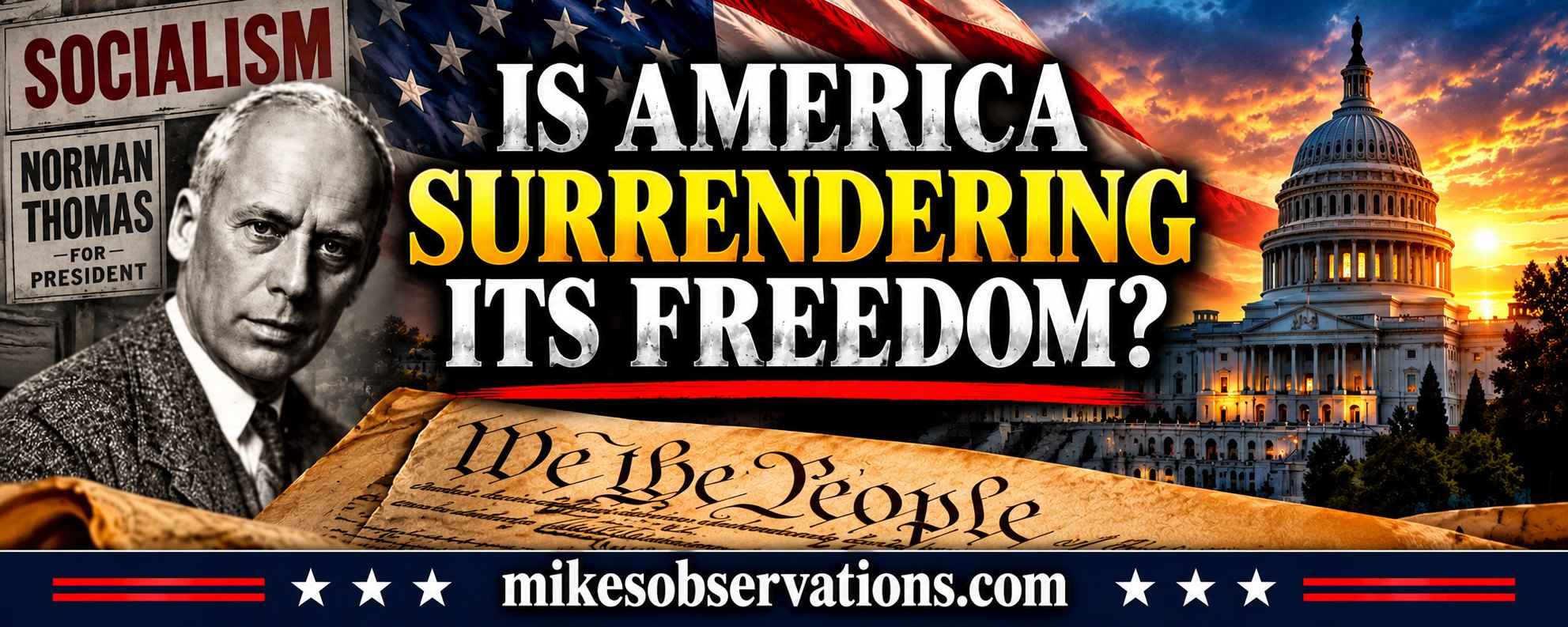
I recently came across a Facebook post featuring Norman Thomas, a man who ran for president six times on the Socialist Party ticket.
The post attributed a remarkable prediction to Thomas. It suggested that Americans would never knowingly embrace socialism, but that socialist policies could gradually become accepted under the banner of liberalism.
Another statement attributed to him claimed that the Democratic Party had adopted the Socialist Party's platform.
Now, before we go any further, there is something important I want to make clear.
Although these quotations have circulated for years, their authenticity has not been reliably established. I don't believe we should build an argument on words that may never have been spoken.
But the controversy raises a question that deserves serious consideration.
Could America gradually become something entirely different from the republic our Founding Fathers envisioned, without the American people ever consciously choosing that destination?
I've Watched America Change for Eight Decades
At 82 years old, I have witnessed changes that would have seemed almost unimaginable when I was growing up.
I remember an America where families depended heavily upon themselves, their neighbors, their churches, and their communities.
Government existed, of course. Social Security was already established before I was born. But government did not occupy nearly as much of our daily conversation as it does today.
People worked, saved, struggled, and sometimes failed.
Neighbors helped neighbors.
Churches cared for families.
And most people understood that freedom came with responsibility.
Today, we live in a country where government influences almost every aspect of our lives.
Our healthcare, retirement, education, agriculture, energy production, housing, and countless other activities are affected by federal regulations, spending, or assistance programs.
Some of these programs have accomplished genuine good.
Others deserve serious scrutiny.
But there is a fundamental question we should never stop asking:
At what point does government assistance become government dependency?
Socialism, Liberalism, and the American Republic
First, we need to understand what socialism actually means.
Traditionally, socialism involves social or public ownership or control of major productive resources and economic activity.
That is not the same thing as every government benefit, public school, or taxpayer-funded program.
America has always had a mixed economy, combining private enterprise with public institutions and government regulation.
The real debate is not whether government should exist or provide services.
It is how much power government should exercise, what responsibilities individuals should retain, and whether citizens can hold their government accountable.
I believe private enterprise, property rights, individual initiative, and constitutional limitations on government have been essential to America's success.
But I also believe arguments about those principles must be based on facts rather than slogans.
The Danger of Becoming Dependent
One of my greatest concerns is not simply how much money Washington spends.
It is what happens when Americans begin believing that government is responsible for solving every problem in their lives.
When government becomes the first answer to every difficulty, personal responsibility can become an afterthought.
But there is another side to that argument.
A widow receiving Social Security is not surrendering her freedom.
A disabled Marine receiving earned benefits is not embracing socialism.
A struggling family receiving temporary assistance is not necessarily becoming dependent.
The important distinction is whether our policies help people regain independence or create conditions that make independence increasingly difficult.
Government should serve the people. The people should never exist merely to serve the government.
When Did Washington Become So Powerful?
The federal government's role expanded significantly during the twentieth century.
The New Deal introduced major economic and social programs during the Great Depression.
The Great Society expanded federal involvement in healthcare, education, and poverty programs.
Subsequent administrations of both political parties continued to expand federal responsibilities in different ways.
Republicans and Democrats have both supported major spending initiatives, regulations, and federal interventions.
That is why I believe this question goes beyond party politics.
We cannot condemn government expansion when the opposing party is in power and ignore it when our own party controls Washington.
Principles should not change depending upon who occupies the White House.
Freedom Can Be Lost Gradually
We often imagine that freedom disappears suddenly.
A dictator takes power. Soldiers occupy the streets. The Constitution is abolished.
But democratic institutions can also weaken gradually.
Government agencies can become less accountable.
Citizens can become less informed.
Emergency powers can become permanent.
Political leaders can begin treating constitutional limitations as inconveniences.
And ordinary Americans can become so distracted by everyday life that they stop paying attention.
However, we must also recognize that not every new law or government program represents an attack on liberty.
The proper question is whether a policy protects constitutional rights, respects democratic accountability, and genuinely serves the public interest.
Freedom requires vigilance, not fear of every change.
The Constitution Still Matters
When I became a United States Marine in 1962, I took an oath to support and defend the Constitution.
That oath meant something to me then.
It still means something today.
Our Constitution establishes a government with limited and divided powers, protections for individual rights, and mechanisms for holding public officials accountable.
Those principles should matter to every American, regardless of political affiliation.
The Constitution does not belong to Republicans.
It does not belong to Democrats.
It belongs to the American people.
And if we stop understanding it, defending it, and demanding that our leaders respect it, we risk losing the very foundation of our republic.
Are We Asking the Right Questions?
Instead of simply accusing one another of being socialists, fascists, radicals, or extremists, perhaps Americans should start asking more meaningful questions.
Does this policy strengthen individual opportunity?
Does it protect constitutional freedoms?
Does it encourage responsibility and independence?
Can taxpayers afford it?
Does it concentrate too much power in government?
And perhaps most importantly:
Will the next generation inherit more freedom and opportunity than we enjoyed, or less?
Those questions deserve answers from both political parties.
My 82nd-Year Lesson
After eight decades of watching this country change, I have learned something important.
A nation does not have to announce that it is changing direction for that change to occur.
Sometimes the transformation happens through thousands of decisions made over generations.
But I have also learned that fear and misinformation are poor substitutes for understanding history.
Norman Thomas really did advocate socialism.
Whether he ever made the famous prediction attributed to him is another matter.
We don't need an unverified quotation to examine the direction of our country.
We need informed citizens who understand the Constitution, question government power, recognize legitimate public needs, and refuse to surrender their responsibility to think independently.
The greatest danger to American freedom may not be a particular political label. It may be a population that stops paying attention to how it is governed.
My Question to America
Are we gradually surrendering too much responsibility and authority to Washington?
Or are we simply watching government adapt to the demands of a changing society?
Perhaps the answer includes elements of both.
But I want to hear what you think.
Has America moved too far toward government control, or are warnings about socialism being exaggerated for political purposes?
Leave your thoughts in the comments at mikesobservations.com.
Let's have a serious conversation about America's future.
Michael Cunningham Sr.
82 Years — 82 Lessons
mikesobservations.com