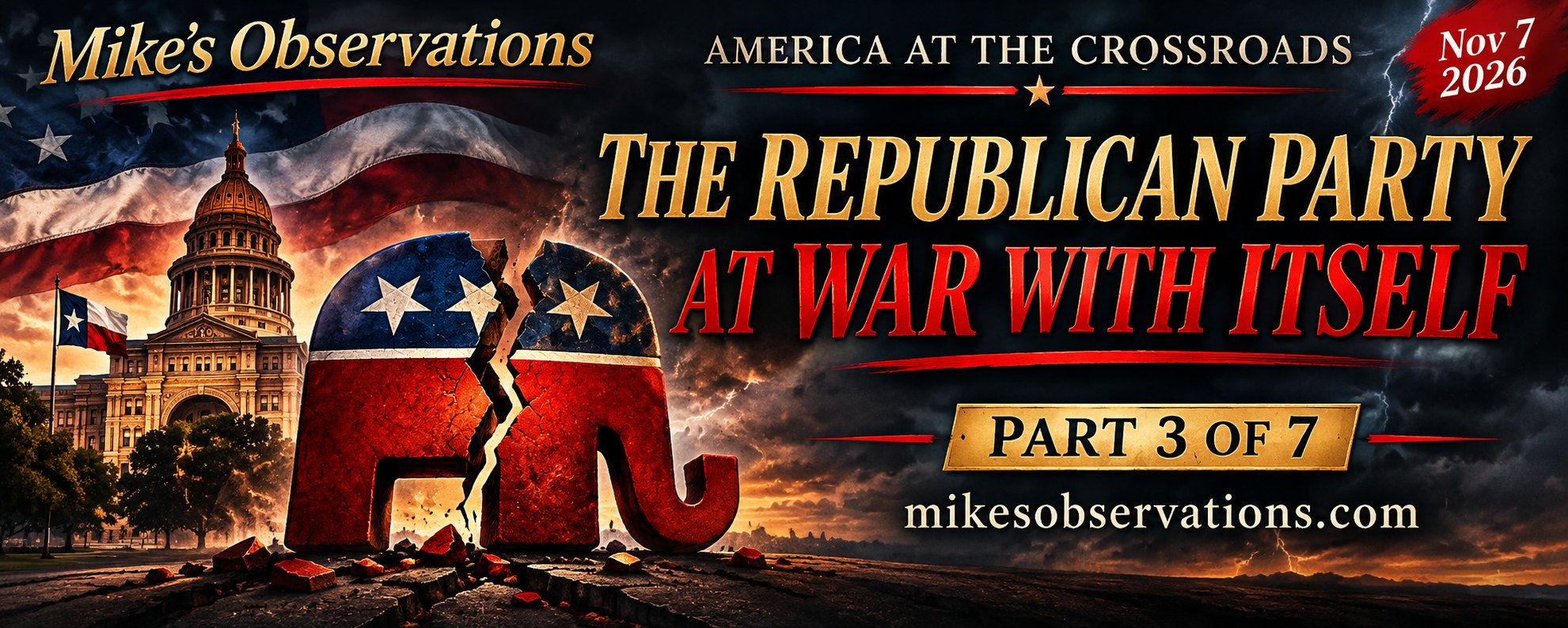
Texas Election Shock: What Republicans Must Learn Before 2028
Today's investigative blog
By Michael Cunningham Sr. | Mike's Observations | Part 1 of 7
The Political Earthquake: What Texas and America Just Told Republicans
The following is conservative editorial analysis based on the November 3 election results.
Something happened in America Tuesday night that Republicans cannot afford to ignore.
And nowhere was the political earthquake more powerful than right here in Texas.
For decades, Texas has been considered one of the Republican Party's strongest fortresses. Conservative candidates could count on the Lone Star State. Republican leadership was practically a fixture in Austin.
Then came November 3, 2026.
Democrat James Talarico defeated Republican Ken Paxton in the U.S. Senate race. Gina Hinojosa defeated Governor Greg Abbott. Democrats also captured the Texas House, ending more than two decades of Republican control.
Fox News+2
Across the nation, Democrats won control of both chambers of Congress.
The Guardian+1
This was not an ordinary election.
It was a warning.
1. Texas didn't just stumble. It changed direction.
Consider the Senate race.
James Talarico (D)
55.1%
Projected winner
Ken Paxton (R)
43.0%
Republican candidate
Associated Press results reported by Fox News, November 4, with approximately 99% reporting.
Fox News Texas Elections
That is not a narrow defeat. It is a substantial rejection of the Republican candidate.
Republicans must ask themselves an uncomfortable question: Did Texas voters reject conservative principles, or did they reject the candidates and leadership representing those principles?
Those are two very different things.
And until Republican leadership understands the difference, it risks repeating the same mistakes.
2. Was the Republican Party listening?
Americans are worried about everyday life.
They are concerned about grocery prices, energy costs, housing, healthcare, and whether their children will enjoy the same opportunities their parents did.
The Associated Press reports that affordability and other household concerns are expected to shape the priorities of newly elected Democratic state governments.
AP News
Republicans cannot assume that voters will overlook economic frustration simply because they agree with the party on immigration, religious liberty, or traditional values.
Political loyalty has limits.
When families are struggling to make ends meet, they want more than speeches and promises.
They want results.
And that applies to Republicans just as much as Democrats.
3. The Ken Paxton question
Republicans should examine whether nominating Ken Paxton helped cost them a Senate seat.
Paxton entered the race with a history of political controversy. His supporters saw him as a fighter against Washington and the political establishment. His critics questioned his judgment and suitability for higher office.
But Tuesday's results raise a larger issue.
Is being a fighter enough to win a general election?
Conservatives need candidates who will defend their principles. But they also need candidates who can earn the confidence of independent voters and Republicans who have become disillusioned.
Winning a Republican primary and winning a statewide general election are not the same thing.
That lesson may have cost the party dearly.
4. What about President Trump?
President Donald Trump remains a central figure in American politics.
His supporters credit him with challenging the Washington establishment, strengthening border enforcement, and confronting problems they believe career politicians ignored.
His critics point to the Iran war, economic pressures, and his confrontational political style.
The Washington Post identified voter dissatisfaction with Trump, the war with Iran, and high gasoline prices as important factors in the Democrats' Senate victories.
The Washington Post
Republicans now face a difficult balancing act.
They must decide how to support policies they believe are right while recognizing that presidential popularity cannot substitute for effective local candidates, practical economic solutions, and public trust.
Supporting a president does not mean abandoning independent judgment.
A political party should be larger than any one individual.
5. Does this mean Texas is turning blue permanently?
Not necessarily.
One election cannot tell us what will happen in every future election.
But dismissing these results as a temporary accident would be foolish.
Democrats didn't merely win a competitive congressional district or a handful of local offices. They captured major statewide positions and the Texas House.
That represents a genuine change in political power.
Republicans must study where their votes declined, where Democrats gained ground, and which groups of voters changed their minds.
They also need to determine whether this was primarily a vote for Democratic policies or a protest against Republican leadership.
Those questions require evidence, not excuses.
6. Is America moving toward socialism?
This is one of the questions troubling many conservatives, including this writer.
But we need to be careful with our terminology.
Democratic Party victories do not automatically mean America has voted for socialism. The Democratic coalition includes moderates, progressives, and democratic socialists with differing economic and political beliefs.
The more important question is what the new congressional and state majorities actually intend to do.
Will they expand government programs? Raise taxes? Increase regulation? Pursue policies that reduce individual choice or increase dependence on government?
Or will they focus on practical compromises addressing affordability, healthcare, and public services?
We should judge proposals by what they contain and what they accomplish, not simply by the party label attached to them.
That is precisely what this investigative series intends to examine.
7. The danger of endless political warfare
There is another warning hidden in these election results.
Americans are exhausted by political bickering.
Republicans and Democrats have spent years attacking each other, often treating political opponents as enemies rather than fellow citizens.
But the country still needs to function.
Congress must pass budgets. Families need economic stability. Communities need security. Our military needs responsible leadership.
There are serious disagreements between the parties, and those disagreements should not be concealed.
Nevertheless, compromise on legitimate national priorities is not surrender.
It is governing.
The 2028 presidential election is only two years away.
If Republicans and Democrats spend those two years fighting for political advantage while ignoring the concerns of ordinary Americans, both parties could discover that the public's patience has limits.
My observation: America needs leadership, not another shouting match
I've lived through more than eight decades of American history.
I've watched presidents come and go. I've seen wars, recessions, political scandals, national tragedies, and moments when Americans came together despite their differences.
And I have learned something.
America is stronger than any political party.
But America is not indestructible.
We cannot continue down a road where winning the next election matters more than preserving the nation's future.
I remain a conservative. I believe in personal responsibility, limited government, constitutional liberty, strong families, and the principles that helped build this country.
Those convictions have not changed because Republicans lost an election.
But conviction without accountability can become complacency.
Republicans need to examine their failures.
Democrats need to recognize that winning an election is not a blank check.
And both parties need to remember that they serve the American people, not the other way around.
Tuesday's election was not the end of America. But it may have been the beginning of a very different political chapter.
The question now is whether our leaders have the wisdom to recognize it.
Because the dark cloud gathering over America may not be coming from the left or the right alone.
It may be coming from a political system that has forgotten whom it was created to serve.
— Michael Cunningham Sr.
Mike's Observations | mikesobservations.com
Tomorrow — Part 2
“Is Socialism Coming to America? Separating Political Fear from Political Reality.”