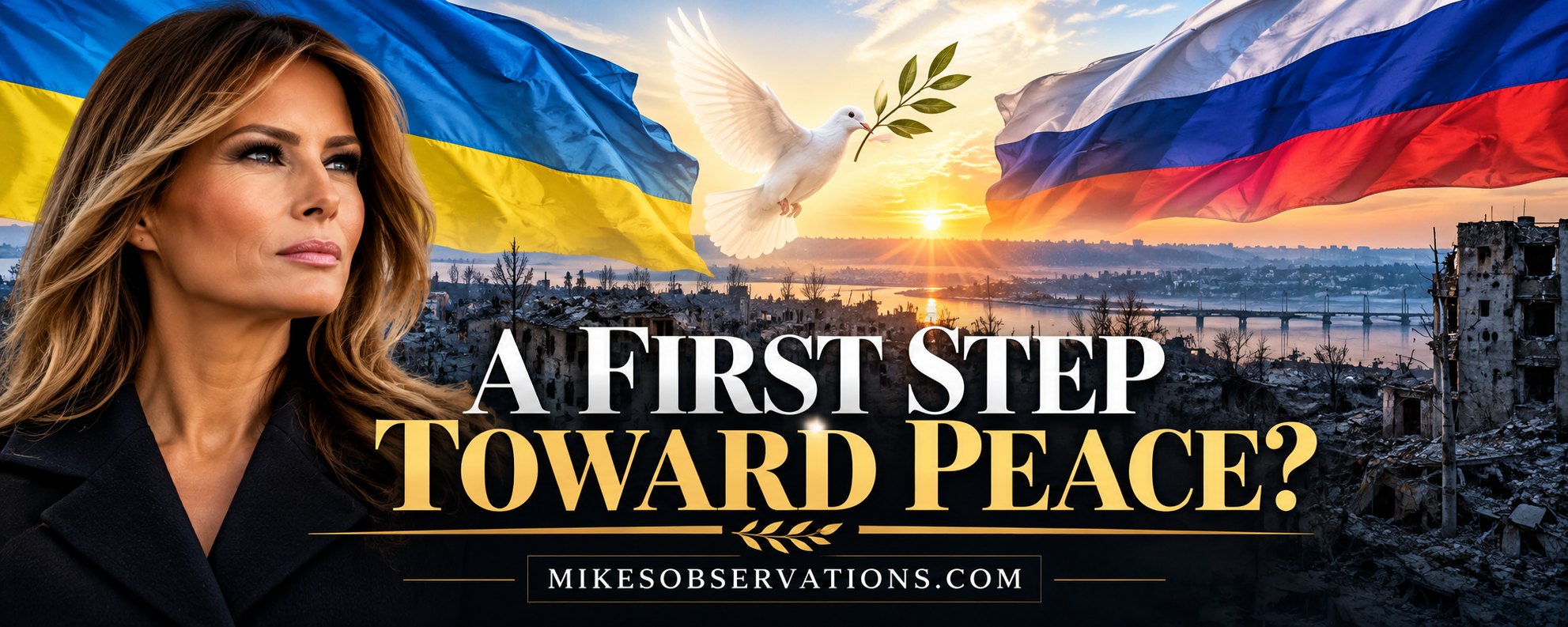
Melania Trump Helps Broker a Ceasefire in Ukraine — Could This Be the First Step Toward Peace?
By Mike Cunningham | October 26, 2026
Sometimes the most important victories aren't won on the battlefield. They're won when someone finds a way to stop the shooting.
For more than four and a half years, the world has watched Russia and Ukraine wage a terrible war. Cities have been destroyed, families separated, soldiers killed, and innocent civilians caught in the middle of a conflict that seems to have no end.
And now, something encouraging has happened.
On October 23, 2026, the White House announced that First Lady Melania Trump helped secure a temporary ceasefire between Russia and Ukraine in the Russian-occupied Ukrainian town of Oleshky.
This was not simply an American announcement. Officials from both Russia and Ukraine confirmed the agreement and acknowledged the First Lady's involvement.
No, the war is not over. But for the people trapped in this devastated town, even a few days without gunfire could mean the difference between life and death.
A Town Desperate for Help
Before Russia's full-scale invasion in February 2022, approximately 24,000 people lived in Oleshky, located in southern Ukraine across the Dnipro River from Kherson.
Today, according to White House estimates, only 1,700 to 2,000 remain, including approximately 50 children.
Many are elderly. Some are unable to leave. Food, medicine, clean water, and electricity have become desperately scarce.
These are not military objectives. These are human beings trying to survive.
The agreement calls for a temporary suspension of fighting so humanitarian workers can deliver supplies, clear dangerous routes, and help residents who wish to evacuate.
Russian and Ukrainian military officials have announced plans for the ceasefire to begin October 27, although the White House initially announced October 29.
The real test will be whether both sides honor their commitments and civilians receive the assistance they desperately need.
An Unexpected Diplomatic Role for America's First Lady
Melania Trump has generally maintained a different public profile from many political figures in Washington.
But behind the scenes, she has been involved in efforts to reunite children separated from their families by the war.
According to the White House, communication channels established during six earlier reunification efforts involving 34 children helped make these latest negotiations possible.
When the humanitarian crisis in Oleshky came to her attention, she and her representative worked with Russian and Ukrainian officials to coordinate the terms of a temporary ceasefire.
The Kremlin publicly praised her contribution. Ukrainian officials also acknowledged her involvement.
Pope Leo played a role in encouraging humanitarian cooperation.
That matters.
Diplomacy doesn't always come from generals, presidents, or foreign ministers. Sometimes progress begins with people willing to address a humanitarian problem that others have been unable to resolve.
Melania Trump deserves recognition for her documented role in bringing the parties together.
And everyone who helped make this agreement possible deserves thanks.
But Let's Not Confuse a Ceasefire With Peace
I believe it is important to give credit where credit is due. It is equally important to tell the whole truth.
This agreement applies to a limited area of Ukraine. It does not end the war. It does not settle territorial disputes, establish security guarantees, or resolve the profound disagreements between Moscow and Kyiv.
Russia invaded Ukraine. Ukraine has fought to defend its territory and independence. Any lasting settlement will have to confront those realities.
There are difficult questions about borders, sovereignty, security, and what guarantees could prevent another war.
Those problems will not disappear simply because the guns fall silent in one town.
But every meaningful peace process has to begin somewhere.
How Many More Must Die?
I served in the United States Marine Corps during the Cold War. I remember the Cuban Missile Crisis and what it felt like when the possibility of a much larger conflict was very real.
I also learned something about military service that has stayed with me for more than sixty years.
War is not a television program. It is not a political slogan. It is not something to celebrate from the comfort of a living room.
It is young men who may never come home.
It is wives who become widows.
It is children who grow up without fathers.
It is elderly people who spend their final years frightened, hungry, and wondering whether tomorrow will come.
And it is families on both sides who will carry the scars long after the fighting stops.
How many more lives must be lost before diplomacy succeeds?
How many more communities must be reduced to rubble?
And how many more generations will inherit hatred from a war they never wanted?
Can This Become Something Bigger?
There is another encouraging development.
Russia, Ukraine, and the United States are preparing for additional technical-level peace discussions in November, according to statements reported by Reuters.
Those negotiations will face enormous obstacles. Previous rounds have failed to produce a lasting settlement.
Still, the Oleshky agreement demonstrates that even bitter enemies can reach a limited arrangement when they recognize a shared humanitarian need.
Could that cooperation expand?
Could one humanitarian corridor become several?
Could a temporary ceasefire eventually lead to wider negotiations?
Nobody can promise that. But it is a possibility worth pursuing.
The objective should not be peace at any price, nor a temporary pause that merely allows another round of destruction.
It should be a durable agreement that protects civilians, respects legitimate security concerns, and offers people a future without constant fear.
My Observation After 82 Years
I have lived long enough to see wars begin with tremendous confidence and end with terrible regret.
I have watched political leaders make promises while ordinary families paid the price.
And I have learned that there is a world of difference between winning an argument and saving a human life.
I applaud Melania Trump's efforts to help the civilians of Oleshky. I applaud the humanitarian involvement of Pope Leo. And I hope Russian, Ukrainian, and American leaders will build upon whatever cooperation this agreement makes possible.
But I want to see more than a few days of silence in one town.
I want to see serious negotiations.
I want to see prisoners reunited with their families.
I want to see children returned home.
And above all, I want to see an end to the killing.
Scripture tells us in Matthew 5:9:
"Blessed are the peacemakers: for they shall be called the children of God." — KJV
That is a message the entire world could stand to remember.
Let us pray that this small agreement becomes the beginning of something far greater.
Because after four and a half years of war, surely it is time for diplomacy to accomplish what bullets and bombs never can: give families the chance to live in peace.
— Mike Cunningham
Eight Decades of Faith · Service · Adventure · A Life Well Lived
mikesobservations.com