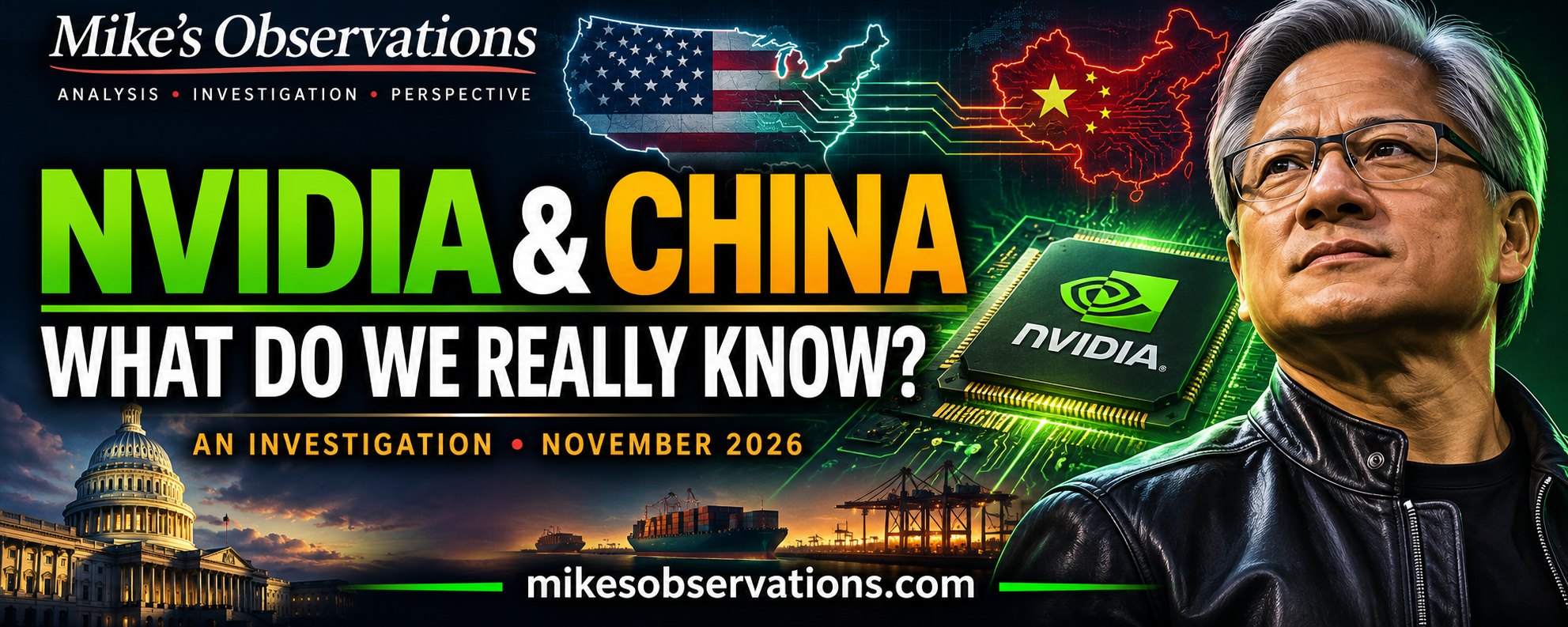
Nvidia, China, and the Billion-Dollar Question: Were America's AI Secrets Compromised?
A Mike's Observations Special Investigative Report — Part 1
By Michael Cunningham Sr. | November 13, 2026
One of the most influential men in American technology has stepped down from the company he helped build into an artificial intelligence powerhouse.
But Jensen Huang's resignation from Nvidia raises questions far beyond the future of one company.
It raises questions about American national security, our technological competition with China, the movement of advanced computer chips across international borders, and whether sensitive information may have fallen into the wrong hands.
Did American technology reach China in violation of our laws? Did an alleged foreign intelligence operation compromise Nvidia? And what, if anything, did Jensen Huang know?
These are serious questions.
But before we begin, let me make one thing perfectly clear: There has been no publicly established finding that Jensen Huang knowingly leaked American secrets, sold restricted technology illegally, or participated in espionage.
An investigation must establish the facts, not manufacture a conclusion.
The Man Who Helped Build the AI Revolution
In 1993, Jensen Huang helped establish Nvidia, a company that would eventually transform how computers process information.
Originally associated with computer graphics, Nvidia expanded into scientific computing and ultimately became a dominant supplier of the powerful processors that drive today's artificial intelligence systems.
Huang recognized opportunities in specialized computing long before AI became a household term.
His leadership helped position Nvidia at the center of a technological revolution that now touches medicine, national defense, manufacturing, communications, scientific research, and nearly every segment of the modern economy.
That makes his sudden resignation particularly significant.
On November 12, 2026, Nvidia formally announced that Huang had resigned as president, chief executive officer, and board member. Chief Financial Officer Colette Kress was appointed interim CEO.
But his departure came amid allegations that demand much closer examination.
The Alleged Chinese Intelligence Connection
Recent reporting has focused on Huang's personal relationship with Alice Huang, a former executive associated with Singapore-based technology company Megaspeed International. The two are not related.
American intelligence officials reportedly suspected Alice Huang of having connections to Chinese intelligence.
China has denied the espionage allegations.
On November 12, Attorney General Todd Blanche made an important clarification: the Justice Department had not reached a conclusion about whether Alice Huang was a Chinese spy. The FBI was examining the matter.
That distinction matters.
A suspicion by intelligence authorities is serious enough to justify investigation, particularly when a leading American technology executive may have been involved.
However, suspicion alone does not prove espionage.
The critical issue is whether any sensitive business information, technical information, or protected American technology was actually obtained or transferred.
We need evidence of what happened—not merely speculation about what could have happened.
The Chip Sales That Raise Additional Questions
Separate from the alleged intelligence connection is another troubling issue: whether advanced American AI chips have been diverted to China despite export restrictions.
Megaspeed International, an Nvidia customer, has come under scrutiny over possible export-control violations.
The company says it takes its legal obligations seriously, has cooperated with U.S. inspections, and has engaged independent legal assistance to review its chip inventory and compliance procedures.
Singapore and Malaysia have also examined transactions involving the company and related operations.
There is an important difference between an investigation into suspicious transactions and a finding that the company actually broke the law.
However, the broader issue is substantial.
On November 13, Reuters reported identifying Chinese AI computing projects and equipment agreements valued at approximately $3.2 billion that involved restricted Nvidia processors.
That figure includes planned investments, contracts, facilities, and supporting infrastructure—not simply the purchase price of semiconductor chips.
Reuters did not establish that those projects were connected to Megaspeed or Jensen Huang.
Nevertheless, its findings illustrate an important challenge.
It is one thing to restrict the sale of advanced processors. It is another to determine where those processors ultimately go and who uses their computing power.
That is where an investigation into international technology transfers becomes essential.
Did Jensen Huang Compromise American Technology?
This is the question many Americans will naturally ask.
At present, publicly available evidence does not establish that Huang knowingly gave confidential information to Chinese intelligence or deliberately participated in illegal chip transfers.
Nvidia's board announced an independent investigation on November 8.
At that time, the company stated that it had no reason to believe Nvidia secrets or American national security had been compromised.
On November 10, the independent directors announced that former federal prosecutor Joon H. Kim and the law firm Wachtell, Lipton, Rosen & Katz had been retained to investigate.
Those actions demonstrate that the company considers the allegations serious.
But an investigation is not proof of wrongdoing.
In addition, we should distinguish between three possible issues:
These involve different transactions, different legal questions, and potentially different parties.
Finding a violation in one area would not automatically prove a violation in another.
Congress Wants Answers
Members of Congress have begun pressing Nvidia and federal officials for information.
On November 5, Republican committee chairmen Brian Mast, John Moolenaar, and Rick Crawford requested that Huang provide a closed-door briefing about his reported interactions with Alice Huang and Nvidia's protection against foreign espionage.
On November 12, the chairmen issued additional requests seeking information from Huang, Nvidia's general counsel, and a senior Commerce Department official.
The original request proposed November 18 for the briefing.
This is an important development because congressional oversight may help clarify what company officials and government regulators knew, what protective measures were in place, and whether additional action is necessary.
The investigation should also examine whether American export-control policies were consistently enforced.
Technology companies have commercial incentives to reach large international markets.
Federal officials have a responsibility to protect national-security interests.
Those interests can conflict, and the public deserves to know how difficult decisions were made.
Why This Matters Beyond Nvidia
Artificial intelligence is no longer merely a commercial convenience.
Advanced computing can contribute to scientific breakthroughs, industrial productivity, cyber operations, intelligence analysis, and military capabilities.
The countries that develop and control the most sophisticated systems may gain important economic and strategic advantages.
That is why the protection of advanced American technology matters.
It is also why this investigation must be conducted carefully.
If restricted technology was deliberately transferred in violation of the law, there should be accountability.
If national-security safeguards proved inadequate, those weaknesses should be corrected.
If individuals or companies are cleared of allegations, that conclusion should receive just as much attention as the original accusations.
America cannot protect its technological future by ignoring credible security concerns.
Neither can it protect that future by allowing rumors to substitute for evidence.
What Happens to Nvidia Without Huang?
There is another issue worth watching.
Huang was more than a corporate executive. He helped shape Nvidia's strategy throughout the development of modern AI computing.
His departure raises legitimate questions about the company's long-term leadership.
Nvidia has an established engineering organization, experienced executives, and a multiyear product roadmap. Its board says it expects the business and development plans to continue without interruption.
Still, replacing a founder who spent more than three decades building a company is no ordinary leadership transition.
A disruption in Nvidia's technological development could affect businesses, researchers, and government agencies that depend on its computing platforms.
Whether such disruption actually occurs remains to be seen.
Five Questions That Must Be Answered
Before this controversy can be considered settled, Americans deserve answers to five fundamental questions.
First: Did any confidential American technical information reach Chinese intelligence or other unauthorized recipients?
Second: Where did the advanced Nvidia processors sold through international customers ultimately go, and who controlled their use?
Third: What did Huang and other Nvidia executives know about potential security concerns, and when did they learn it?
Fourth: Did American government agencies have information that warranted stronger export-control enforcement?
Fifth: What changes, if any, are necessary to prevent future failures while preserving legitimate American technological innovation?
These questions can be investigated without assuming anyone's guilt.
Mike's Observations: Follow the Evidence
I believe America has every right to protect the technological advantages its scientists, engineers, and entrepreneurs have worked decades to develop.
I also believe that anyone entrusted with protecting sensitive technology must be held accountable for their decisions.
But accountability requires evidence.
We should not condemn Jensen Huang based on an allegation that has not been proved. Nor should we dismiss national-security concerns simply because he helped build a remarkable American company.
Neither wealth nor reputation should place anyone above investigation.
And neither public suspicion nor political pressure should replace due process.
Follow the chips. Follow the money. Follow the communications. Follow the decisions.
Then let the evidence tell us what happened.
The American people deserve no less.
This Investigation Continues
This report represents what could be established from publicly available information as of November 13, 2026.
Our follow-up will compare today's findings with new government statements, corporate disclosures, congressional proceedings, and reporting on the chip investigations.
If new evidence supports serious wrongdoing, we should report it.
If the allegations are disproved or remain unsubstantiated, we should report that with equal clarity.
Because the purpose of this investigation is not to prove our suspicions correct.
It is to discover the truth.
Michael Cunningham Sr.
Mike's Observations
mikesobservations.com