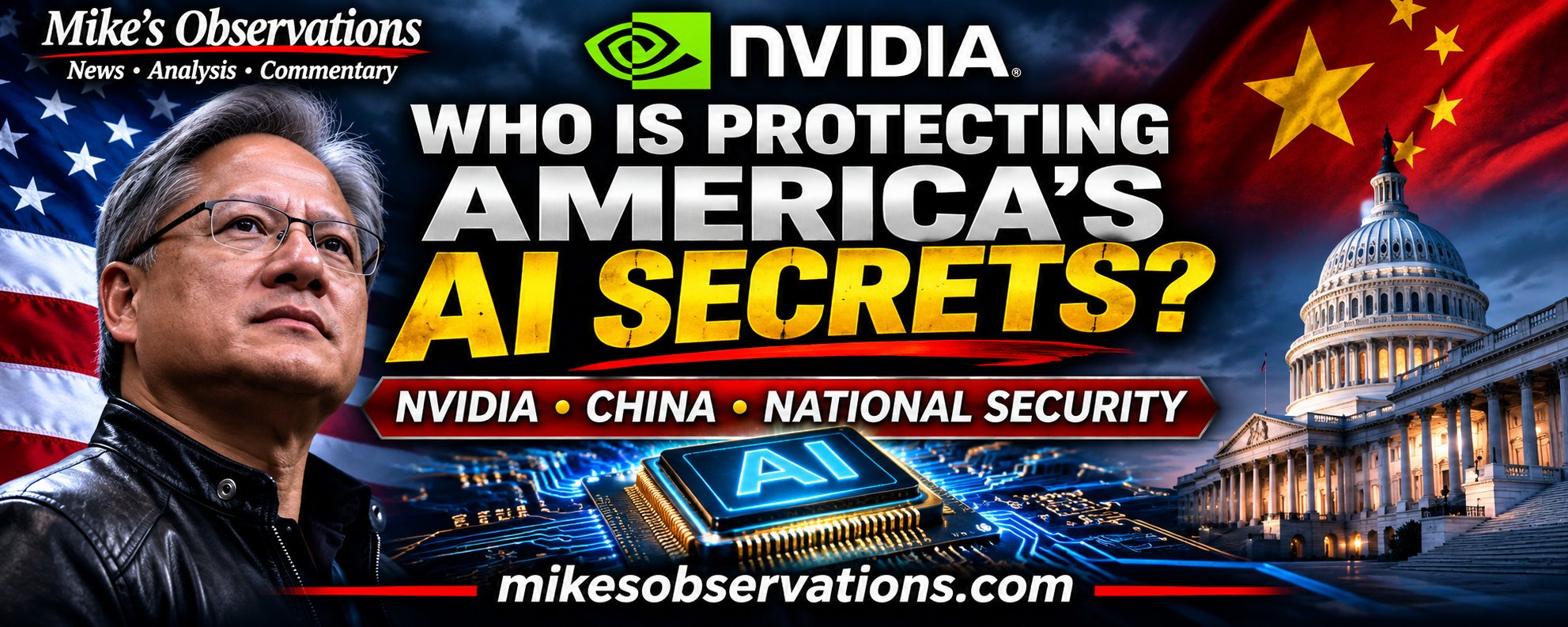
Who Is Protecting America's AI Secrets?
By Michael Cunningham Sr. | Mike's Observations | November 11, 2026
What happens when the man leading one of America's most important technology companies becomes entangled in allegations involving Chinese intelligence?
That is no longer a hypothetical question.
Nvidia, the American technology giant whose advanced computer chips help power the artificial intelligence revolution, is facing a crisis that reaches far beyond Wall Street.
Its longtime CEO, Jensen Huang, is under scrutiny following reports of a personal relationship with a woman suspected of having connections to Chinese intelligence.
Now Congress wants answers.
And the American people should want answers, too.
This Is Bigger Than a Corporate Scandal
Let's get something straight.
I'm not particularly interested in turning somebody's personal mistakes into public entertainment.
But when those mistakes potentially expose American technology to a foreign adversary, the situation changes.
Nvidia produces some of the world's most important artificial intelligence processors. Those chips help power everything from medical research to sophisticated computing systems.
The same technology also has potential military and intelligence applications.
China understands that.
So does Washington.
And that is why these allegations deserve serious investigation.
What We Know
Nvidia has launched an independent investigation into whether its chief executive was targeted by a foreign intelligence operation.
Huang has acknowledged marital infidelity. However, the espionage allegations remain under investigation, and there has been no established public finding that he knowingly assisted Chinese intelligence or disclosed protected technology.
On November 11, Reuters reported that Nvidia's board was meeting to consider Huang's future.
Meanwhile, lawmakers are demanding answers about the company's handling of sensitive technology and its relationships with Chinese businesses.
The distinction between suspicion and proof matters.
But so does the obligation to investigate credible national security concerns.
Congress Is Asking Questions
Republican lawmakers, including House Foreign Affairs Committee Chairman Brian Mast, are pressing Huang to provide information about the allegations.
A congressional subpoena is reportedly under consideration.
Democratic lawmakers have also called for tighter restrictions on advanced chip exports to China.
There is something worth recognizing here.
Protecting American technological leadership should not be a Republican issue or a Democratic issue.
It should be an American issue.
The Bigger Question: Who Controls the Technology?
America has invested enormous resources in becoming a world leader in artificial intelligence.
Private companies have invested billions more.
But what good is technological leadership if we cannot protect the innovations that make it possible?
There are legitimate arguments about how restrictive export controls should be.
American companies need international markets to remain competitive. Excessive restrictions can have economic consequences and may encourage foreign competitors to develop alternatives.
But national security cannot simply be treated as another expense on a corporate balance sheet.
Congress must determine whether existing safeguards are sufficient, whether export rules are being enforced and whether American technology is reaching organizations that threaten our security.
Those questions deserve documented answers, not political theater.
Where Does President Trump Stand?
President Donald Trump has defended Huang against suggestions that he knowingly participated in espionage.
That position does not eliminate the need for an investigation.
A president can believe someone is innocent while still supporting a thorough examination of the facts.
And if protecting American technological leadership is a national priority, accountability must apply regardless of corporate influence or political relationships.
My Observation
I've lived long enough to see America face threats from many directions.
Some came with armies.
Some came with missiles.
And some came through economic competition and intelligence operations.
Today, another battlefield exists inside the computers, data centers and laboratories that will shape tomorrow's world.
We cannot afford to be careless.
I am not suggesting that Jensen Huang is guilty of espionage. That has not been established.
I am suggesting that no corporation, no executive and no political administration should be beyond legitimate scrutiny when America's national security is at stake.
The question isn't simply whether Nvidia's CEO keeps his job.
The question is whether America is doing enough to protect the technology that may determine its future.
And that, my friends, is a question worth asking.
Michael Cunningham Sr. — Mike's Observations
Faith. Experience. Common Sense.
Read more at mikesobservations.com