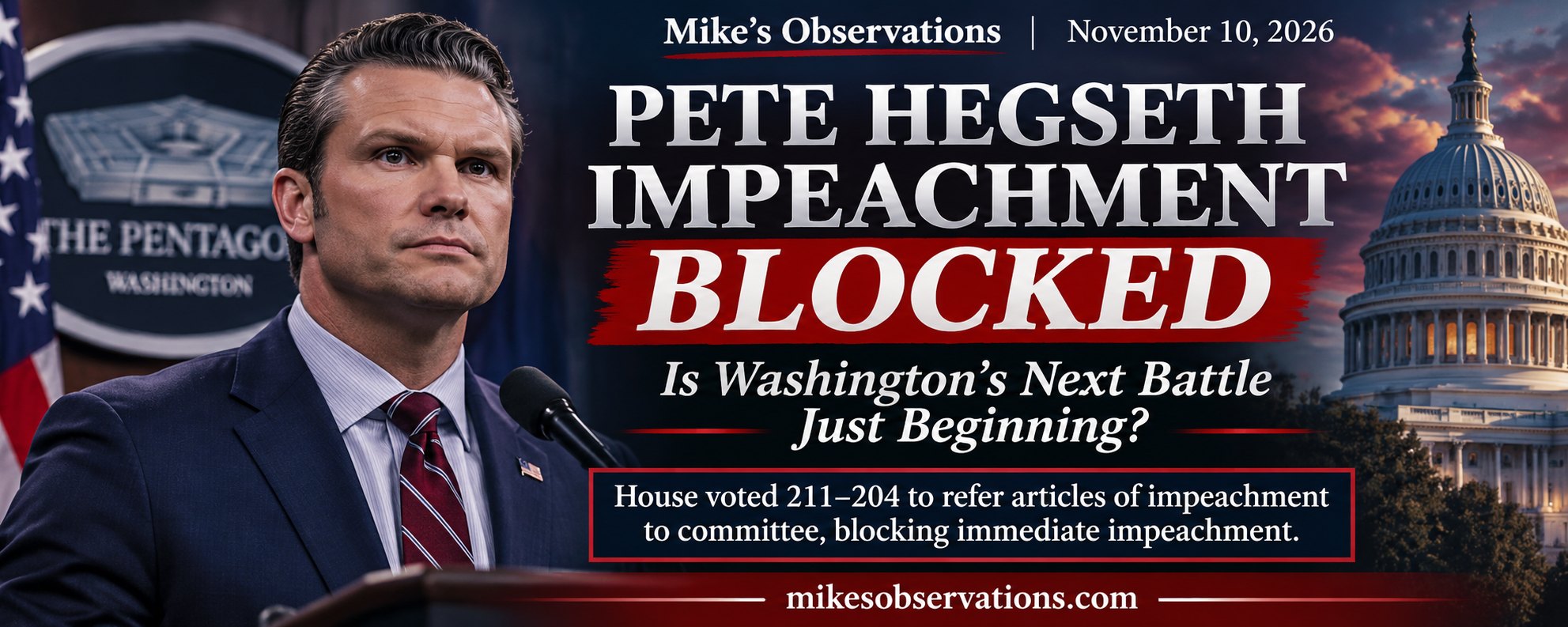
Pete Hegseth Impeachment Blocked: Is Washington's Next Political Battle Just Beginning?
By Michael Cunningham Sr. | Mike's Observations
Washington has just witnessed another political confrontation, and this time the challenge came from within the Republican Party itself.
On November 10, 2026, the United States House of Representatives voted 211–204 to send eight articles of impeachment against Defense Secretary Pete Hegseth to the House Judiciary Committee.
The procedural move effectively stopped the impeachment effort for the remainder of the current Congress.
But it did not settle the larger questions surrounding America's military operations or the constitutional authority to conduct them.
A Republican Challenges a Republican Administration
Representative Thomas Massie of Kentucky introduced the impeachment resolution, accusing Hegseth of violating constitutional and legal limits on military operations.
His allegations concern the war with Iran, military strikes against suspected drug-trafficking vessels, operations involving Venezuela and Yemen, and other actions.
These are serious accusations. But accusations are not convictions, and introducing articles of impeachment does not establish that any law has been broken.
Massie was the only Republican to oppose sending the resolution to committee. The overwhelming majority of his Republican colleagues supported the procedural move that stopped the impeachment effort.
Hegseth Fires Back
Hegseth rejected the accusations at a Pentagon news conference, describing the impeachment effort as political theater rather than legitimate accountability.
The Trump administration also strongly opposed the resolution, arguing that the military operations were lawful and that the impeachment effort threatened national security.
That raises an important distinction.
Disagreeing with a military decision is not automatically evidence of an impeachable offense. At the same time, serving in a presidential administration does not place an official beyond congressional oversight.
Both principles matter.
What Does the Constitution Actually Say?
Article I of the United States Constitution gives Congress the power to declare war.
Article II establishes the president as commander in chief of the armed forces.
For generations, these provisions have generated disputes over when a president may order military action without a formal declaration of war.
The question is not simply whether military operations are successful. It is whether those operations comply with the Constitution and applicable law.
That question deserves a serious examination, regardless of which political party occupies the White House.
Is This About Accountability or Political Warfare?
Americans have watched Washington become increasingly consumed by investigations, accusations, political confrontations, and impeachment proceedings.
Sometimes investigations expose genuine wrongdoing. Sometimes political disputes are pursued through procedures that were intended for extraordinary circumstances.
The challenge is distinguishing one from the other.
The American people deserve evidence, transparency, and constitutional accountability—not political accusations presented as established facts.
And that standard should apply equally to Republicans and Democrats.
What Happens Next?
The November 10 vote effectively stopped the immediate impeachment effort.
But with Democrats preparing to assume control of Congress in January, the possibility of renewed proceedings remains.
The political confrontation may therefore continue long after this particular resolution has been set aside.
One Final Observation
I spent four years serving in the United States Marine Corps, and one lesson stayed with me: accomplishing a mission matters, but so does the responsibility that comes with authority.
The Constitution is not an inconvenience to be set aside when it becomes politically uncomfortable. Neither should impeachment become an ordinary weapon in every disagreement between Washington politicians.
If Pete Hegseth violated the law, the evidence should be examined.
If the accusations cannot be substantiated, Congress should turn its attention to the serious responsibilities entrusted to it.
America needs leadership, constitutional accountability, and a government focused on serving the people.
The question Americans should be asking is not simply whether Pete Hegseth survived an impeachment attempt.
It is whether Washington can still distinguish genuine accountability from political warfare.
Michael Cunningham Sr.
Mike's Observations
mikesobservations.com