82 Years — 82 Lessons
There was a time when nobody had a cell phone.
No smartphone. No texting. No email. No GPS.
And somehow, we managed to get the job done.
Young people today may have a hard time imagining what working in the oilfield was like before
instant communication.
I don't have to imagine it.
I lived it.
During my years in the oilfield, we couldn't simply take a picture of a report and send it to the office.
There was no "Send" button.
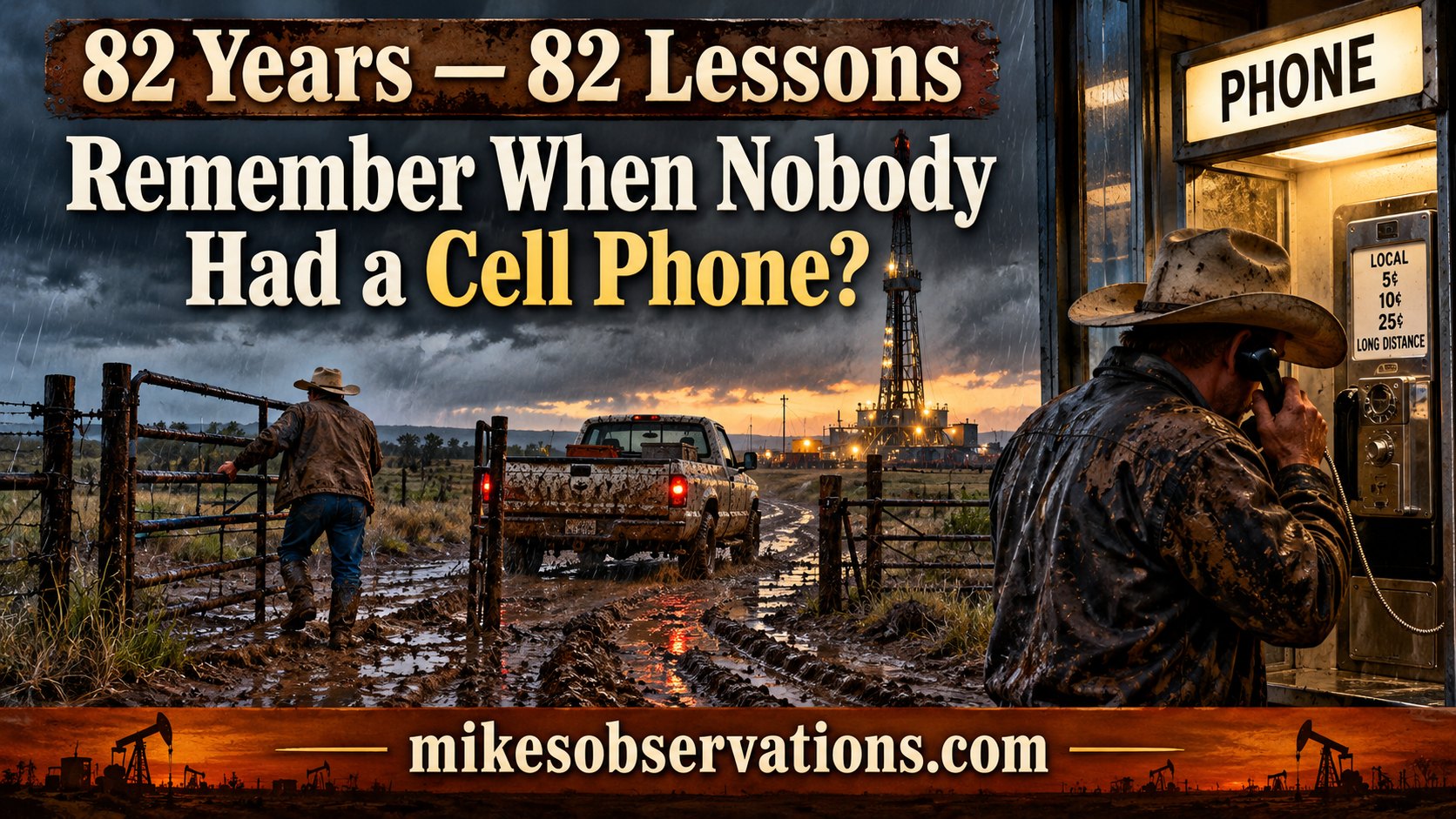
When a report had to go out from a drilling location, somebody had to physically get it to a telephone.
Sometimes that telephone was a long way from the rig.
I remember driving as much as 30 miles from a well location just to send a report.
And 30 miles in the South Texas oilfield wasn't necessarily 30 miles of pavement.
You might have ten gates between the drilling rig and town.
Every gate meant stopping the truck, getting out, opening the gate, driving through, stopping
again, getting back out, closing the gate and climbing back into the truck.
Now imagine doing that ten times.
In pouring rain.
At night.
On muddy South Texas roads.
By the time you reached town, your boots might weigh twice what they did when you left the rig.
Then you had another problem.
You had to find a pay phone.
Remember Pay Phones?
I certainly do.
I remember when a local telephone call cost a nickel.
Five cents.
Later it became a dime.
Then a quarter.
And that was just a local call.
Long distance was another matter entirely.
You watched those minutes because long-distance telephone calls could become expensive in a hurry.
But sending an oilfield report presented another challenge.
We often used what we called flapper text—a portable communications device that needed
access to a telephone connection.
Finding a pay phone wasn't always enough.
You needed one where you could get access to a telephone jack or connection that would let
you transmit the report.
So after driving miles through rain, mud and cattle gates, you might finally reach town and
discover that the telephone you found wouldn't work for what you needed.
Then the search continued.
Today we would consider that ridiculous.
Back then, it was simply part of the job.
There Was No GPS Either
Getting to a drilling location could be an adventure all by itself.
Today you type an address into your phone and a pleasant voice tells you:
"Turn right in 500 feet."
We didn't have that.
Oilfield directions might sound something like:
"Go about twelve miles south of town. Turn right at the old cattle guard. Go past the windmill.
When you see the big oak tree, take the second dirt road. Go through four gates and stay
left at the fork."
Miss the oak tree and you might spend an hour figuring out where you went wrong.
And if you got lost, you couldn't call the drilling rig and ask for directions.
There wasn't a phone in your pocket.
You figured it out.
If Something Broke, You Couldn't Google It
That may be one of the biggest differences between then and now.
Today, when something breaks, we pull out a phone.
Within seconds we can find a manual, watch a video, locate a replacement part or ask somebody
halfway around the world for advice.
Back then, you relied on experience.
You relied on the men around you.
You carried tools, spare parts and whatever knowledge you had accumulated over the years.
Sometimes you improvised.
Sometimes you made do.
And sometimes you spent half the night fixing something because the nearest replacement part
was many miles away.
Communication Wasn't Instant
Today we expect people to answer immediately.
Send a text.
Make a call.
Send an email.
Transmit a photograph.
Share your exact location.
All from a device that fits in your shirt pocket.
We couldn't do any of that.
If the office needed information from a remote well location, somebody might have to climb into a
truck and go find a telephone.
If you were expected home at 6:00 and didn't arrive until 9:00, your family couldn't simply check
your location on a phone.
They waited.
And worried.
There were no text messages saying:
"Running late. Be home soon."
We Had Fewer Conveniences—but We Learned Something
I wouldn't pretend those days were better in every way.
They weren't.
Cell phones have made life safer and communication dramatically easier.
If I had been stuck on some muddy South Texas lease road decades ago, I would have gladly
traded a pocketful of nickels for an iPhone.
But those years taught us something valuable.
We learned to solve problems.
We learned patience.
We learned responsibility.
We learned how to plan ahead.
You couldn't assume help was one telephone call away.
Sometimes you were the help.
And when the job had to be done, you did it.
Rain didn't matter.
Mud didn't matter.
Ten gates didn't matter.
Thirty miles didn't matter.
The report had to get to the office.
So you got in the truck and delivered it.
The Lesson
Technology has made our lives tremendously easier.
I'm thankful for it.
But convenience can sometimes hide how capable human beings really are.
We once traveled across the country without GPS.
We worked remote jobs without cell phones.
We found people without location sharing.
We repaired equipment without YouTube.
And we transmitted important oilfield reports from pay phones after driving miles through mud
just to find one that would work.
We weren't superheroes.
We simply lived in a world where inconvenience was normal.
And maybe that's the lesson.
Convenience is wonderful—but don't let convenience convince you that you can't function without it.
At 82, I've watched the world move from nickel pay phones to smartphones capable of reaching
almost anyone on Earth in seconds.
That's an astonishing amount of change in one lifetime.
And every once in a while, when I pull my phone out of my pocket, I remember those South Texas nights.
The rain.
The mud.
The cattle gates.
The long drive into town.
And the search for a telephone.
Then I think:
We've come a mighty long way.
— Mike Cunningham
82 Years — 82 Lessons