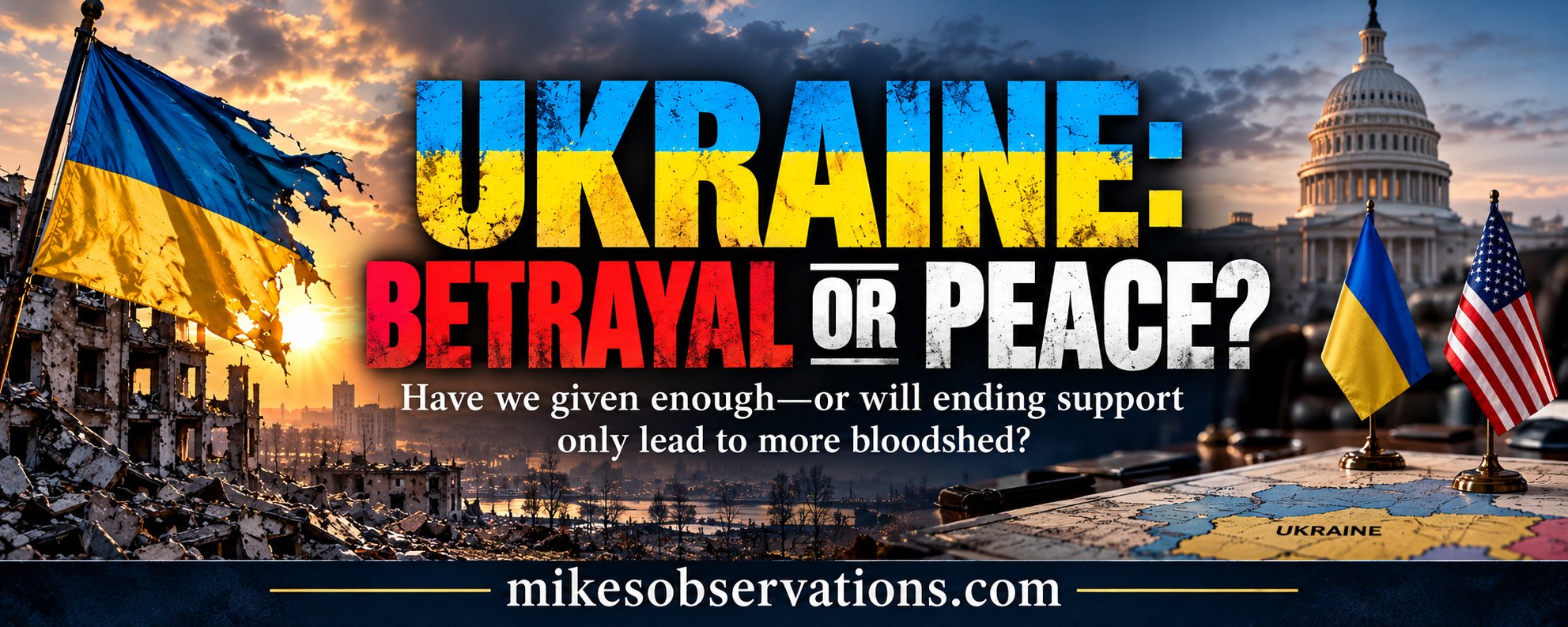
Is America Betraying Ukraine—or Has Enough Blood Already Been Shed?
By Mike Cunningham | Mike's Observations
At what point does helping a nation defend itself become helping prolong a war that is destroying it?
That is a question Americans need to be asking, and it deserves something better than another shouting match between Republicans and Democrats.
For more than four years, the war in Ukraine has consumed lives, destroyed cities, separated families, and placed an enormous financial burden on the nations supporting Ukraine's defense.
Now, as the Trump administration presses for a negotiated settlement, accusations are flying that the White House is betraying Ukraine.
But is it betrayal to demand an end to the killing? Or could withdrawing support before a secure peace is reached leave Ukraine vulnerable to another Russian attack?
Both questions deserve answers.
Let's Remember Who Started This War
Russia launched its full-scale invasion of Ukraine on February 24, 2022.
That fact should never disappear from the discussion.
Ukraine did not invade Russia. Russia invaded Ukraine.
The Ukrainian people have every right to defend their homes, their families, and their independence.
America and its European allies responded with military equipment, financial assistance, humanitarian relief, and economic sanctions against Russia.
Those actions helped Ukraine resist a much larger military power.
But supporting a nation's right to defend itself does not automatically answer how long foreign assistance should continue, what objectives it should serve, or how the war should eventually end.
Those are legitimate questions, not evidence of disloyalty.
How Much Is Enough?
The United States has committed enormous resources to Ukraine.
Americans have every right to ask how their tax dollars are being spent, whether the assistance is accomplishing its intended purpose, and whether European governments should shoulder a greater share of the burden.
But we must distinguish between money appropriated by Congress, equipment transferred from American military inventories, funds spent replenishing those inventories, and money actually delivered to Ukraine.
Those are not interchangeable figures.
The more important question may be this:
What is the achievable objective of continued American involvement?
Is it to help Ukraine survive as an independent nation?
Is it to restore every inch of Ukrainian territory?
Is it to strengthen Ukraine's negotiating position?
Or is it to keep Russia occupied in a costly war indefinitely?
Those objectives are not identical, and Americans deserve to know which one their government is pursuing.
The Human Cost Cannot Be Ignored
While politicians negotiate and television commentators argue, ordinary people continue to die.
The United Nations has documented thousands of civilian deaths and injuries during 2026 alone. The actual human toll is greater when military casualties and cases that cannot be independently verified are considered.
Behind every statistic is a human being.
A father who will never return home.
A mother trying to protect her children.
A young soldier who had plans for a future he will never see.
A family sitting in darkness because another missile destroyed the electrical system.
These are not chess pieces on a geopolitical board.
They are people.
And when we discuss whether to send another billion dollars or another shipment of weapons, we should also discuss what those decisions mean for the people living under bombardment.
At the same time, we cannot simply assume that stopping American assistance would stop the killing.
If Ukraine's defenses collapse while Russia continues its offensive, the humanitarian consequences could become even worse.
That possibility deserves just as much attention.
Is the White House Betraying Ukraine?
President Trump's emphasis on negotiations has produced sharply different reactions.
Critics fear that Washington may pressure Ukraine into accepting territorial losses or security arrangements that leave it exposed to future aggression.
Supporters argue that the administration is challenging the assumption that military assistance alone can produce an acceptable conclusion to the war.
The disagreement is not simply about whether peace is desirable.
Virtually everyone says they want peace.
The disagreement concerns the terms of that peace, the pressure used to achieve it, and whether the resulting agreement can last.
A peace agreement imposed on Ukraine without credible security protections could leave the country facing another invasion.
But an endless military commitment without clear objectives also raises serious questions about accountability, cost, and the human consequences.
Both concerns can be examined without pretending that either one is insignificant.
What Would Real Peace Look Like?
A ceasefire might stop the shooting tomorrow.
That would be welcome news to families who have spent years listening for air raid sirens.
But a ceasefire is not necessarily peace.
Real peace would require serious consideration of Ukraine's independence, its security, the future of occupied territory, enforcement mechanisms, and the consequences if either party violates the agreement.
It would also require confronting the difficult question of whether Russia would honor its commitments.
Ukraine has reasons to be skeptical. Previous agreements and diplomatic efforts did not prevent the full-scale invasion in 2022.
A lasting settlement cannot depend entirely on promises that no one is prepared to enforce.
The objective should not merely be to stop the fighting for six months or a year.
It should be to establish conditions under which another generation of Ukrainians does not have to fight the same war.
Europe Has Responsibilities Too
This conflict is taking place on Europe's doorstep.
European nations have provided substantial assistance to Ukraine, and many have increased defense spending and military production.
Nevertheless, the division of responsibilities between the United States and Europe remains an important issue.
America has commitments and interests around the world. Its resources are not unlimited.
Europe has an especially direct interest in preventing further Russian aggression and maintaining regional security.
Any long-term settlement or defense arrangement should address how those responsibilities will be shared.
That is not an argument for abandoning Ukraine.
It is an argument for clearly defining who is responsible for what.
The Danger of Turning War Into Domestic Politics
One of the most troubling aspects of this debate is how quickly it becomes another American political contest.
If President Trump proposes negotiations, some critics assume he must be surrendering to Russia.
If someone supports continued assistance to Ukraine, opponents sometimes accuse that person of wanting the war to continue.
Neither accusation automatically follows from the position being expressed.
A person can support negotiations without supporting Russian aggression.
A person can support military assistance without wanting another Ukrainian soldier to die.
We should be capable of recognizing both distinctions.
The lives of Ukrainians should not become political ammunition in Washington.
Eight Decades Have Taught Me Something About War
I served in the United States Marine Corps during the Cold War, including the Cuban Missile Crisis.
I remember a time when the possibility of a confrontation between nuclear powers was not an abstract subject.
It was something we lived with.
That experience does not make me an expert on every military or diplomatic question.
But it taught me to take the consequences of armed conflict seriously.
War has a way of creating circumstances that no one anticipated when the first shots were fired.
And once a war begins, finding a way to end it can be far more difficult than anyone imagined.
I respect the courage of people defending their homeland.
I also respect the obligation of national leaders to seek an end to bloodshed without creating an even greater danger.
Those responsibilities should not be treated as mutually exclusive.
My Final Observation
There are questions the White House, Congress, European leaders, and Ukraine's government should be prepared to answer.
What are we trying to accomplish?
What will it cost?
How will we know when that objective has been achieved?
And what happens if the proposed peace fails?
There is no virtue in allowing people to die indefinitely simply because political leaders cannot agree on a strategy.
There is also no lasting benefit in a settlement that rewards aggression and invites another war.
The challenge is to find a peace that is not merely an interruption between battles.
America must be willing to discuss the cost of continuing this war. But it must also confront the cost of ending its support before a durable peace is secured.
And above all, we should never forget the Ukrainian families who must live with the consequences long after the politicians finish their speeches.
Because the ultimate measure of peace is not how quickly an agreement is signed. It is whether the killing stops—and stays stopped.
Mike Cunningham
Mike's Observations