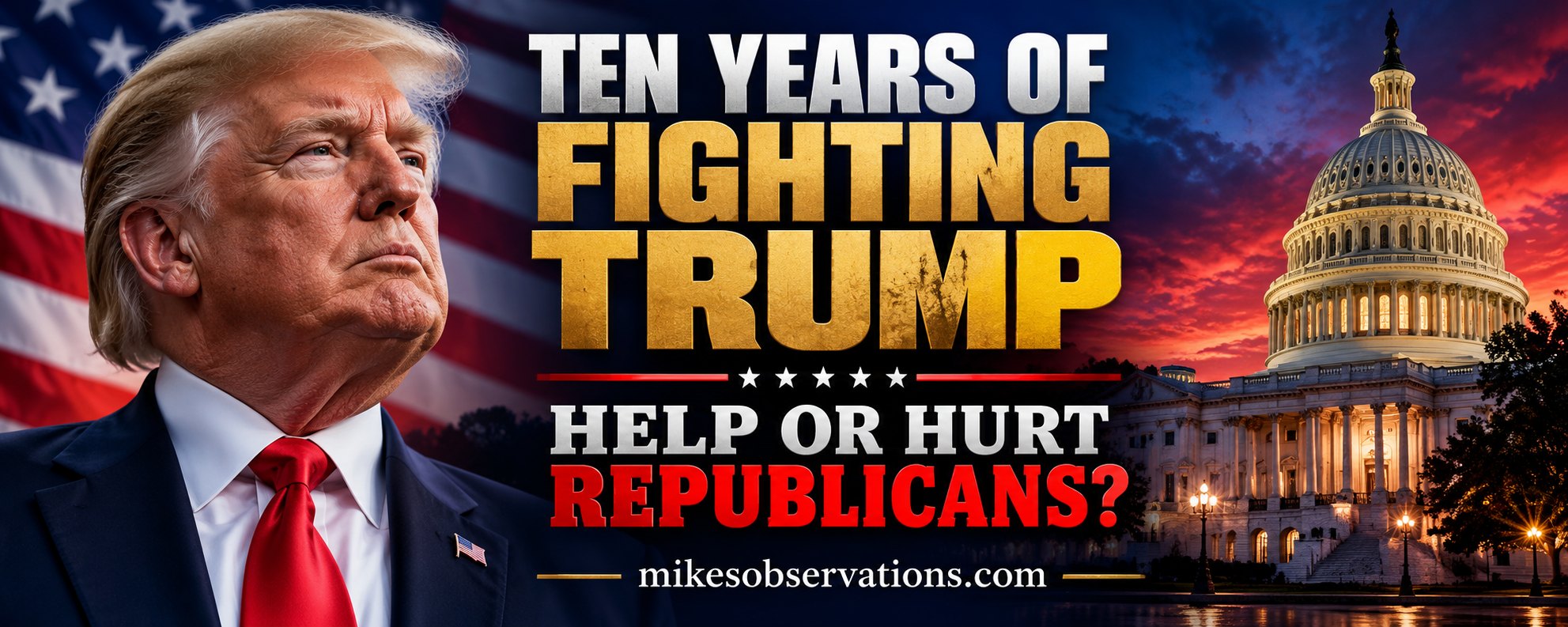
Ten Years of Fighting Trump: Will the Backlash Help or Hurt Republicans in November?
By Mike Cunningham | Mike's Observations | October 25, 2026
On June 16, 2015, Donald J. Trump descended the golden escalator at Trump Tower and announced that he was running for president of the United States.
I don't believe anyone standing in that building that day could have imagined the political earthquake that was about to shake this country.
More than eleven years later, that earthquake hasn't stopped.
From the beginning, Trump faced fierce opposition. There were demonstrations, accusations, investigations, impeachments, lawsuits, and enough political controversy to fill a library.
Now, with the November 3 midterm elections approaching, I find myself asking a question:
Has the relentless battle against Donald Trump strengthened the Republican Party, or could it end up costing Republicans control of Congress?
As a conservative Republican who supports President Trump, I think that question deserves serious consideration.
What Was So Threatening About Donald Trump?
Before Trump entered politics, Washington operated under a familiar arrangement. Republicans and Democrats disagreed publicly, sometimes bitterly, but both parties largely worked within established political traditions.
Then came a businessman who had never held elected office, didn't speak like a politician, and seemed perfectly willing to offend just about anybody.
Trump challenged immigration policy, international trade agreements, government bureaucracy, and the political establishment itself.
To millions of Americans, particularly those who believed Washington had forgotten them, that was exactly what they wanted to hear.
But to others, Trump's language, proposals, and confrontational behavior raised serious concerns about how he would govern.
I believe his willingness to challenge the political establishment was a major reason he attracted such enthusiastic support. It was also one reason he encountered such determined opposition.
When Did Political Disagreement Become Personal Hatred?
I've lived through a great many presidential administrations.
I've watched Republicans and Democrats argue over wars, taxes, civil rights, government spending, and foreign policy.
But I cannot remember another president who became such a constant source of political confrontation as Donald Trump.
It sometimes seems that every statement, every executive decision, and every controversy involving Trump becomes another national battle.
Now, I don't believe a president should be immune from criticism or investigation. No American, including the president, is above the law.
But I also believe Americans ought to be able to distinguish legitimate accountability from political gamesmanship.
And that standard should apply equally to Republicans and Democrats.
When disagreement becomes personal hostility, the country suffers regardless of which party is responsible.
Has Trump Changed the Republican Party Forever?
There is little doubt that Donald Trump changed the Republican Party.
He brought working-class concerns, immigration enforcement, economic nationalism, and distrust of Washington institutions to the forefront of Republican politics.
His style also changed what many Republican voters expected from their political leaders.
For supporters like me, one of Trump's most appealing characteristics is his willingness to confront powerful institutions rather than simply accept the political status quo.
But there's another side to that story.
Not every Republican voter approves of everything Trump says or does. And not every independent voter who agrees with his policies appreciates his confrontational style.
That distinction could become very important on Election Day.
The Midterm Question Nobody Can Ignore
Historically, the president's party often struggles in midterm elections.
In 2018, during Trump's first presidency, Democrats gained 41 seats in the House of Representatives.
Now Republicans face another test.
There are Americans who will turn out to vote because they support Trump and believe he has been treated unfairly.
There are others who will turn out specifically because they oppose him.
And then there are the voters who are more concerned about grocery prices, healthcare, housing, taxes, border security, and their family's financial future than another political argument.
Those voters may ultimately be more important than either party realizes.
A political party cannot govern on enthusiasm alone. It must convince Americans that its policies will improve their lives.
Are Republicans Making Their Own Job Harder?
This is a question I believe conservatives should be willing to ask.
Supporting President Trump does not mean pretending every Republican candidate is effective, every Republican decision is wise, or every Republican campaign is well run.
Republicans need to explain what they have accomplished, what remains unfinished, and what they intend to do next.
They also need to recognize that voters who supported Trump in a presidential election will not automatically show up for every Republican congressional candidate.
If Republicans want to maintain congressional control, they must give voters compelling reasons to support their candidates beyond loyalty to the president.
That is not abandoning Trump. It is recognizing that winning elections and governing successfully require more than political confrontation.
Have Democrats Become Too Focused on Trump?
From my perspective, the Democratic Party has devoted an extraordinary amount of political energy to opposing Donald Trump.
Some of that opposition involves genuine disagreements over policy and presidential conduct.
But I question whether making Trump the center of nearly every political argument serves the American people.
At some point, shouldn't voters be asking what each party intends to accomplish rather than simply whom it intends to defeat?
Americans deserve serious answers about the national debt, inflation, healthcare costs, immigration, energy, and the future of Social Security.
Those problems will still be here after the election.
And no amount of political name-calling will solve them.
Nine Days Until America Speaks
On November 3, voters will make their decisions.
Some will vote out of loyalty. Some will vote out of anger. Others will vote because they believe one party offers a better direction for the country.
I hope more Americans will examine the records, policies, and proposals of the candidates before casting their ballots.
I make no secret of where I stand politically. I'm a conservative Republican, and I support President Trump.
But I also believe that loving this country means expecting accountability, honesty, and responsible government from our own political leaders as well as from those we oppose.
If Republicans succeed, they will have responsibilities to fulfill.
If Democrats succeed, they will have responsibilities of their own.
Either way, the American people deserve more than another two years of political warfare.
My Final Observation
After more than eight decades of watching this country change, I've learned that political battles come and go, but the consequences of our decisions can last for generations.
I believe America is worth defending, our Constitution is worth preserving, and our freedoms are worth protecting.
But I also believe we have reached a point where political hatred is consuming too much of our national conversation.
Donald Trump will not be president forever.
The Republican and Democratic parties will continue long after his presidency ends.
And the problems facing America will not disappear simply because one side defeats the other.
Perhaps the greatest challenge facing America isn't deciding which politician we dislike the most. Perhaps it's remembering what kind of country we want to leave our children and grandchildren.
So here is my question to readers:
When you vote on November 3, will you be voting for the future you want—or simply against the people you've grown to dislike?
I'd like to hear your thoughts.
Mike Cunningham
Mike's Observations — Eight Decades of Faith · Service · Adventure · A Life Well Lived
mikesobservations.com