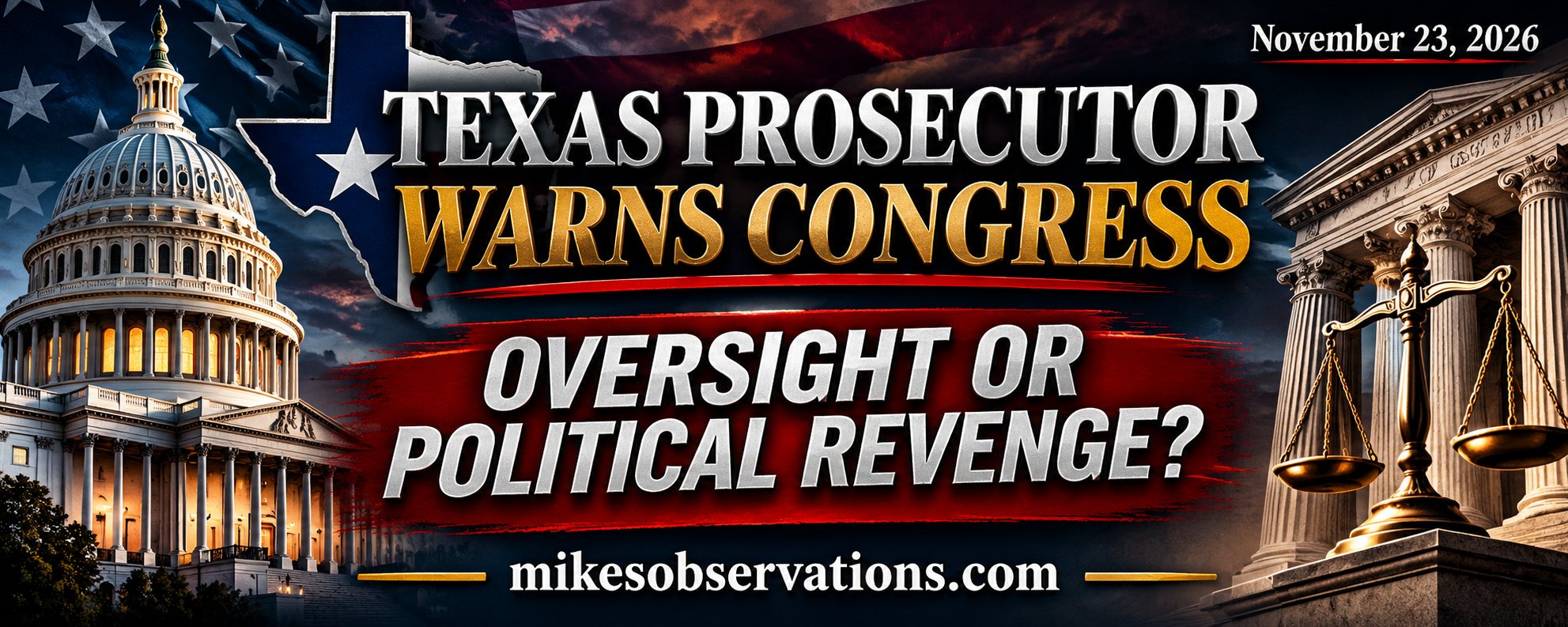
TEXAS FEDERAL PROSECUTOR WARNS CONGRESS: OVERSIGHT OR POLITICAL REVENGE?
When Washington's investigators become the subjects of an investigation, America had better pay attention.
Imagine receiving a letter from a federal prosecutor warning that your plans to investigate political opponents could potentially violate federal law.
Now imagine that you're a member of the United States Congress.
That is the controversy unfolding in Texas, where U.S. Attorney Aaron Reitz has sent warning letters to four Democratic lawmakers who have publicly discussed investigating President Donald Trump, his administration, and individuals associated with him.
And the battle is no longer confined to Washington.
A Texas federal prosecutor has stepped into the middle of it.
The question facing America is simple: Is this an effort to prevent political persecution, or an attempt to intimidate Congress?
The answer matters far beyond the political fortunes of Donald Trump or the Democratic Party.
It goes straight to the Constitution.
THE TEXAS PROSECUTOR WHO FIRED THE WARNING SHOT
Aaron Reitz, the U.S. Attorney for the Southern District of Texas, has sent letters to Democratic Senators Elizabeth Warren, Richard Blumenthal, and Elissa Slotkin, along with Representative Robert Garcia.
These lawmakers have discussed conducting investigations into the Trump administration and people associated with the president.
Reitz argues that Congress has legitimate oversight authority, but that authority is not unlimited.
Congressional investigations must serve a legitimate legislative purpose.
They cannot lawfully become instruments for punishing private citizens merely because of their political beliefs or associations.
In a November 22 interview with CBS News Texas, Reitz confirmed that he had opened a preliminary inquiry into whether statements by the lawmakers raised concerns under federal civil-rights statutes.
He cited 18 U.S.C. Sections 241 and 242, which address conspiracies against constitutional rights and deprivation of rights under color of law.
Importantly, Reitz acknowledged that his office was not yet alleging that the lawmakers had committed those violations.
That distinction matters.
A preliminary inquiry is not an indictment. A warning is not a conviction. And suspicion is not proof.
CONGRESSIONAL OVERSIGHT OR POLITICAL RETRIBUTION?
Congress has a constitutional responsibility to oversee the executive branch.
It can investigate waste, fraud, abuse, corruption, and possible misconduct.
Those powers are essential to a functioning republic.
But here is where the controversy becomes serious.
What happens when lawmakers announce investigations before identifying evidence of wrongdoing?
What happens when political rhetoric begins sounding less like a search for truth and more like a promise to settle scores?
Those questions deserve answers regardless of which political party controls Congress.
The First Amendment protects freedom of speech and association.
Supporting a president, donating to a political campaign, or maintaining a lawful business relationship with an elected official does not automatically make someone a legitimate target for punishment.
At the same time, political connections do not provide immunity from legitimate investigations into corruption or illegal conduct.
Political association is not a crime. Neither is conducting lawful congressional oversight.
Both principles must survive.
DEMOCRATS FIRE BACK
The lawmakers receiving the letters have rejected Reitz's warnings.
Senator Richard Blumenthal has insisted that congressional investigations into potential corruption will continue.
Senator Elissa Slotkin has likewise said she will not be deterred.
Former Congressman and incoming Representative Colin Allred of Texas criticized Reitz's actions, arguing that federal prosecutors should concentrate on criminal activity rather than interfering with congressional oversight.
Their position is that the Constitution gives Congress the authority to investigate the executive branch, and that prosecutors should not use the threat of criminal investigations to discourage lawmakers from performing their duties.
That is a serious constitutional argument.
Congress cannot function properly if its members fear prosecution merely for asking legitimate questions.
But the reverse is also true.
Congress cannot be allowed to use subpoenas, hearings, and investigations simply to harass political enemies.
NOW THE PROSECUTOR IS UNDER FIRE
The controversy took another turn when the watchdog organization Campaign for Accountability filed an ethics complaint against Reitz with the State Bar of Texas.
The organization alleges that his warning letters may violate professional conduct rules governing attorneys and prosecutors.
Reitz has rejected the complaint as baseless and defended his actions.
As of this reporting, the filing of an ethics complaint does not establish that he violated any professional rule.
And the existence of his preliminary inquiry does not establish criminal wrongdoing by any lawmaker.
We are watching competing accusations, not judicial findings.
That is an important difference in a country where people are supposed to be innocent until proven guilty.
THE CONSTITUTION IS NOT A POLITICAL WEAPON
America's founders understood the danger of concentrating government power.
That is why they established three branches of government with separate responsibilities.
Congress writes laws and exercises oversight.
The executive branch enforces laws.
The judiciary interprets laws and resolves legal disputes.
Each branch has authority.
Each branch has limits.
And none should be allowed to use its power merely to destroy political opponents.
If congressional investigators uncover genuine corruption, follow the evidence wherever it leads.
If federal prosecutors uncover genuine criminal misconduct, follow that evidence too.
But neither side should be permitted to turn government authority into a personal revenge machine.
The law must be stronger than the party holding power.
THE QUESTION WASHINGTON DOESN'T WANT TO ANSWER
Here is something every American should consider.
Would we accept these same tactics if the political parties were reversed?
If a Democratic administration warned Republican lawmakers against investigating its associates, would we defend the prosecutor?
If Republican lawmakers threatened investigations solely to punish Democratic donors and supporters, would we defend Congress?
Our answer should not change depending on the party involved.
The Constitution was not written for Republicans.
It was not written for Democrats.
It was written to establish a government of laws, with protections that apply to every American.
And those protections mean very little if we defend them only when our preferred political party benefits.
MY OBSERVATION
I've lived long enough to watch Washington change hands many times.
Presidents come and go.
Congressional majorities rise and fall.
Political movements appear, disappear, and sometimes return under different names.
But one thing has remained constant.
When politicians begin believing that their power is greater than the Constitution, ordinary Americans are the ones who eventually pay the price.
I believe in holding corrupt officials accountable.
I believe in protecting innocent citizens from political persecution.
And I believe those principles should apply whether the person involved is a Republican, a Democrat, a president, a senator, or a federal prosecutor.
If Congress has evidence of wrongdoing, investigate it.
If prosecutors have evidence of crimes, investigate them.
But stop treating the machinery of government like a weapon to be passed from one political party to the next.
Justice must be blind to political affiliation, or it ceases to be justice.
America doesn't need another political revenge campaign.
It needs accountability, constitutional restraint, and leaders who remember whom they serve.
The American people.
Michael Cunningham Sr.
Mike's Observations — Eight Decades of Faith, Service, Adventure, and a Life Well Lived.
mikesobservations.com
What do you think? Is the Texas prosecutor protecting constitutional rights, or is Congress being intimidated? Share your opinion respectfully in the comments.