By Michael Cunningham Sr. | Mike's Observations
When a government begins treating silent prayer as a potential criminal offense, something has gone terribly wrong.
I have lived 82 years on this earth. I have served my country as a United States Marine. I have watched governments change, politicians come and go, and freedoms that once seemed untouchable become subjects of political negotiation.
But I never imagined I would see the day when a Christian woman could face criminal prosecution over standing quietly in a public place and praying.
Yet that is precisely the controversy unfolding in Great Britain.
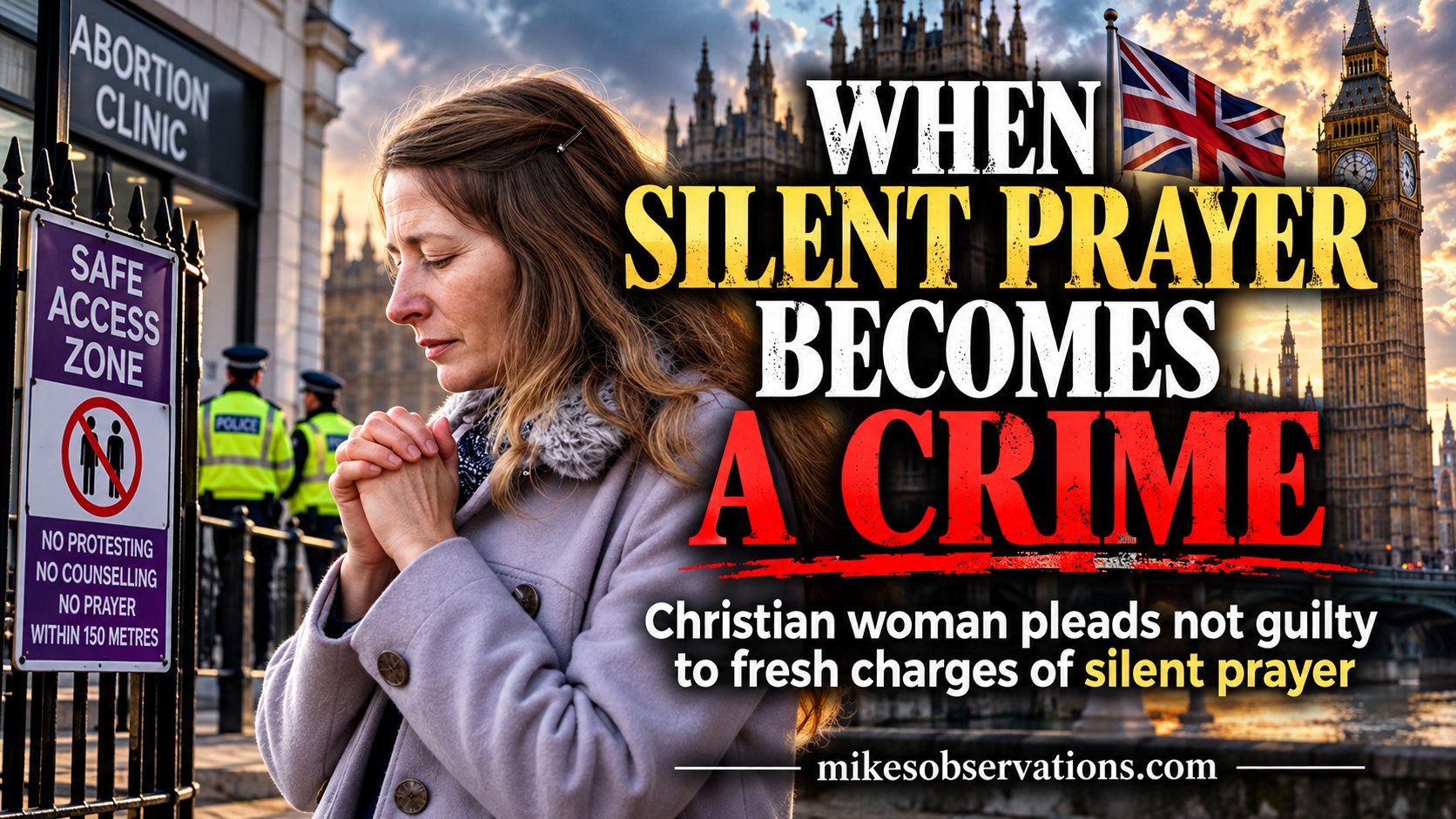
Her name is Isabel Vaughan-Spruce, and her case ought to concern every freedom-loving person in America.
This woman is not accused of physically attacking anyone. The allegations do not involve blocking an entrance or shouting threats. Her defense maintains that she was simply standing and praying silently near an abortion facility.
And now she faces five criminal charges.
Five charges. For conduct her lawyers describe as peaceful, silent prayer.
Let that sink in.
WHEN DID SILENT PRAYER BECOME A THREAT?
In 2023, earlier proceedings against Vaughan-Spruce ended in her acquittal after prosecutors offered no evidence. In 2024, she received a £13,000 settlement from police following two arrests.
You might think that would have settled the matter.
You would be wrong.
Under nationwide legislation introduced in October 2024, certain activities within 150 meters of abortion facilities in England and Wales can constitute criminal offenses.
The law is intended to prevent harassment, obstruction, and attempts to influence people accessing abortion services.
Protecting people from genuine harassment is a legitimate responsibility of government.
But since when does that responsibility give government authority over a person's silent prayers?
That is where I draw the line.
In October 2026, Vaughan-Spruce pleaded not guilty to five new charges. Her lawyers argue that she has been unfairly targeted because of her Christian and pro-life beliefs.
The prosecution alleges that her conduct violated the law's restrictions on influencing abortion-related decisions. A court must still determine whether the legal requirements have been met.
But the mere fact that this case has reached this stage should alarm us.
A government powerful enough to investigate a person's silent religious expression is a government that deserves serious scrutiny.
THE GOVERNMENT DOES NOT OWN YOUR CONSCIENCE
I am a Christian. I believe our fundamental rights come from God, not from the generosity of politicians.
The Declaration of Independence says that human beings are endowed by their Creator with certain unalienable rights.
Those words mean something.
Government does not manufacture our humanity. Government does not create our conscience. Government does not grant us permission to believe in Almighty God.
Its proper responsibility is to protect our liberties.
And when government begins treating peaceful religious expression as a potential offense, it risks crossing the line from protecting citizens to controlling them.
My thoughts belong to me. My prayers belong to God. Neither belongs to the government.
You may disagree with my religious beliefs. You may disagree with my position on abortion. You may reject Christianity altogether.
That is your right.
But disagreement does not justify criminal punishment.
FREEDOM IS NOT JUST FOR PEOPLE WE AGREE WITH
Here is something I want every reader to understand.
Religious liberty is not a special privilege reserved for Christians.
A Muslim has the right to pray. A Jew has the right to practice his faith. An atheist has the right not to believe.
And a Christian should have the right to pray peacefully without being treated as a criminal merely because someone objects to the message associated with that faith.
I do not have to agree with you to defend your freedom.
That is what genuine liberty means.
Of course, religious freedom does not excuse threats, obstruction, or harassment. No one should be intimidated while seeking lawful medical services.
But if the conduct at issue is simply standing quietly and praying internally, then the government should have to demonstrate something more than disapproval of a person's beliefs.
A free society must distinguish between actual misconduct and unpopular convictions.
Lose that distinction, and freedom becomes little more than a word politicians use in speeches.
AMERICA, DO NOT THINK THIS CANNOT HAPPEN HERE
Some Americans will dismiss this controversy because it is happening in England.
That would be a mistake.
The United States has stronger constitutional protections for freedom of religion and expression, particularly through the First Amendment. But those protections require citizens, judges, lawmakers, and public officials willing to uphold them.
Our freedoms are not self-enforcing.
History teaches us that governments rarely announce that they intend to become oppressive.
Restrictions are often introduced with reassuring language.
They promise safety. They promise order. They promise protection.
Sometimes those promises address genuine problems.
But good intentions do not excuse unconstitutional or disproportionate restrictions.
The question must always be whether government has gone beyond preventing harm and begun punishing peaceful conduct.
Today, the controversy is silent prayer near an abortion facility in Britain.
Tomorrow, the legal dispute could involve another unpopular belief, another religious community, or another form of peaceful expression.
The principle is bigger than abortion. It is bigger than Christianity. It is bigger than political parties.
It concerns the limits of government power.
I DID NOT SERVE MY COUNTRY TO WATCH FREEDOM BECOME A GOVERNMENT FAVOR
As a Marine, I learned that freedom comes with responsibility, sacrifice, and sometimes a terrible price.
I also learned that authority must be held accountable.
I am not suggesting that America and Great Britain have identical laws. They do not.
But I am saying that Americans should pay close attention whenever another democracy tests the boundaries of religious freedom.
A right that exists only when government officials approve of how it is exercised is not much of a right.
And a government that can decide which peaceful thoughts are acceptable has acquired far too much power.
I will respect lawful authority. I will defend the rights of people who disagree with me. But I will never accept the idea that government owns the human conscience.
CHRISTIANS, WHERE IS OUR COURAGE?
There is another part of this story that troubles me.
Too many Christians are willing to remain silent when religious freedom is challenged.
We complain privately. We shake our heads. We tell each other how terrible things have become.
And then we go back to our comfortable routines.
Scripture tells us in Acts 5:29:
"We ought to obey God rather than men."
That does not mean Christians are above the law.
It means our ultimate allegiance belongs to God, and we must have the courage to defend freedom of conscience through peaceful, lawful means.
The Church should not be afraid to speak.
Pastors should not be afraid to address religious liberty.
And Christians should not be afraid to defend the rights of others, even when their beliefs are different from ours.
If we only defend freedom when it benefits our own side, we have misunderstood freedom entirely.
MY FINAL WORD
Isabel Vaughan-Spruce deserves a fair trial, and the prosecution must prove its allegations under the law.
But I believe her case exposes a dangerous question that every free society must answer.
Does the government exist to protect our freedom, or does our freedom exist only with government permission?
My answer is simple.
The government does not own my faith.
It does not own my conscience.
It does not own my prayers.
And it certainly does not own my relationship with Almighty God.
At 82 years old, I have no intention of remaining quiet when fundamental liberties are at stake.
A government should fear violating the rights of its citizens far more than it fears a woman standing silently in prayer.
That is the lesson I want to leave behind.
Freedom of conscience is not a favor from the state. It is a fundamental human right.
And once we surrender that principle, getting it back may be far harder than we imagine.
Michael Cunningham Sr.
Marine | Christian | Writer
Mike's Observations
mikesobservations.com
Eight Decades of Faith · Service · Adventure · A Life Well Lived.
What do you think? Should silent prayer ever be grounds for criminal prosecution? Leave your opinion in the comments at mikesobservations.com.