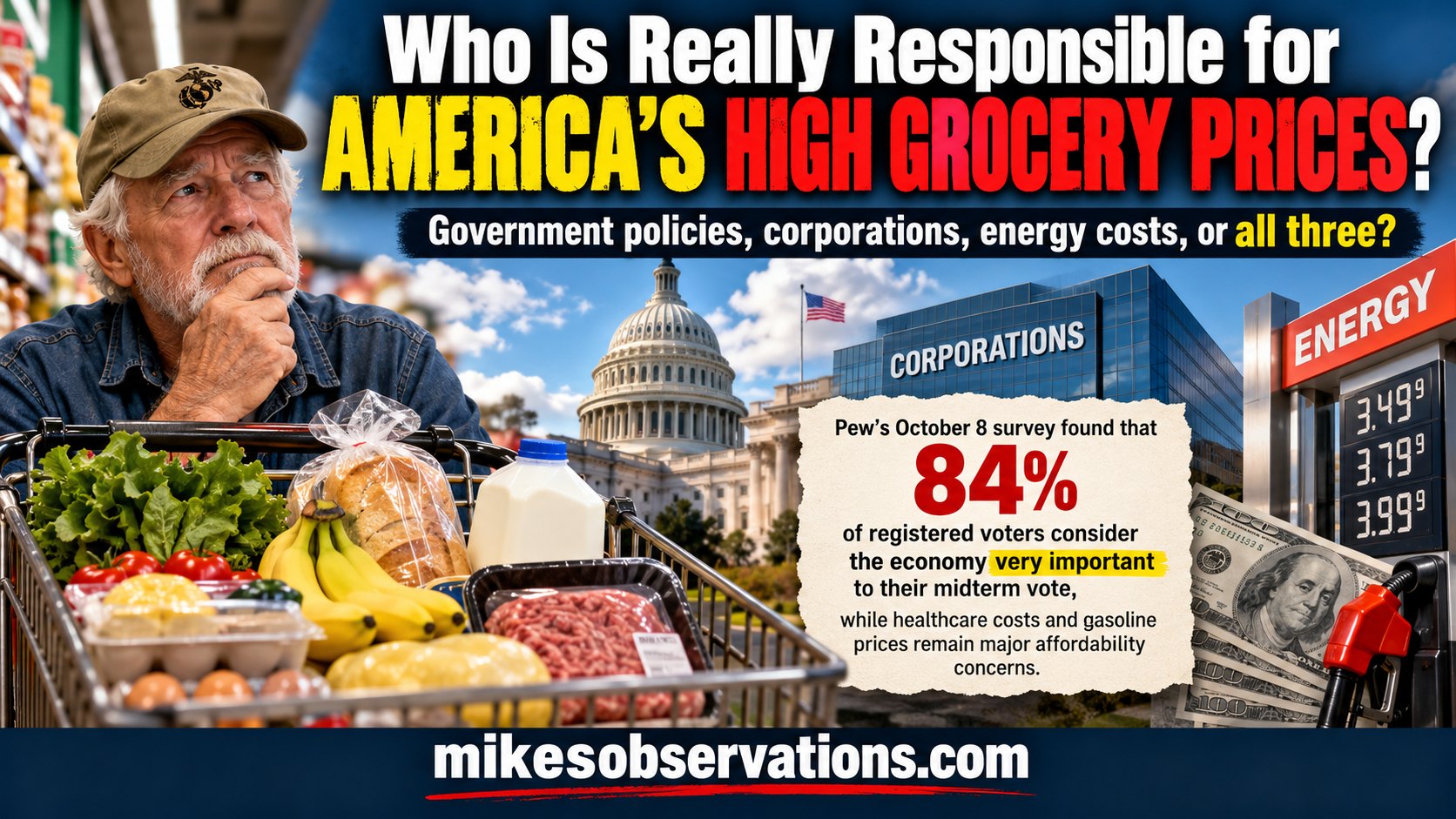
Who Is Really Responsible for America's High Grocery Prices?
Government Policies, Corporate Profits, Energy Costs — or All Three?
Category: ObservationsAuthor: Michael Cunningham Sr.Website: mikesobservations.com
THE NUMBERS BEHIND THE STORY
84%
Voters who say the economy is very important
1.8%
Annual grocery inflation, September 2026
20.4%
Annual energy inflation, September 2026
Sources: Pew Research Center, October 8, 2026; Bureau of Labor Statistics, October 14, 2026.
Pew Research Center
+1
The Blog Article
Who Is Really Responsible for America's High Grocery Prices?
Government Policies, Corporate Profits, Energy Costs — or All Three?
By Michael Cunningham Sr. | Mike's Observations
There was a time when a hundred dollars would buy a respectable amount of groceries. You could fill several bags, put meat in the freezer, and still have enough left for a few extras.
Today, a hundred dollars can disappear before you've made it halfway through the grocery store.
And Americans are asking a question that deserves more than another political speech:
Who is really responsible for these prices?
Is it Washington? Is it the corporations controlling our food supply? Is it the rising cost of diesel fuel, electricity, and transportation?
Or have we created an economic system where all these forces work together, leaving the American consumer to pay the bill?
I believe we need to examine every part of that question.
Americans Are Tired of Hearing Excuses
On October 8, 2026, the Pew Research Center reported that 84% of registered voters consider the economy very important to their vote in the upcoming congressional elections.
That includes substantial majorities of voters supporting both political parties.
This shouldn't surprise anybody.
People may disagree about immigration, foreign policy, healthcare, and almost everything else. But everyone understands what happens when the grocery bill exceeds the family budget.
An older couple living on retirement income understands it.
A young family raising three children understands it.
A working man who puts in fifty hours a week and still struggles to buy groceries understands it.
The grocery store has become one of the places where Americans experience the economy most directly.
1. Government Policies: Decisions Have Consequences
Government doesn't set the price of every loaf of bread or pound of hamburger.
But government decisions can influence nearly every expense involved in producing and delivering those products.
Consider the effects of tariffs, agricultural regulations, taxation, trade restrictions, labor policies, and energy policy.
Tariffs on imported food or materials can raise costs for American businesses and consumers, although they may also be intended to protect domestic industries.
Regulations can impose compliance expenses, while also protecting food safety, workers, and the environment.
Government spending, taxation, and monetary policy can influence economic conditions and inflation, although their effects are complicated and often delayed.
Both political parties have made decisions affecting these areas.
And policies adopted years ago can continue influencing prices long after the politicians responsible have left office.
We should examine policies by their measurable results rather than accepting political promises at face value.
2. Corporate America: Where Does the Money Go?
Let's talk about something that deserves serious attention.
The American food industry includes enormous corporations involved in processing, packaging, distributing, and selling the food we eat.
Some markets are dominated by relatively few major competitors.
When competition is limited, companies may have greater power to influence prices.
That doesn't mean every grocery company is exploiting its customers. Retailers have real expenses, and profits vary substantially between manufacturers, processors, distributors, and supermarkets.
But it raises legitimate questions.
When wholesale costs decrease, how quickly do retail prices follow?
When a company raises prices because transportation becomes more expensive, does it reduce those prices when transportation costs fall?
Are consumers benefiting from genuine competition?
And are corporate profits increasing because companies are operating more efficiently, or because consumers have fewer alternatives?
Those questions deserve transparent answers.
Profit is not a dirty word. I spent years in business, and I understand that no company survives without making money.
But there is a difference between earning a reasonable return and taking advantage of customers who have little choice but to buy what you're selling.
The evidence must tell us when that line has been crossed.
3. Energy Costs: The Expense Hidden in Every Grocery Item
Here's something many consumers overlook.
Before that head of lettuce reaches your shopping cart, energy has already played a role in nearly every step of its journey.
Fuel powers tractors and harvesting equipment.
Energy is used to manufacture fertilizer.
Electricity runs irrigation pumps, processing facilities, warehouses, and refrigeration systems.
Diesel trucks transport food from farms to distribution centers and then to supermarkets.
And when energy becomes more expensive, those costs can spread throughout the food supply chain.
The latest Bureau of Labor Statistics report shows that energy prices were 20.4% higher in September 2026 than one year earlier.
That is a substantial increase.
Not every increase in energy costs is immediately passed on to shoppers. Businesses may absorb some expenses, negotiate contracts, or adjust operations.
But energy is an important part of the cost of putting food on America's tables.
And because energy markets are affected by international events as well as domestic policies, there is no single switch Washington can flip to control every price.
4. The Farmer Isn't Necessarily Getting Rich
I live in East Texas, where agriculture is part of everyday life.
I've seen enough of farming and raising livestock to understand that producing food involves far more work and expense than many people realize.
Farmers face costs for land, equipment, fuel, fertilizer, feed, repairs, insurance, and labor.
They also face weather, disease, changing market conditions, and risks they cannot control.
When you pay more for a pound of beef, that doesn't automatically mean the rancher is receiving a windfall.
There are processors, transportation companies, wholesalers, and retailers between the ranch and the dinner table.
Every step adds costs.
Some of those costs are necessary. Others deserve examination.
If we want affordable food, we need a system in which farmers can remain profitable while consumers can still afford what farmers produce.
5. Inflation Slowing Doesn't Mean Prices Are Back to Normal
Here is one of the biggest misunderstandings about inflation.
When government officials announce that inflation has slowed, many Americans wonder why their grocery bills are still so high.
The answer is simple.
Slower inflation usually means prices are rising more slowly. It does not mean prices have returned to where they were several years ago.
According to the Bureau of Labor Statistics, grocery prices were 1.8% higher in September 2026 than a year earlier, although they declined slightly during September itself.
That may sound encouraging.
But consider the much larger increases Americans experienced earlier in the decade.
The USDA reports that grocery prices rose 11.4% in 2022 and another 5.0% in 2023.
Those increases became part of the new price level.
A family that once spent $150 on groceries may still be paying substantially more today, even when the current inflation rate is relatively modest.
This is why economic statistics and everyday experience can sound like two different stories.
Both can be true.
6. What Would Actually Help?
I don't believe Americans need another round of politicians pointing fingers at one another.
We need serious examination of the costs and policies affecting our food supply.
That includes encouraging competition in food processing and retailing, examining the effects of tariffs and regulations, improving transportation efficiency, and supporting reliable, affordable energy.
We should also make it easier for small farmers and independent food producers to compete without sacrificing essential safety standards.
And when companies or public officials make claims about why prices are increasing, those claims should be tested against the evidence.
There are tradeoffs in every policy. Cheap food cannot be the only goal if achieving it means unsafe products, bankrupt farmers, or unsustainable production.
But affordable food should remain a national priority.
My Final Observation
I've lived long enough to watch this country go through recessions, oil shortages, inflation, economic recoveries, and more political promises than I care to count.
One thing I've learned is that complicated problems rarely have simple explanations.
Government policies matter.
Corporate pricing decisions matter.
Energy costs matter.
And so do weather, disease, labor, transportation, international trade, and competition.
The responsibility for America's grocery prices cannot honestly be assigned to one institution or one political party.
But that doesn't mean nobody should be held accountable.
Government officials should be accountable for the consequences of their policies.
Corporations should be accountable for lawful and competitive business practices.
And those who promise lower prices should explain precisely how they intend to deliver them.
The American people deserve facts, transparency, and practical solutions.
Because while Washington debates and corporations issue earnings reports, ordinary families are standing in supermarket aisles trying to decide what they can afford to put back on the shelf.
And that, my friends, is where this discussion ought to begin.
What do you think?
Who bears the greatest responsibility for high grocery prices — government policies, large corporations, energy costs, or some combination of all three?
And more importantly, what would you change to make groceries affordable again?
I'd like to hear your thoughts. Visit the Contact page at mikesobservations.com and join the conversation.
Michael Cunningham Sr.
Mike's Observations
Eight Decades of Faith · Service · Adventure · A Life Well Lived
Sources and fact-checking
These are reliable references to place at the bottom of the published article. The FTC's findings also give the corporate-pricing section a stronger factual foundation.
- Pew Research Center — October 8 voter survey. Surveyed 3,917 registered voters among 5,062 adults.
- Pew Research Center
- Bureau of Labor Statistics — September 2026 Consumer Price Index. Grocery inflation 1.8% annually; energy inflation 20.4%.
- 2026 M09 Results
- USDA — Food Price Outlook. Documents the cumulative increases since 2022 and forecasts grocery inflation of 2.4% for 2026.
- Economic Research Service
- Federal Trade Commission — Grocery Supply Chain Investigation. Found elevated retail profit measures during the pandemic and concerns about competition, without establishing that all price increases were unjustified.
- Federal Trade Commission
- +1