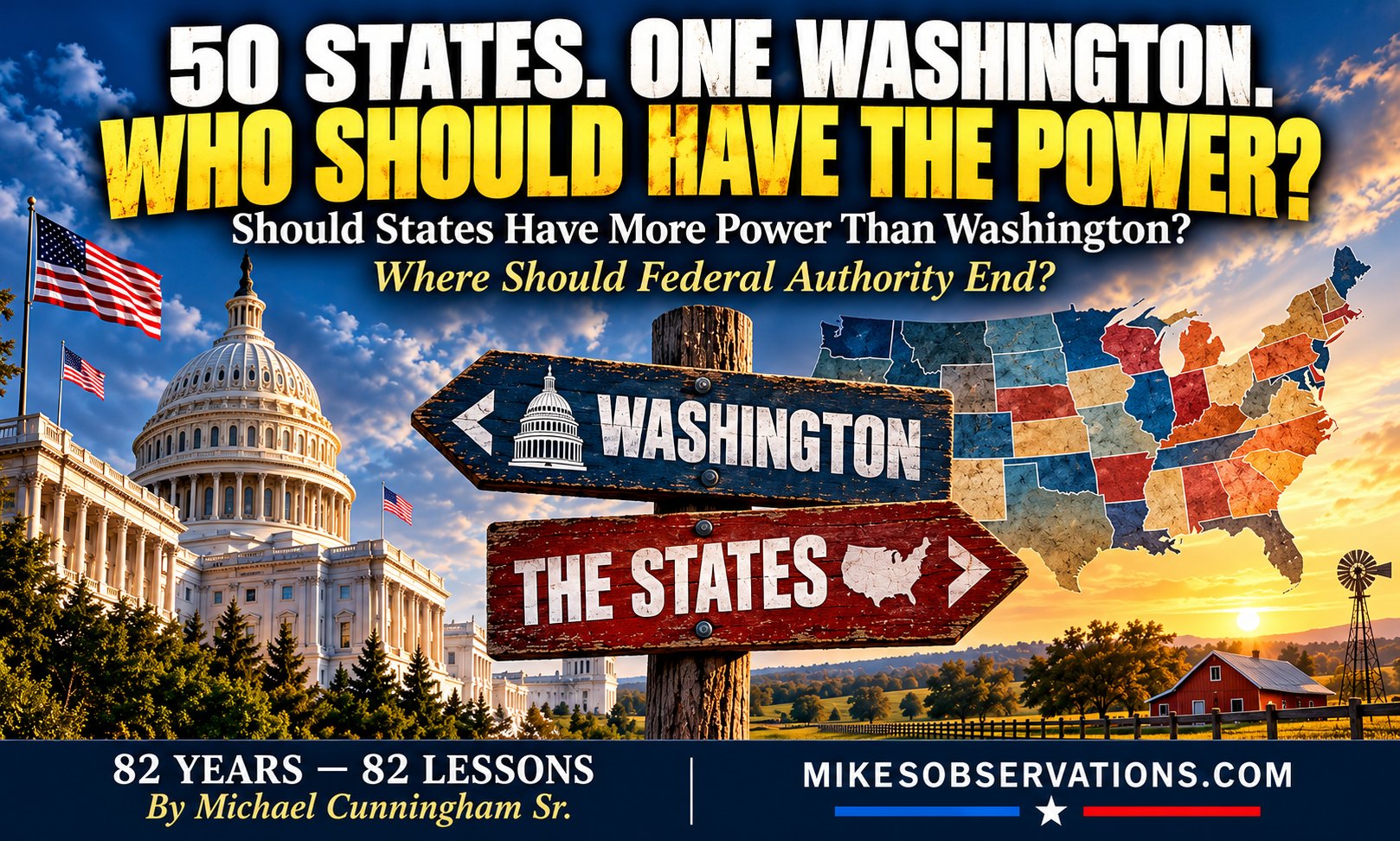
Where Should Federal Authority End—and Who Gave Washington So Much Control?
82 Years — 82 Lessons
By Michael Cunningham Sr.
I've lived 82 years in this country. I've watched presidents come and go, political parties rise and fall, and the federal government become involved in more and more aspects of American life.
And somewhere along the way, I began asking myself a question:
Whatever happened to the idea that the government closest to the people should be the government most accountable to the people?
When our Constitution was written, the founders did not intend for every decision affecting every American to be made in Washington, D.C.
They created a federal government with specific powers, while reserving other powers to the states and the people.
That principle was important enough to become the Tenth Amendment.
Yet today, Washington influences everything from education and healthcare to transportation, environmental regulations, and how states spend public money.
So here's my question:
Have we allowed the federal government to become too powerful, or has modern America simply become too complicated to govern any other way?
The Constitution Was Supposed to Set Boundaries
The Tenth Amendment states:
"The powers not delegated to the United States by the Constitution, nor prohibited by it to the States, are reserved to the States respectively, or to the people."
That's a pretty straightforward statement.
But there's another side to the Constitution that cannot be ignored.
The federal government has enumerated powers, including authority over interstate commerce, national defense, and taxation. Federal laws made pursuant to the Constitution are supreme over conflicting state laws.
That means states are not completely independent governments.
And they were never intended to be.
The real argument is over where legitimate national authority ends and state authority begins.
And I believe that boundary deserves far more public debate than it receives.
Why Should Washington Decide What's Best for Texas?
I live in East Texas.
The needs of people living in rural Texas can be very different from those of people living in New York City, Los Angeles, or Chicago.
Our economies differ. Our communities differ. Our geography, industries, and local priorities differ.
So why should every state be governed by exactly the same rules?
Shouldn't Texans have a greater say in matters that primarily affect Texas?
And shouldn't Californians, New Yorkers, and Floridians have that same opportunity?
If a state makes a bad decision, its voters should have the power to hold their state officials accountable.
But here's the uncomfortable part.
States' rights must apply even when another state makes a decision we personally dislike.
We cannot demand local control only when our preferred political party is in charge.
That isn't a constitutional principle.
That's political convenience.
Washington Has a Powerful Tool: Money
Here's something that bothers me.
The federal government collects taxes from Americans across all fifty states, then distributes substantial funding back to state governments through federal programs.
Some of that money comes with conditions.
Sometimes those conditions advance important national goals.
Other times, they raise legitimate questions about whether Washington is using money to influence decisions that should belong closer to home.
Think about that.
Your tax dollars go to Washington, and Washington may attach requirements when money returns to your state.
Is that cooperation between governments?
Or can it become a way of controlling states without directly ordering them to act?
I believe Americans should be asking that question much more often.
But States' Rights Have a Dark History, Too
Now here's where this conversation gets uncomfortable.
Not every argument made in the name of states' rights has been honorable.
Throughout American history, states' rights arguments have been used to defend slavery, segregation, and discriminatory laws.
Federal authority, constitutional amendments, federal courts, and civil rights legislation played essential roles in ending legally enforced discrimination.
That history matters.
Because local control cannot become an excuse to deny Americans their constitutional rights.
The federal government has a responsibility to protect those rights, even when a state government refuses.
A state should have freedom to govern itself, but not freedom to violate the Constitution.
That's a distinction worth defending.
Here's Where I Challenge Both Political Parties
Republicans frequently argue for states' rights and limited federal government.
Democrats frequently emphasize federal protections and national standards.
But political principles become less convincing when they change depending on who controls Washington.
If you believe states should make their own decisions, does that belief survive when another state adopts policies you oppose?
If you believe Washington should establish national standards, do you still support that authority when the opposing party controls the presidency?
Those questions apply to everyone.
A principle that only matters when your party is winning isn't much of a principle.
And perhaps that's one of the biggest problems with American politics today.
Too many arguments seem to revolve around who holds power rather than how much power government should possess in the first place.
What Should Washington Actually Control?
I believe we need a serious national conversation about the proper division of power.
National defense? Certainly a federal responsibility.
Foreign relations? Absolutely.
Protecting constitutional rights? Without question.
But what about education policies, land use, healthcare decisions, energy regulations, and local economic development?
Some of these issues cross state lines. Others are primarily local. Many involve legitimate responsibilities at both levels.
Why shouldn't we examine them individually instead of automatically assuming that Washington—or the states—should control everything?
A strong nation does not necessarily require a government that makes every decision.
And strong states do not require a weak or ineffective federal government.
What we need is a constitutional balance that actually means something.
Have Americans Become Too Comfortable With Centralized Power?
Here's the question I find most troubling.
Have we become so accustomed to Washington making decisions that we've forgotten how much responsibility belongs to us?
We complain about federal regulations.
We complain about federal spending.
We complain about politicians who seem disconnected from everyday Americans.
Yet when a problem arises, how often is our first demand that Washington do something about it?
Maybe part of the problem isn't simply government officials seeking more authority.
Maybe we've become too willing to hand it over.
Every time we demand that government solve another problem, shouldn't we also ask what authority we're giving it—and whether we're willing to live with that authority when our political opponents take office?
That's a question every American ought to consider.
My Final Observation After 82 Years
I've lived long enough to know that government is necessary.
I've also lived long enough to believe that government power must have boundaries.
I don't want fifty states operating as fifty separate countries.
But neither do I want fifty states reduced to administrative districts taking instructions from Washington.
I want a federal government strong enough to fulfill its constitutional responsibilities, states free enough to address their own needs, and citizens informed enough to hold both accountable.
Most of all, I want Americans to stop treating constitutional limits as obstacles to be ignored whenever they become politically inconvenient.
The Constitution should limit the power of government, regardless of which party holds that power.
And now I'd like to hear from you.
Let's Stir the Pot!
Should states have more authority over their own affairs?
Has Washington accumulated too much power?
Or would giving states greater independence create more inequality, confusion, and threats to individual rights?
And here's the toughest question of all:
Would you still support states' rights if your state passed a law you strongly disagreed with?
Don't just tell me whether you're Republican or Democrat.
Tell me what you believe—and why.
I welcome respectful disagreement. In fact, I encourage it.
Because if Americans can't debate the limits of government power, we may eventually discover those limits have been decided without us.
Michael Cunningham Sr.
82 Years — 82 Lessons
mikesobservations.com