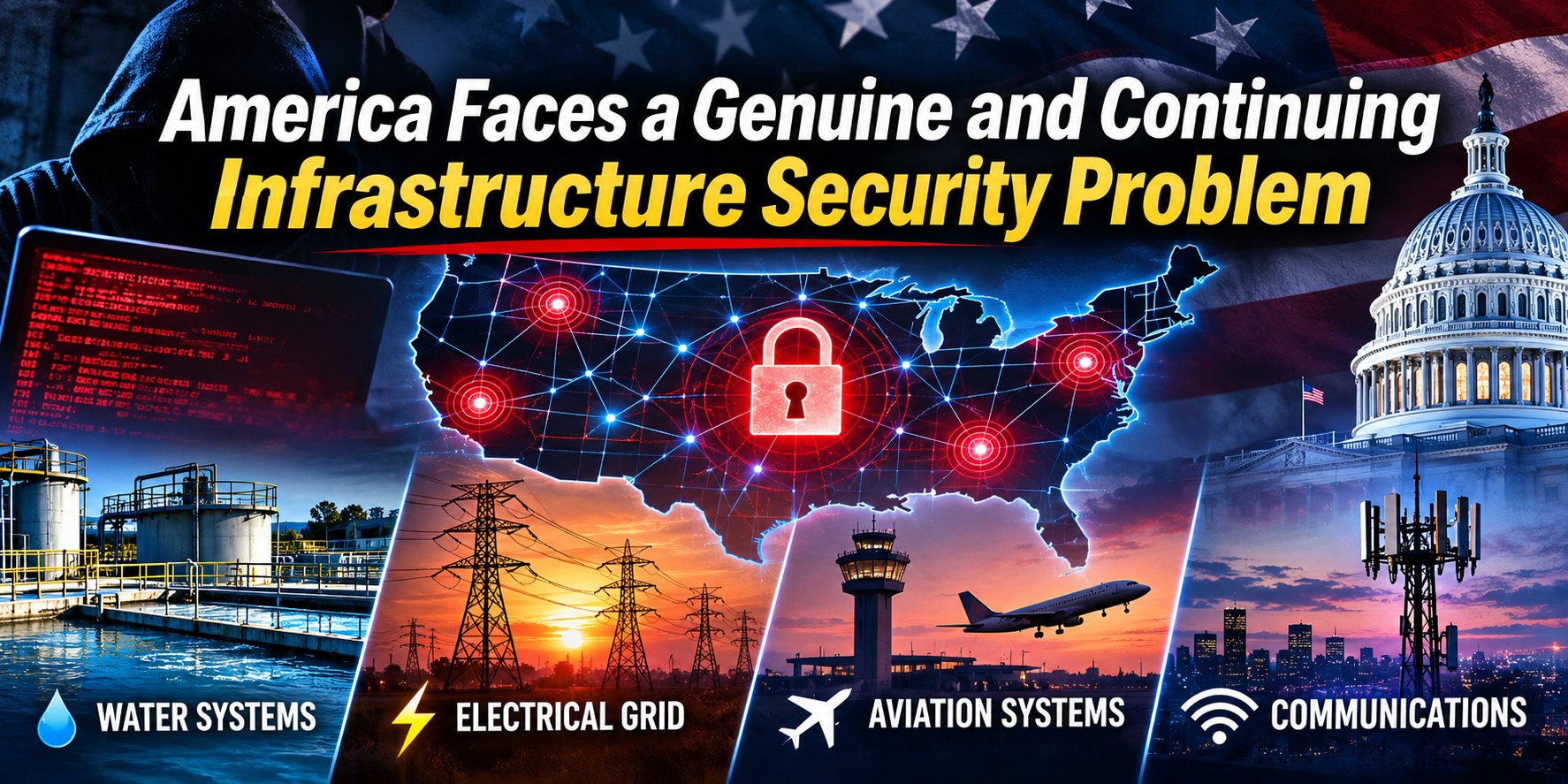
America Faces a Genuine and Continuing Infrastructure Security Problem
America's water systems, electrical grid, communications networks, and aviation infrastructure are too important to leave vulnerable. The threats are real. The question is whether our government and infrastructure operators are doing enough to confront them.
By Michael Cunningham Sr. | Mike's Observations | November 16, 2026
America Has a Problem—and Ignoring It Won't Make It Disappear
America has spent decades building one of the most technologically advanced nations in human history.
We have electrical networks that power entire regions, computerized systems that control drinking water, communications networks that connect millions of Americans, and aviation systems responsible for safely moving thousands of aircraft every day.
Yet beneath that remarkable technological achievement lies an uncomfortable reality.
Some of the systems Americans depend upon for their daily survival have already been targeted by hostile cyber actors.
That is not a conspiracy theory. It is not an internet rumor. It is not a prediction of some imaginary doomsday scenario.
It is a documented national security problem.
And the American people deserve more than reassuring speeches and promises that everything is under control.
They deserve evidence that their country is prepared.
Our Water Systems Are Not Off-Limits to America's Enemies
Think about what happens when a community loses access to safe drinking water.
Hospitals face immediate complications. Businesses struggle to operate. Families scramble for bottled water. Fire protection and sanitation can become serious concerns.
Now consider that the computerized equipment controlling some American water systems has already been attacked.
Federal cybersecurity authorities have warned about malicious actors exploiting internet-connected programmable logic controllers—the industrial devices that help operate pumps, valves, and treatment equipment.
Some documented attacks have disrupted operations.
Let that sink in.
Foreign-linked cyber activity is no longer merely a threat discussed in intelligence briefings. It has reached equipment involved in delivering essential services to American communities.
The fact that these incidents have generally been limited does not make them insignificant.
It makes them warnings.
And warnings are valuable only when somebody acts on them.
China, Russia, and Iran: Different Actors, One Dangerous Reality
American intelligence and cybersecurity agencies have documented infrastructure threats associated with actors linked to China, Russia, and Iran.
These operations are not all identical.
Chinese state-sponsored activity associated with Volt Typhoon has raised particular concern because of its apparent emphasis on maintaining access to critical infrastructure networks.
That is an entirely different problem from someone stealing a password or attempting credit card fraud.
An intruder who maintains hidden access inside an essential network may be positioning himself to cause damage later.
Pro-Russia hacktivist groups have targeted poorly protected industrial systems, while Iranian-linked cyber activity has prompted warnings involving exposed industrial controllers.
Not every claimed attack has been independently verified. Not every intrusion results in disruption. And not every cyber incident can be confidently attributed to a foreign government.
But the larger picture is unmistakable.
America's critical infrastructure is an attractive target for hostile actors, and some of those actors have demonstrated both the interest and the ability to interfere with essential systems.
We should stop treating that reality as tomorrow's problem.
The FAA Disruption: A Warning Even Without a Cyberattack
The November 13 aviation disruption raises another disturbing question.
How can a technical failure create consequences across a system as important as American air traffic control?
The FAA has reported network instability and significant operational disruptions. Its investigation has not established that a cyberattack caused the event.
That distinction matters.
We must not label an equipment failure an act of foreign sabotage simply because it makes a more sensational headline.
But neither should we dismiss the incident because investigators have not identified a hostile actor.
A system that can be severely disrupted by an internal technical failure deserves scrutiny just as much as a system vulnerable to an outside attacker.
Passengers stranded at airports do not particularly care whether the failure began with a hacker, a defective component, or a preventable engineering mistake.
They want to know why the system failed.
More importantly, they want to know what is being done to prevent it from happening again.
The Electrical Grid: America's Most Dangerous Dependency
Consider what depends on electricity.
Almost everything.
Water treatment facilities need power. Hospitals need power. Communications networks need power. Fuel distribution, refrigeration, banking, emergency services, and transportation all depend on functioning electrical systems.
A prolonged regional outage could become a humanitarian emergency, particularly during extreme weather.
The American electrical grid is not one giant switch that an enemy can simply turn off. It consists of interconnected but regionally organized systems with multiple layers of protection.
That makes a simultaneous nationwide blackout far more complicated than some sensational internet predictions suggest.
Nevertheless, complexity does not equal invulnerability.
America does not need to experience a coast-to-coast blackout for an infrastructure attack to become a national tragedy.
A serious disruption affecting one major metropolitan area, a critical fuel network, or several essential utilities could cause enormous damage.
The question is not whether every light in America could go out at the same moment.
The question is whether our systems can withstand a serious attack, isolate the damage, and recover quickly enough to protect human life.
That is where the national conversation belongs.
Washington Must Answer Some Uncomfortable Questions
This is where the issue moves beyond cybersecurity and becomes a question of leadership and accountability.
For years, federal agencies have issued warnings about vulnerabilities in America's critical infrastructure.
Warnings are necessary.
But warnings alone do not secure a water treatment plant, replace obsolete equipment, or restore a failed communications network.
The American people have a right to ask:
- How many critical systems still rely on outdated or poorly secured equipment?
- How many utilities have verified that their industrial controls cannot be accessed by unauthorized users?
- Are smaller rural communities receiving the technical assistance necessary to protect their essential services?
- Can vital systems continue operating manually when their computerized controls fail?
- Who is accountable when known vulnerabilities remain uncorrected year after year?
These questions should not be dismissed as partisan attacks.
Republicans and Democrats alike have governed during the decades in which our dependence on interconnected technology has grown.
National security is not a campaign slogan. It is a responsibility.
Congress should demand measurable progress, independent security assessments, realistic recovery exercises, and clear explanations of how taxpayer money is improving actual resilience.
Not another glossy report that identifies the same weaknesses and then disappears onto a government shelf.
We Do Not Need Another Manufactured Panic
There have been online claims suggesting that America faces a coordinated nationwide infrastructure attack in December.
At present, the publicly available evidence examined for this investigation does not establish such a plan.
That does not mean cyber threats are imaginary.
It means responsible reporting must distinguish a genuine security warning from an unsupported prediction.
Fear may attract attention, but facts build credibility.
And the facts are serious enough without embellishment.
Our country has documented infrastructure intrusions, exposed industrial systems, persistent foreign cyber threats, and recent examples of major technical disruptions.
We do not have to invent a catastrophe to recognize the possibility of one.
America Must Prepare Before the Emergency
Preparedness is not paranoia.
It is common sense.
Infrastructure operators must secure exposed equipment, test backup systems, maintain effective incident-response plans, and ensure that essential services can continue when technology fails.
Federal and state governments must coordinate with local utilities, particularly smaller operators that may lack the resources of major metropolitan systems.
And Congress must recognize that protecting the systems delivering drinking water, electricity, transportation, and emergency communications is a fundamental national security obligation.
Americans should also understand the difference between sensible household emergency preparedness and the fear-driven claims circulating online.
Keeping emergency water, medications, flashlights, batteries, and basic supplies available is reasonable preparation for storms, equipment failures, and other disruptions.
It is not evidence that some secret nationwide catastrophe is scheduled.
My Final Observation: We Have Been Warned
America has the engineering talent, technological knowledge, industrial capability, and financial resources to strengthen its essential infrastructure.
What we cannot afford is complacency.
The documented attacks against industrial systems should have captured the attention of every official responsible for protecting the American public.
The foreign infiltration campaigns should concern every national security leader.
And major technical disruptions should force serious examination of how much failure our essential networks can tolerate.
We cannot eliminate every threat. No country can.
But there is a tremendous difference between an unavoidable emergency and a disaster made worse because known vulnerabilities were ignored.
America should not have to suffer a catastrophic infrastructure failure before its leaders decide that prevention deserves the same urgency as disaster response.
The American people are not asking for perfection.
They are asking for competence, accountability, and a government that takes the protection of essential services seriously.
The threats are real. The vulnerabilities are documented. The warnings have been issued.
Now comes the question that Washington must answer:
WHAT, EXACTLY, ARE WE DOING ABOUT IT?
Michael Cunningham Sr.
Mike's Observations
mikesobservations.com
Independent commentary and analysis based on publicly reported infrastructure incidents and federal cybersecurity advisories. Allegations of a scheduled nationwide December attack remain unsubstantiated.
Verification notes for publication
I checked the strongest factual claims against current federal sources. The July 30 FBI/EPA warning confirms attacks affecting water utilities in at least seven states, including reports of pressure loss and flooding.
FBI
The July 22 CISA advisory confirms Iranian-affiliated activity disrupting industrial controllers across several infrastructure sectors.
GovDelivery
The FAA's November 15 report confirms that network instability affected 17 of 22 air-route traffic control centers. The FAA says it has no indication of a cyberattack, although the root-cause investigation continues.
Federal Aviation Administration