By Michael Cunningham Sr.
There Was a Time When a Handshake Meant Something
I'm 82 years old, and I've watched this country change in ways I never could have imagined when I was a young man.
Some of those changes have been wonderful. Others make me wonder what happened to the values that once held our communities, our businesses, and our families together.
One of the greatest losses, in my opinion, is something so simple that it shouldn't even need explaining.
Keeping your word.
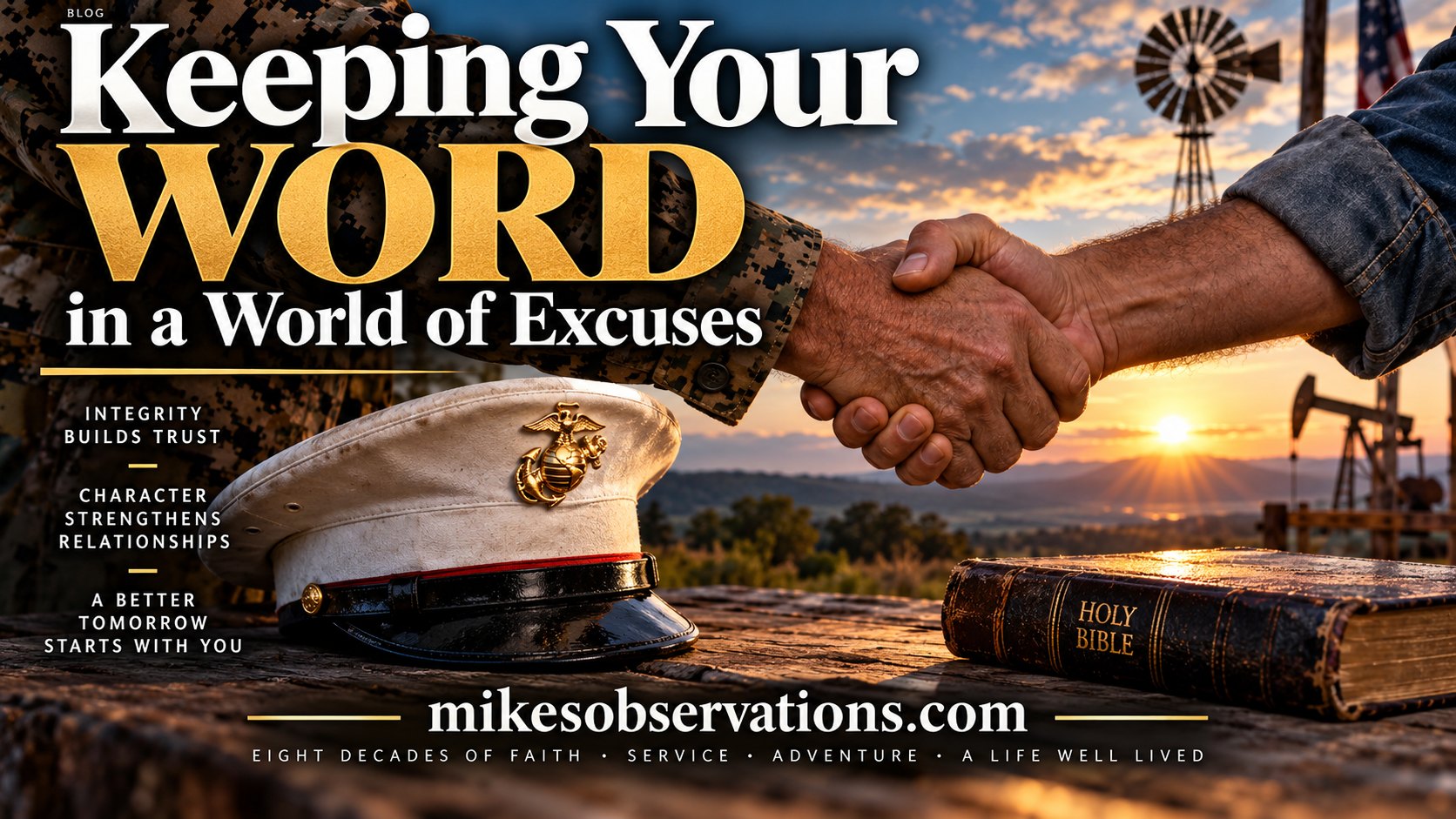
There was a time when a man's handshake was as good as his signature. When somebody told you they would do something, you didn't need three reminders, a written contract, and a lawyer standing by.
You took them at their word.
And if they failed to deliver, they didn't blame the weather, their circumstances, their childhood, or somebody else.
They took responsibility.
Now, before somebody jumps all over me, I'm not saying everybody was honest back then. We had our share of liars, cheats, and scoundrels, too.
But there was a standard.
And people who violated that standard risked losing something money couldn't easily replace.
Their reputation.
What Happened to Personal Responsibility?
Today, excuses seem to be everywhere.
An employee doesn't show up for work. There's an excuse.
A contractor promises to finish a job and disappears for three weeks. There's an excuse.
A politician makes a campaign promise, gets elected, and promptly forgets it. There's an excuse.
A business promises customer service but won't even answer the telephone. Another excuse.
And when somebody finally gets called out for failing to do what they promised, they're often more offended by being questioned than embarrassed by breaking their word.
When did accountability become an insult?
When did expecting somebody to do what they said they would do become unreasonable?
And when did we decide that having a good excuse was almost as respectable as doing the job?
An excuse may explain a failure, but it doesn't automatically excuse a broken promise.
What the Marine Corps Taught Me
I joined the United States Marine Corps in 1962.
I was a young fellow who still had plenty to learn about life, responsibility, and discipline.
It didn't take long for my drill instructor, Sergeant Martin, to begin teaching me.
In Marine Corps boot camp, when you were given an assignment, you were expected to carry it out.
You didn't get to decide whether you felt like doing it.
You didn't get to explain that you had a rough night.
And you certainly didn't get very far telling your drill instructor that somebody else was responsible.
You learned that your actions had consequences.
But I learned something more important than simply following orders.
Other people had to be able to depend on me.
In the military, failure to do your duty can affect the men standing beside you.
That lesson followed me long after I took off the uniform.
And it's one I wish more people understood today.
Thirty-Six Years in the Oilfields
After my Marine Corps service and my years working in photography, I eventually found my way into the oil business.
I spent 36 years in that industry, working my way through the ranks and eventually operating my own businesses.
In the oilfields, a person's word could mean the difference between keeping a customer and losing one.
If you told an operator you would have a crew on location Monday morning, that crew had better be there.
If you promised equipment, you had better deliver it.
And if something went wrong, you picked up the telephone, explained the problem, and did everything you could to make it right.
Did I always succeed?
Of course not.
I made mistakes. I misjudged situations. I probably made promises I should have thought through more carefully.
But there's a tremendous difference between failing despite your best efforts and never seriously intending to follow through.
Your reputation isn't built on what you say when everything is going well. It's built on what you do when keeping your promise becomes difficult.
We've Become Too Comfortable With Excuses
I believe we've developed a culture in which almost everybody wants to be understood, but fewer people want to be held accountable.
We hear plenty about rights.
We hear plenty about feelings.
We hear plenty about what society owes us.
But how often do we talk about what we owe one another?
We owe each other honesty.
We owe each other respect.
And when we give somebody our word, we owe them a sincere effort to honor it.
That doesn't mean life never interferes.
People get sick. Emergencies happen. Circumstances change.
Sometimes a promise simply cannot be kept.
But when that happens, you don't disappear. You don't make up a story. And you don't pretend the promise was never made.
You tell the truth.
You apologize when necessary.
And you do whatever is reasonably possible to make things right.
That's called character.
Even Our Leaders Have Forgotten
I don't care whether a politician has an R or a D beside their name.
If they make promises to the American people, they should be expected to answer for them.
I'm tired of hearing politicians campaign on one set of principles and govern by another.
I'm tired of watching public officials explain away their failures while congratulating themselves for their accomplishments.
And I'm especially tired of watching people excuse dishonesty simply because the dishonest person belongs to their preferred political party.
A lie doesn't become the truth because your side told it.
If integrity matters, it must matter when holding our friends accountable just as much as when criticizing our opponents.
Otherwise, we're not defending principles.
We're defending personalities.
What Does the Bible Say?
As a Christian, I believe keeping your word is more than a social courtesy.
It's a moral responsibility.
Jesus taught in Matthew 5:37:
"But let your communication be, Yea, yea; Nay, nay: for whatsoever is more than these cometh of evil." — KJV
In other words, let your yes mean yes and your no mean no.
Don't promise what you have no intention of delivering.
Don't say what people want to hear merely to win their approval.
And don't sacrifice your integrity for temporary convenience.
The Bible also tells us in Proverbs 22:1:
"A good name is rather to be chosen than great riches, and loving favour rather than silver and gold." — KJV
I've lived long enough to understand just how true that is.
You can lose money and earn it back.
You can lose property and replace it.
But when you lose the trust of the people who once believed in you, restoring it can take years.
Sometimes it never happens.
The Lesson I Want to Leave Behind
At 82, I don't pretend to have all the answers.
I've made enough mistakes in my lifetime to know better than that.
But if I could sit down with a young man or woman just beginning adult life, I'd tell them something that might sound old-fashioned.
Be careful what you promise.
Don't tell somebody you'll be there if you have no intention of showing up.
Don't borrow money you have no serious plan to repay.
Don't accept a responsibility and then walk away when it becomes inconvenient.
Don't make commitments merely to impress people.
And above all, don't expect others to trust your words when your actions continually contradict them.
You don't need to be rich, famous, powerful, or highly educated to possess integrity.
You just need to be somebody whose word can be trusted.
One Final Thought
I sometimes wonder what would happen if every American decided tomorrow morning to make one simple change.
No more empty promises. No more dishonest excuses. No more blaming somebody else for our own failures.
Imagine the difference in our families.
Our marriages.
Our workplaces.
Our churches.
And especially our government.
Maybe we can't change the whole country overnight.
But we can change the way we conduct ourselves.
And perhaps that's where rebuilding character in America ought to begin.
Not in Washington.
Not in somebody else's home.
But with the person looking back at us in the mirror.
Now, Let Me Stir the Pot
Do you believe a person's word still means as much as it did 40 or 50 years ago?
Or have we become a society where excuses are more acceptable than accountability?
And here's the tougher question:
Have you ever broken a promise that you still regret today?
I'd like to hear what you think. Agree or disagree, let's have an honest conversation.
Visit mikesobservations.com and share your thoughts.
Michael Cunningham Sr.
82 Years — 82 Lessons
Faith. Service. Adventure. A Life Well Lived.
Semper Fi!