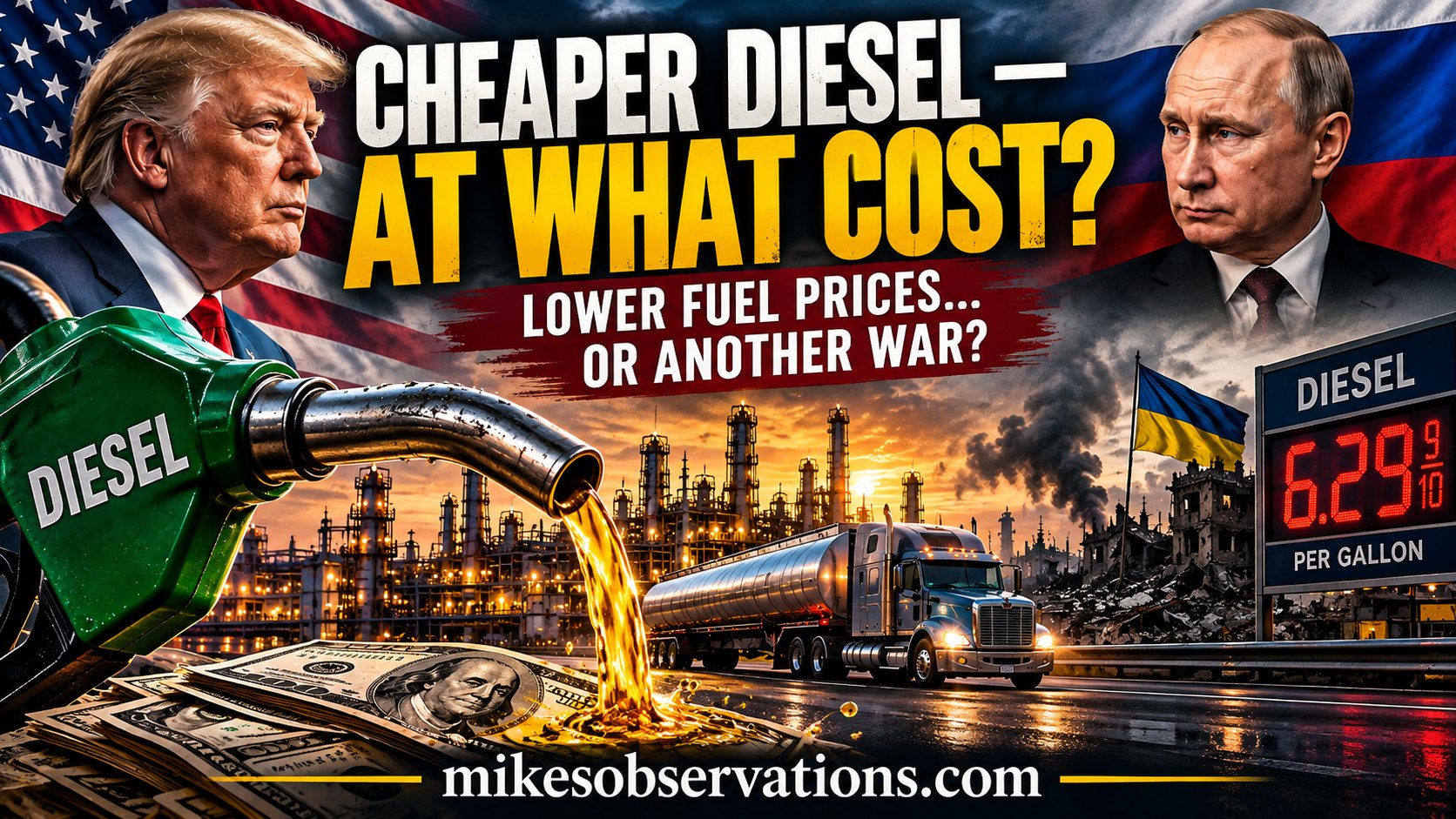
When American Energy Policy Collides With Foreign Policy
By Michael Cunningham Sr. | Mike's Observations
There is something happening in Washington that deserves more than a passing glance, and I believe every American who buys gasoline, drives a diesel truck, operates a farm, or pays a grocery bill ought to be paying attention.
On September 18, 2026, President Donald Trump signed legislation designed to increase economic pressure on Russia over its war in Ukraine.
Twenty-one days later, on October 9, the president announced an agreement with Vladimir Putin that would allow millions of metric tons of Russian diesel fuel to enter American and global markets.
Now, I have a question.
If we are trying to cut off the money that helps Russia fight a war, why are we making arrangements that could put more money into Russia's economy?
Before anybody gets excited and starts calling me a Republican, Democrat, conservative, liberal, or anything else, understand something. I'm asking a question that ought to concern every American, regardless of political affiliation.
And I believe it deserves an answer.
I Remember When Energy Independence Was a National Priority
I spent 36 years working in the oilfield. I've watched the industry go through booms, busts, shortages, price collapses, and government policies that sometimes seemed to change with the direction of the wind.
I've watched men lose their jobs when drilling stopped. I've watched families struggle when fuel prices climbed. And I've seen what happens to communities when the oil industry takes a beating.
So I understand the importance of affordable fuel.
Diesel is not simply something we put into an eighteen-wheeler. Diesel moves the trucks that deliver our groceries. It powers tractors that work our fields, equipment that builds our highways, and machinery that keeps much of America operating.
When diesel prices increase, those costs eventually find their way into nearly everything we purchase.
But I also understand that energy is more than a commodity.
Energy is economic power. And economic power can become political and military power.
That is why I find this latest agreement so interesting.
Twenty-One Days That Raise Some Serious Questions
On September 18, President Trump signed the Lindsey O. Graham Sanctioning Russia and Iran Act of 2026.
The legislation was intended to increase pressure on Russia by restricting economic activities that could help finance its war against Ukraine.
Then, on October 9, the administration announced a deal with Russia involving approximately 4.8 million metric tons of diesel fuel in planned deliveries.
The Treasury Department also provided temporary sanctions relief allowing certain Russian fuel transactions.
The president says the arrangement is intended to reduce fuel prices.
And that is certainly an objective worth examining.
But there is another side to the equation.
Russia does not give away its diesel fuel. Someone purchases it. Money changes hands. And that revenue can support the Russian economy while its government continues financing a war.
The question is not whether Americans deserve affordable fuel. Of course they do.
The question is what we may be paying for that fuel beyond the price printed on the pump.
Can This Agreement Actually Lower Fuel Prices?
According to energy analysts cited by Reuters and the Associated Press, the additional Russian diesel supplies may not be sufficient to produce a major reduction in American fuel prices.
That doesn't mean the agreement will have no effect.
Additional supplies can ease pressure in certain markets, and even modest price reductions matter to truckers, farmers, and families struggling with expenses.
But if the economic benefit turns out to be relatively small while Russia receives additional revenue, Americans deserve to know that.
And there is something else worth remembering.
Oil and refined petroleum products are traded in international markets. Fuel prices respond to supply, demand, refining capacity, transportation costs, taxes, and world events.
We cannot simply assume that buying a certain quantity of Russian diesel will produce a corresponding reduction at the neighborhood filling station.
We should be asking for actual numbers, not just promises.
What About Ukraine?
While Washington is discussing diesel shipments, Ukraine continues fighting a war that began with Russia's full-scale invasion in 2022.
Ukraine has attacked Russian oil refineries and energy infrastructure in an effort to weaken Russia's ability to supply its military and generate revenue.
The Trump administration has urged Ukraine to stop attacking Russian refineries, while Ukrainian leaders have objected to easing restrictions on Russian energy sales.
That creates an uncomfortable question.
If Russia can continue its military operations while gaining greater access to energy markets, what incentive does it have to make concessions at the negotiating table?
On the other hand, supporters of the administration's approach may argue that economic engagement can create opportunities for diplomacy and reduce the costs Americans are paying because of global instability.
That argument deserves consideration, too.
But diplomacy should produce measurable results.
Are negotiations moving forward? Are attacks decreasing? Are civilians safer? Has either side made meaningful concessions?
Those are the results I would want to see.
I Believe America Should Be Looking at Its Own Energy Resources
After spending most of my working life in the petroleum industry, I have never understood why our country should be comfortable depending heavily on foreign governments for something as essential as energy.
America has substantial oil and natural gas resources, skilled workers, sophisticated technology, and an enormous energy industry.
That doesn't mean we can isolate ourselves from international markets. We cannot. Nor does producing more crude oil automatically solve a shortage of diesel refining capacity.
But it does mean we should be asking whether our long-term energy policy is strengthening American security or making us more vulnerable to international crises.
We need to look seriously at domestic production, refinery capacity, infrastructure, and the policies that affect investment in American energy.
Energy independence should be more than a campaign slogan.
It should be a serious national objective, measured against economic reality.
There Is a Difference Between Making a Deal and Making a Good Deal
I have negotiated business arrangements during my lifetime, and I learned something important.
A deal is not successful simply because two people shake hands.
It is successful when the benefits justify the costs.
If this agreement lowers American diesel prices, helps our farmers and truckers, and contributes to a genuine diplomatic breakthrough, those results deserve recognition.
But if fuel prices barely move, Russia collects additional revenue, and the war continues without meaningful progress toward peace, then Americans should question what the agreement accomplished.
That is not a partisan argument.
That is accountability.
At 82, I've Learned to Ask Who Benefits
I've lived long enough to watch politicians from both parties make promises that sounded wonderful at a podium but looked considerably different when the bills came due.
I've also learned that sometimes the most important question is not what a politician says.
It is who benefits from what he does.
Will American consumers benefit from this agreement?
Will American businesses benefit?
Will the agreement help bring an end to the war?
Or will Russia gain additional revenue while American families see little meaningful relief?
We don't have all those answers yet.
But we should insist on getting them.
Because there is a great deal more at stake here than the price of a gallon of diesel.
There are American economic interests, international commitments, Ukrainian lives, and the credibility of our foreign policy.
And all of them deserve serious consideration.
Now I Want to Hear From You
I have three questions for my readers.
Would you support purchasing Russian diesel if it lowered American fuel prices, even though the revenue could benefit Russia's economy?
Should the United States place greater emphasis on expanding domestic energy production and refining capacity instead?
And should Washington require measurable progress toward peace before easing economic pressure on Russia?
I want to hear from Republicans, Democrats, independents, and anyone else willing to discuss the issue thoughtfully.
We may not agree on every answer.
But surely we can agree that American energy policy and American foreign policy ought to make sense together.
What do you think? Is this smart economic policy, a diplomatic gamble, or a contradiction that Washington needs to explain?
Leave your thoughts in the comments. I read them, and I welcome a respectful disagreement.
Michael Cunningham Sr.
Mike's Observations
Eight Decades of Faith · Service · Adventure · A Life Well Lived
mikesobservations.com
Semper Fi!
The article's factual foundation is supported by the September 18 law, Reuters' October 9 reporting, the Associated Press' energy-market analysis, and S&P Global's coverage of the proposed fuel volumes